Yugawara Onsen Day Trip from Tokyo
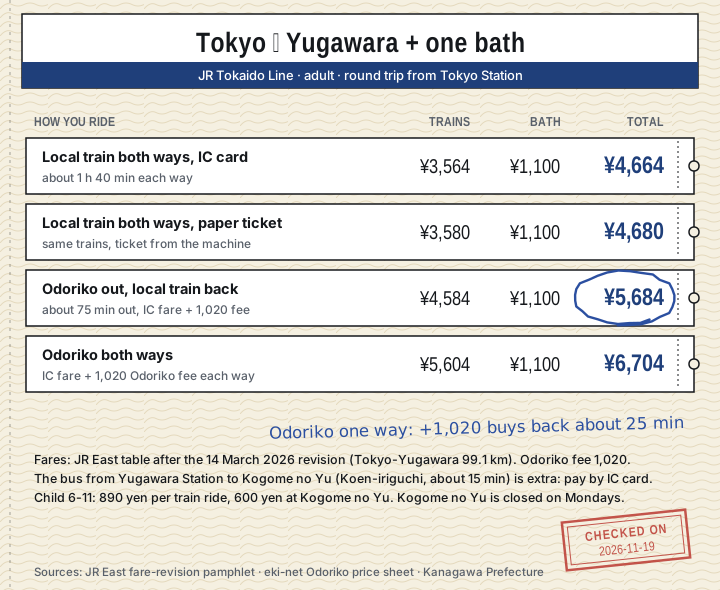
Yugawara is the last hot-spring town in Kanagawa before Atami, and the cheapest one to reach from Tokyo without a pass: one JR Tokaido Line train from Tokyo Station, no change, ¥1,790 (¥1,782 with an IC card). The town-run bath Kogome no Yu costs ¥1,100, so a plain day of train, bath and train comes to about ¥4,700 for an adult. The catch is the last few kilometres: the station is by the sea and the onsen streets are up the valley, so you need a local bus. Everything below is from JR East's fare table, the Odoriko price sheet and Kanagawa Prefecture's own pages, checked 2026-11-19.
Which train to take
| Local train (Tokaido Line) | Limited express Odoriko | Shinkansen to Atami, back one stop | |
|---|---|---|---|
| From | Tokyo, Shinagawa, Yokohama | Tokyo, Shinagawa, Yokohama | Tokyo, Shinagawa |
| Time | about 1 h 40 min, through train | about 75 min | fastest, but you change at Atami |
| Adult fare | ¥1,790 (IC ¥1,782) | ¥1,790 + ¥1,020 fee = ¥2,810 | ¥1,990 fare + shinkansen fee |
| Child (6–11) | ¥890 | ¥890 + ¥510 | — |
| Seat | unreserved (Green Car seats extra) | all reserved or "seat-undetermined" ticket, same price | Kodama, then a local back |
How the numbers work:
- Local train. Tokyo to Yugawara is 99.1 km on the Tokaido Line. After JR East's fare revision of 14 March 2026, the 91–100 km band costs ¥1,790 on a paper ticket and ¥1,782 on an IC card. Yugawara is one stop before Atami, so a local train bound for Atami or beyond takes you all the way; one that ends at Odawara or Kozu means changing trains there.
- Odoriko. Add the ¥1,020 limited express fee to the same fare. JR East says the Odoriko takes about 75 minutes from Tokyo Station. You can tap in with an IC card for the fare and hold only the express ticket.
- Shinkansen. This is where people overpay. Since March 2026 the shinkansen and the Tokaido Line between Tokyo and Atami count as separate routes, and JR East's own worked example is exactly this trip: Tokyo to Atami by shinkansen (110.1 km, ¥1,980) plus 5.5 km back to Yugawara (¥10) makes a ¥1,990 fare, before the shinkansen fee. Not every shinkansen stops at Atami, and you still change to a local train for the last stop. For a day trip it saves little time over the Odoriko and costs more.
From Shinjuku, the cheap way is Odakyu to Odawara and a JR train on from there. The Odakyu part is in the Tokyo to Hakone train guide; the JR part from Odawara is short and you can pay it with an IC card.
From the station to the onsen streets
The hot-spring area starts about 2 km inland and runs up the Chitose River valley to Okuyugawara. Buses for Okuyugawara (奥湯河原) leave from the station bus terminal and run up the valley; Hakone Tozan Bus and Izu Hakone Bus share the route (the operators call it the Onsenba line). Useful stops:
| Stop | For | Bus time from the station |
|---|---|---|
| Koen-iriguchi (公園入口) | Kogome no Yu, Manyo Park | about 15 min |
| Ochiaibashi (落合橋) | Fudo Falls, end of the Amagasan walk | about 10 min (to the station) |
| Okuyugawara-iriguchi (奥湯河原入口) | start of the Amagasan walk | about 15 min |
I could not open either operator's fare table, so I give no bus fare here: tap an IC card when you board and when you get off. A taxi from the station to Kogome no Yu is about 8 minutes, according to the Kanagawa tourism association.
No bus to Hakone. The bus from Yugawara Station over the hills to Moto-Hakone (Lake Ashi) is suspended, according to Kanagawa Prefecture's walking-course sheet (information as of February 2026). If you want both towns in one trip, go back to Odawara and take the Odawara to Hakone route instead.
Kogome no Yu, the town bath
| Adult | ¥1,100 |
| Child (elementary and junior high) | ¥600 |
| Hours | 9:00–21:00, last entry 20:30 |
| Closed | Mondays (Tuesday when Monday is a public holiday) |
| Bus stop | Koen-iriguchi, about 15 min from Yugawara Station |
Kogome no Yu is the town's own day-use bath, with no booking needed. Its Monday closing is the one thing to plan around: a Monday is a bad day for this trip unless you bathe somewhere else. The other day bath listed by the prefecture on the same walking course is the Otaki Hotel's source-spring bath, ¥1,100 for elementary age and up, 14:00–18:00 (reception until 17:00), closed on irregular days.
Kogome no Yu is by Manyo Park, the riverside park in the middle of the onsen area, and both use the Koen-iriguchi ("park entrance") stop. That makes a simple loop: bus up, walk the park along the river, bathe, then take the bus back down.
Fudo Falls and the Amagasan course
If you want to earn the bath first, Kanagawa Prefecture publishes a walking course through Yugawara's waterfalls (sheet issued March 2026):
| Distance | 8.7 km |
| Walking time | about 3 h 12 min |
| Height change | about 642 m |
| Start | Okuyugawara-iriguchi bus stop |
| Via | Hirogawara, Kyorai Falls, Amagasan Shrine, Hakuun Falls, Mt Amagasan, Byobu-iwa, Fudo Falls |
| Finish | Ochiaibashi bus stop |
Fudo Falls itself is a 15 m fall on a cliff of lava and tuff, with a Fudo statue on the left and a Daikoku statue on the right. The rock around it contains a white zeolite named after the town, yugawaraite. If 3 hours is too much, the falls are a short walk from Ochiaibashi on their own.
The prefecture's rules are the usual ones, but one matters in winter: finish the descent before sunset. In Tokyo the sun sets at about 16:30 in early December, and the valley gets dark sooner.
A day that fits the bath's hours
| Time | Plan |
|---|---|
| Morning | Local train from Tokyo (about 1 h 40 min), or Odoriko (about 75 min) |
| Late morning | Bus to Ochiaibashi, Fudo Falls, then walk or bus down the valley |
| Lunch | In the onsen streets near the river |
| Afternoon | Manyo Park, then Kogome no Yu (not Mondays) |
| Evening | Bus back to the station, local train or Odoriko to Tokyo |
Two add-ons on the same line: the Enoura Observatory is reached from Nebukawa, two stops before Yugawara, and Odawara has the castle and the Suzuhiro Kamaboko Museum. Either one plus a bath makes a full day; both is too much.
Plum season
Yugawara's other draw is the plum grove at Makuyama Park, about 15 minutes by bus from the station. The 2026 "Ume no Utage" plum festival ran from 7 February to 8 March, 9:00–16:00, with admission raised from ¥200 to ¥300 (ages 15 and over; junior high pupils free). The 2027 dates were not published when I checked; expect a similar February to early March window.
Is Yugawara worth it over Hakone?
For a bath and a walk, yes: the round trip on local trains (¥3,564 by IC) is about half the price of a 2-day Hakone Freepass from Shinjuku (¥7,100), there is no change of train, and the town is quieter. What it does not have is Hakone's loop of ropeway, lake boat and museums. If you have one day and want "onsen and rest", pick Yugawara; if you want sights between baths, pick Hakone and compare its day-use onsen.
Yugawara and Izu bookings
- Yugawara on Klook onsen and activity listings; Kogome no Yu is paid at the door
- Yugawara and Atami tours on Viator guided days from Tokyo
PR Affiliate links (disclosure): booking through them supports this site at no extra cost. Partner prices can differ from the official prices in the tables above.
Frequently asked questions
How do I get to Yugawara from Tokyo?
Take a JR Tokaido Line train from Tokyo Station. Local trains run through without a change in about 1 hour 40 minutes for ¥1,790 (¥1,782 by IC card). The limited express Odoriko takes about 75 minutes for ¥2,810 including the ¥1,020 fee.
Can I use Suica or another IC card to Yugawara?
Yes. JR East's fare table gives an IC fare of ¥1,782 for the trip from Tokyo. On the Odoriko you still need the express ticket on top. Tap the same card on the local bus.
How much is Kogome no Yu?
¥1,100 for adults and ¥600 for elementary and junior high school children. It is open 9:00 to 21:00 (last entry 20:30) and closed on Mondays, or on Tuesday when Monday is a holiday.
Is it cheaper to take the shinkansen to Atami and come back?
No. The fare becomes ¥1,990 (JR East's own example for Tokyo–Atami–Yugawara), and you pay the shinkansen fee on top. The Odoriko is ¥2,810 in total and needs no change.
Can I go from Yugawara to Hakone by bus?
Not at the moment: Kanagawa Prefecture lists the Yugawara Station to Moto-Hakone bus as suspended. Go back to Odawara by train and continue from there.
Is Yugawara a good day trip from Tokyo?
If you want a hot spring without changing trains, yes. A round trip on local trains plus one bath at Kogome no Yu is about ¥4,700 per adult, less than a 2-day Hakone Freepass from Shinjuku (¥7,100) before you have paid for any bath there.
When is the Yugawara plum festival?
In 2026 it ran from 7 February to 8 March at Makuyama Park, ¥300 admission. The 2027 dates had not been announced on 2026-11-19.
Official sources (checked 2026-11-19)
- Trunk-line fare table after the 14 March 2026 revision, and the Tokyo–Atami–Yugawara worked example (JR East fare-revision pamphlet)
- Odoriko fare sheet for Tokyo–Yugawara, 50% of the normal fee (JR East eki-net)
- Odoriko about 75 minutes from Tokyo to Yugawara (JR East media)
- Kogome no Yu prices and hours, Otaki Hotel day bath, Amagasan course, Fudo Falls, suspended Moto-Hakone bus (Kanagawa Prefecture walking-course sheet, March 2026)
- Kogome no Yu last entry and bus stop (Kanagawa tourism association)
- Makuyama Park plum festival 2026 dates and fee (Kanagawa tourism association)
- Onsenba line operators and stops (Hakone Tozan Bus notice, March 2026) Fares, hours and bus services can change. Check the operators' pages before you go.
More for your trip
- Hakone Freepass calculator: single tickets vs the pass for your Hakone rides
- Enoshima & Kamakura calculator: single tickets vs Noriorikun vs Freepass
- Japan tax-free refund calculator: the new system from 1 Nov 2026
- Yokohama day trip cost calculator: single tickets vs the Minatomirai, JR and Tokyu passes
- Mt. Takao day trip cost calculator: single tickets vs the Mt. Takao Ticket
- Kawagoe day trip cost calculator: Koedo Kawagoe Coupon vs single tickets and the Premium pass
- Mt. Oyama day trip cost calculator: Tanzawa-Oyama Freepass A vs B vs single tickets
- Odawara day trip cost calculator: Odakyu vs Romancecar vs JR vs Shinkansen, plus Odawara Castle tickets
- Misaki Maguro Kippu calculator: does the Keikyu tuna ticket pay off for your trip
- Hayama Excursion Ticket calculator: Keikyu's Hayama Joshi-tabi Kippu: 2026 prices, the break-even point and the ¥1,000 cruise add-on
- Kamakura temple entrance fees calculator: Great Buddha, Hasedera, Hokokuji, Engakuji and Kenchoji for your group
- Enoshima island tickets calculator: escar, Sea Candle, Iwaya Caves and aquarium: single tickets vs the 1day and Area Passport
- Yokohama Cosmo World tickets calculator: ride prices and the cheapest discount ticket for your group
- Yokohama Anpanman Children's Museum tickets calculator: price by date, family total, sale date and cancellation fee
- Hako Ticket calculator: unlimited entry to 20 Hakone hot springs and museums: does it pay off for your plan
- Hakone Yunessun tickets calculator: price by date, Passport vs Mori no Yu, rentals and tattoo rules
- Hakone museums tickets calculator: Pola, Okada, Open-Air, Glass Forest and more: Freepass discounts and your group total
- Sagamiko Illumillion tickets calculator: winter lights: price by date, night free pass and the JR + bus route from Shinjuku
- Hakone Kamakura Pass calculator: one 3-day pass for both areas vs two Freepasses vs single tickets
- Sarushima Island ferry calculator: ferry and admission by fare day, timetable and the train from Tokyo
- Yokosuka Naval Port Tour calculator: cruise price by fare day, booking and whether the Mankitsu Kippu pays
- Hakone day trip from Tokyo: cost and route: three budgets and the loop in order
- Hakone Freepass: the break-even math
- Kamakura and Enoshima day trip: cost: which pass to buy
- Kamakura day trip itinerary: one-day route with Enoshima, closing times and cost
- Hakone or Kamakura? Day trip compared: cost, time, closing times and a 3-question chart
- Hakone to Kamakura by train: Hakone-Yumoto to Odawara, JR to Ofuna, Yokosuka Line to Kamakura: minutes from the official timetables and which pass covers which leg
- Yokohama to Hakone by train: Tokaido Line or the Shinkansen from Shin-Yokohama to Odawara, the Tozan Train to Hakone-Yumoto, the Freepass sold at Odawara, and why the Yokohama bus no longer reaches Hakone
- Yokohama day trip with kids: family train cost: child fares and the cheapest ticket for a family
- Yokohama Red Brick Christmas Market 2026: dates, hours, the 9 special days at ¥1,000 and the 27 at ¥500, and who gets in free
- Ice skating at Yokohama Red Brick Warehouse (Art Rink 2026–27): 28 Nov – 14 Feb, ¥2,000 adults then ¥1,700 from 4 January, hours for every part of the season and the glove rule
- Yokohama illuminations 2026–27: dates, Yorunoyo show times, fireworks nights and a one-evening route
- Yomiuriland Jewellumination 2026–27: 29 Oct – 4 Apr, lights 16:00–20:30, ¥1,800 admission vs the ¥3,100 After Pass, the ¥300 gondola and the Keio passport
- Narita Airport to Yokohama: Narita Express or the YCAT bus, every direct departure, and the ¥5,200 round-trip ticket
- Haneda Airport to Kamakura: ¥840 with one change at Yokohama, and the direct bus that is suspended
- Narita Airport to Kamakura: Narita Express to Ofuna, or the direct rapid train with no change, departure by departure
- Haneda Airport to Enoshima: ¥1,100 by Keikyu, JR and the Enoden, the Ofuna and Fujisawa finishes, and the airport bus that is suspended
- Narita Airport to Enoshima: Narita Express to Ofuna and the Shonan Monorail (¥5,150), and why the ¥5,200 round-trip ticket makes the return ¥5,880
- Narita Airport to Hakone: Narita Express to Shinjuku and the Romancecar (¥5,800), or Shinagawa and the Shinkansen, with the round-trip ticket and Freepass sums
- Yokohama day trip itinerary: one-day route, opening hours and cost
- Hakone day trip itinerary: the one-day loop in order, ride times and the last boat
- Mt. Takao day trip itinerary: which trail, official hiking times and the last cable car
- Mt. Oyama day trip itinerary: four legs from Shinjuku, the last cable car, three plans and the 2026 autumn light-up
- Mt. Takao cable car vs chair lift: same ¥490 fare, hours by month, the ¥1,450 Mt. Takao Ticket and which ride to take
- Mt. Takao autumn leaves festival 2026: 24 Oct – 13 Dec, peak mid-Nov to early Dec, the Fri–Sun light-up along the cable car line and the ¥1,450 trip from Shinjuku
- Tokyo to Mt. Takao by train: Keio from Shinjuku or Shibuya for ¥430, the JR Chuo Line change at Takao, the Mt.TAKAO train times and the Mt. Takao Ticket price from every station
- Mt. Takao onsen: ¥1,100 weekday bath next to Takaosanguchi Station, hours, the strict tattoo rule and the ¥3,480 weekday Yuttari Kippu
- Hakone Romancecar tickets: price, how to book, observation seats and luggage
- Hakone day-use onsen: prices, hours and tattoo rules for a hot spring on a day trip
- Hakone luggage: storage and hotel delivery: drop times, prices and lockers for a suitcase in Hakone
- Kawagoe day trip itinerary: one-day route in loop-bus order, bus times, opening hours and cost
- Kawagoe Castle Honmaru Goten tickets: ¥100 entry, when the ¥370 and ¥600 combination tickets pay, and every closed date to March 2027 including the eight-day New Year closure
- Kitain Temple, Kawagoe: ¥400 entrance fee, hours that shorten on 24 November, closed dates and the walk from three stations
- Hakone pirate ship tickets: Lake Ashi cruise prices, which ticket is cheapest and the timetable
- Hakone Open-Air Museum tickets: counter vs online vs Freepass price, hours and access
- Hakone Shrine: hours, access and fees: bus or pirate ship to Moto-Hakone-ko, Treasure Hall and goshuin prices, Kuzuryu Shrine and Hakone Motomiya
- Hakone Checkpoint (Sekisho) tickets: ¥500 entry, ¥400 with the Freepass, hours and the 5-minute walk from the pirate ship pier
- Hakone Gora Park tickets: ¥650 or free with the Freepass, hours, the cheaper cable car stop and Craft House prices
- Hakone Ropeway tickets and Owakudani: flat fare, hours, which pass, black eggs and the guided nature trail
- Cup Noodles Museum Yokohama tickets: admission, make your own cup noodle, Chicken Ramen Factory booking and hours
- Hakone Tozan Railway tickets: fares for every station, the 1-day pass, IC cards and last trains
- Enoshima Aquarium tickets calculator: price, pass discounts, the Odakyu set ticket from Shinjuku and dolphin show times
- Hakkeijima Sea Paradise tickets: aquarium and ride passes, which one to buy and the cheap Keikyu ticket from Tokyo
- Yokohama Air Cabin tickets: ropeway prices, the Ferris wheel set ticket, hours and closing days
- Yokohama Sea Bass ferry: water bus fares between the four piers, which boats skip Red Brick, and boat vs train
- Yokohama bay cruise prices: ¥2,000 harbour loop, ¥3,000 night cruise, factory night cruise and Marine Rouge dinner: times, piers, child fares and booking rules
- Sankeien Garden tickets: entrance fee, hours, every bus route and the Minato Burari discount
- Minato Burari Ticket (Yokohama bus and subway day pass): ¥700 or ¥750 Wide, what it covers and what it does not, every single fare, the Akai Kutsu loop and four day plans with the math
- Akai Kutsu loop bus (Yokohama): ¥220 a ride from Sakuragicho bay 3, all 18 stops in order, minutes to Chinatown and Harbour View Park, and the last bus back from each stop
- Enoden 1-day pass (Noriorikun): price, every Enoden fare, where to buy and six day plans with the math
- Yokohama Marine Tower tickets: day and night prices, the 1-day pass, closing days and the Landmark Sky Garden closure
- Manyo Club Yokohama (Minatomirai hot spring): ¥3,500 admission, the ¥2,500 late-night fee after 3:00, what the set includes and the no-tattoo rule
- Hikawa Maru tickets (Yokohama museum ship): ¥300 cash only, hours, closed days to March 2027 and what is on each deck
- Hara Model Railway Museum tickets (Yokohama): ¥1,500 every day, timed-entry tickets sold on e+ and at FamilyMart rather than at the desk, the 16:00 last sale and the Thomas runs from 17 December
- THE MOVEUM YOKOHAMA tickets (Monet and Ukiyo-e): ¥3,000 online or ¥3,800 at the door, the ¥5,600 Pair ticket, kids free, the 45-minute show on the hour, no cash and the shuttle from Yamashita Pier
- Yokohama Museum of Art tickets: ¥500 collection exhibition, free Saturdays for teens, galleries shut 24 Nov–10 Dec and 29 Dec–3 Jan, every open day to 11 February 2027 and the free Grand Gallery
- Mitsubishi Minatomirai Industrial Museum: ¥500 cash, weekday last entry 14:30 (not 16:30), closed Tuesdays and Wednesdays, every closed date to 6 January 2027 and the Shinkai 6500 mock-up
- Nippon Maru and Yokohama Port Museum tickets: ¥800 combo or ¥400 ship only, students ¥100 on Saturdays, and the days the ship is shut to March 2027
- Yamate Western Houses (Yokohama, free): seven free houses on the Bluff, the Christmas 2026 country in each, closed Wednesdays by house to March 2027 and the walk from Ishikawacho
- Enoura Observatory tickets (Odawara): ¥3,300 booked ahead, ages 12 and over, every free shuttle time from Nebukawa Station and four trains from Tokyo from ¥1,120
- Nihon Minka-en tickets (Japan Open-Air Folk House Museum, Kawasaki): ¥550 at the gate, kids free, closed days to March 2027 and the 21, 22 and 28 November night opening
- Lalique Museum Hakone tickets: ¥1,500 at the door, ¥1,200 in advance, the ¥2,750 Orient Express tea you cannot book, hours and the January closing days
- Okada Museum of Art tickets (Hakone): ¥2,800 at the door, ¥2,550 bought at Hakone-Yumoto Station, foot bath included and the no-phones rule
- Hakone-en Aquarium tickets (Lake Ashi): ¥1,600 adults, ¥800 kids, seal feeding and diver show times, and the bus a Freepass covers
- Mt. Takao Monkey Park tickets: ¥600 since September 2026, not ¥500; hours, last entry and why the lift is no use after closing
- Takao Trick Art Museum (closing 30 November 2026): the 12 open days left, ¥1,650 since July 2026, the ¥200 printed coupon and why to visit after the mountain, not before
- Takaosan Yakuoin temple (Mt. Takao): goma fire ritual at 9:30, 11:00, 12:30, 14:00 and 15:30, ¥500 temple seal, shojin ryori lunch from ¥3,300 booked two days ahead, and New Year
- Kawasaki Daishi temple: ¥280 from Shinagawa or ¥330 from Haneda Airport, fire ritual times, hall hours, New Year 2027 and the 900th-anniversary festival in May 2027
- Nogeyama Zoo, Yokohama (free): shuts for rebuilding on 7 January 2027: every open day until then, the animals still there, keeper talk times and the walk from Sakuragicho
- Suzuhiro Kamaboko Museum (Odawara): ¥1,980 kamaboko-making class, not ¥1,500; every start time, when your kamaboko is ready, web booking from 130 days ahead and the ¥220 stop on the way to Hakone
- Romancecar Museum tickets (Ebina): ¥1,100 since March 2026, not ¥900; simulator fees, the six trains including the VSE, and why a Hakone Freepass makes the stop free
- Slam Dunk crossing, Kamakura (Kamakura-Koko-mae Station): Enoden fare from every station, when the ¥800 pass wins, where the city wants you to stand and how crowded it gets
- Battleship Mikasa tickets (Yokosuka): ¥800 not ¥600, last entry for every month, free weekend tours and the Keikyu train from Shinagawa
- Yokosuka day trip itinerary: Sarushima, Mikasa and the Naval Port Tour in clock order, winter boat times, ¥6,140 to ¥7,040 per adult and whether the Keikyu pass pays
- Shin-Yokohama Ramen Museum tickets: entrance fee, ¥750 mini bowls at every shop, payment rules and the subway from Yokohama
- Kirin Brewery Yokohama tour: ¥1,000 from Oct 2026, when booking opens, the tasting, drinking rules and the walk from Namamugi
- Hakone bus guide: route letters, which buses take the Freepass, fares and how to pay
- Hakone Old Tokaido road hike: walking times from Hatajuku and the Amazake-chaya teahouse to Lake Ashi, the K bus after its April 2026 change and teahouse prices
- Hakone to Gotemba Premium Outlets by bus: 10 buses a day from Gora (12 on weekends), 44 minutes, ¥1,120 or free with the Freepass, the one direct bus from Hakone-Yumoto, the 19:00 last bus back and the ¥2,000 bus on to Shinjuku
- Hakone to Kawaguchiko by bus: the change at Gotemba Station, G-Liner times and fares, which Hakone buses connect and the December 2026 fare rise
- Shinjuku to Hakone highway bus: ¥2,560 to Lake Ashi with no change: every stop and fare, booking in English and bus vs Romancecar
- Zoorasia (Yokohama Zoo) tickets: ¥800 adults, kids free on Saturdays, Tuesday closing, the bus from each station and Zoorasia vs Ueno Zoo
- Kamakura Great Buddha: ¥300 entry, ¥50 to go inside, hours, goshuin dates and the food rule at the gate
- Hokokuji bamboo temple: ¥400 garden, ¥600 matcha at the tea house, hours and the bus to Jomyoji
- Kamakura kimono rental prices: three shops compared with tax: ¥3,400 to ¥6,500 with hair styling, couples from ¥6,578, last dressing times, the 17:30 return and who charges to cancel
- Kamakura rickshaw prices (Ebisuya): ¥10,000 for 30 minutes per rickshaw, ¥5,000 each for two; what three riders or a family pay, the +¥1,000 English guide, walk-up or book
- Zeniarai Benten and Sasuke Inari: the free money-washing shrine: hours, the five washing steps, Snake days to 2027 and the 49 torii next door
- Kamakura hiking trails: Daibutsu, Tenen and Gion-yama courses: walking times, fees on the way and the free Tenen entrance
- Fujiko F. Fujio Museum (Doraemon Museum) tickets: price, when online sales open, the 60-minute entry rule and the shuttle bus from Noborito
- Hasedera temple, Kamakura: ¥400 entry, hours by season, the cave, hydrangea dates and goshuin
- Kita-Kamakura temples: Engakuji, Tokeiji, Jochiji, Meigetsuin and Kenchoji: fees, hours and the walk to Kamakura Station