Kitain Temple, Kawagoe: Entrance Fee and Hours
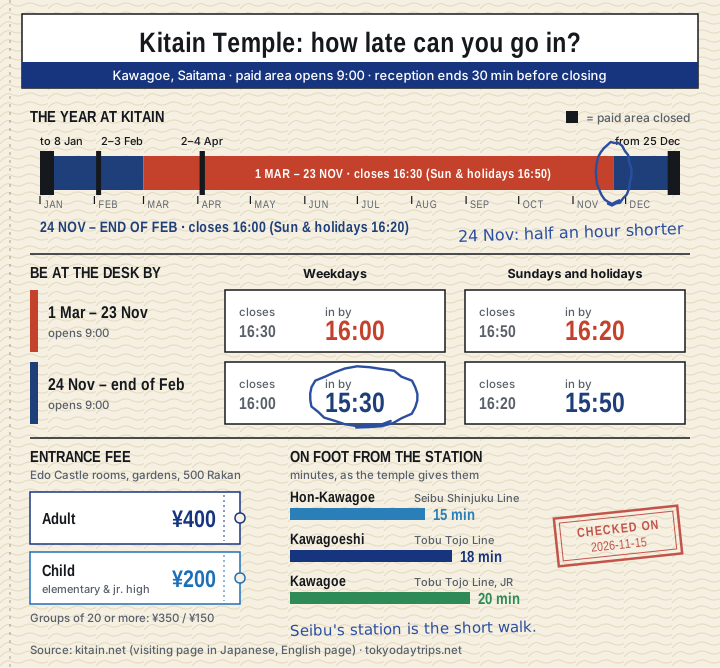
On 24 November Kitain's paid area starts closing at 16:00 on weekdays, and the desk stops taking people 30 minutes before that, at 15:30. Until 23 November the same desk is open until 16:00. If your Kawagoe plan puts the warehouse street first and the temple last, that order gets risky in winter: the street has no closing time and this desk does. The fee is ¥400 for adults and ¥200 for elementary and junior high school students, and it pays for rooms that once stood inside Edo Castle, two gardens and the stone Rakan statues. Every hour, date and price below is from the temple's own pages, checked 2026-11-15.
Entrance fee
| Ticket | Price |
|---|---|
| Adult | ¥400 |
| Elementary and junior high school student | ¥200 |
| Group of 20 or more, adult | ¥350 |
| Group of 20 or more, elementary and junior high | ¥150 |
Two adults and two school-age children pay ¥1,200. The group rate saves ¥50 a head and only starts at 20 people, so a family or a small tour pays the normal price.
The temple's pages give no price for preschool children and no senior or student rate, so I haven't written one. Ask at the desk if you're bringing a toddler.
What the ¥400 covers
The Japanese visiting page lists what you see with the ticket, in the order you walk it:
- Kyakuden (guest hall): the room known as the birthplace of Tokugawa Iemitsu, the third shogun.
- Shoin (study): the dressing room used by Kasuga no Tsubone, Iemitsu's wet nurse, when the building stood in Edo Castle.
- Momijiyama garden, seen from the Kyakuden, and the Kyokusui garden behind the Shoin.
- The 500 Rakan, which the same page places "out of the kuri, beside the main gate".
That last line matters. The Rakan are not inside the halls. You leave the building and walk to a separate spot by the gate. The page doesn't explain how the ticket is checked there, so don't throw it away when you come out of the Shoin.
The grounds, the main hall and the pagoda are a different matter: the official pages list a fee only for the visit above.
Hours, last entry and closed days
| Period | Weekdays | Sundays and holidays |
|---|---|---|
| 1 March – 23 November | 9:00–16:30, in by 16:00 | 9:00–16:50, in by 16:20 |
| 24 November – end of February | 9:00–16:00, in by 15:30 | 9:00–16:20, in by 15:50 |
Reception ends 30 minutes before closing, and so does the goshuin desk. The temple's wording for the longer day is "Sundays and holidays", so treat a Saturday as a weekday. It also says January hours can change with conditions.
The paid area is closed on these dates:
- 25 December – 8 January
- 2 February (afternoon) and 3 February
- 2 – 4 April
- any day with a temple event, when it may close or shut part of the route
Here is how I read that list. The fifteen-day winter closure sits exactly on the dates when overseas visitors are most likely to be in Tokyo. The main hall is open over New Year (7:00–16:30 on 1–3 January 2027, by the temple's schedule), so you can still pray and see the crowds, but the Edo Castle rooms and the Rakan are not on offer. If those rooms are why you're going, go before 25 December or after 8 January.
When to go this season
- Until 23 November: the temple's events page lists the Koedo Kawagoe Chrysanthemum Festival in the grounds for 1–23 November, free to look at, 9:00–16:00 and until 15:00 on the last day. The page doesn't print the year, so look at the temple's news before you travel for it alone.
- Late November to early December: the temple calls this the most beautiful time for its autumn leaves. Notice the overlap: the best colour arrives just after the hours shorten, so a weekday visit for the leaves has to reach the desk by 15:30.
- 3 January: the Daruma Festival, one of Kawagoe's biggest days. The temple's car park is closed that day for traffic control, the paid rooms are shut, and the temple asks people to come by train and bus.
How to get there
On foot from the station
The temple gives three walking times:
| Station | Line | Walk |
|---|---|---|
| Hon-Kawagoe | Seibu Shinjuku Line | about 15 minutes |
| Kawagoeshi | Tobu Tojo Line | about 18 minutes |
| Kawagoe | Tobu Tojo Line, JR | about 20 minutes |
Which train you took from Tokyo decides the station. The fares and the three routes are in Tokyo to Kawagoe by train.
By loop bus from Kawagoe Station
The Koedo Meisho Meguri loop bus leaves Kawagoe Station East Exit, stop 3, and Kitain-mae is its first sightseeing stop: 8 minutes, ¥220, Suica or cash. I read those figures on Tobu Bus's page on 10 November.
Walk or ride? On a weekday I'd walk. The first weekday bus leaves at 10:00, an hour after the temple opens, and it saves 12 minutes over the 20-minute walk. On weekends the first bus is at 9:20. The bus earns its fare later in the day, because it only runs one way round the circle and carries on from Kitain to Honmaru Goten, Hikawa Shrine and the warehouse street. The Kawagoe day trip itinerary uses it in that order, and the Kawagoe passes page shows when a pass beats paying ¥220 and ¥230 per ride.
By car
About 20 minutes from Kawagoe IC on the Kan-etsu Expressway, or 19 from Kawashima IC on the Ken-O Expressway. The temple points drivers to the Myojo car park; its pages don't state the price.
What it costs from Tokyo
| For one adult | Sum | Total |
|---|---|---|
| Kitain only, walking from the station | ¥490 + ¥490 + ¥400 | ¥1,380 |
| Same, with the loop bus to the gate | ¥1,380 + ¥220 | ¥1,600 |
| Kitain and Honmaru Goten tickets together | ¥400 + ¥100 | ¥500 |
Honmaru Goten's ¥100 is from Kawagoe City's leaflet, read in October; its closed days and combination tickets are in the Honmaru Goten tickets guide. ¥490 is the Tobu Tojo Line ticket fare from Ikebukuro to Kawagoe, about 30 minutes, as read on 10 November. For a full day with buses and the other sights, use the Kawagoe day trip cost calculator.
Rules inside the halls
The temple's English page asks four things of visitors inside the buildings:
- No photography.
- Don't touch the exhibits.
- Don't step down into the courtyard garden.
- No eating or drinking.
It also asks for quiet, because the halls belong to a working temple. The photo rule is written for the inside of the halls. The page says nothing either way about the Rakan, so follow the signs when you get there.
What you're looking at
Kitain began in 830, when the monk Ennin founded a temple called Muryojuji here. It burned in the fighting of 1205 and was rebuilt in 1296. Its great period came under Tenkai, the 27th head priest, who had the trust of the Tokugawa shoguns and changed the characters of the name to the ones used today.
In January 1638 a fire took almost everything; only the main gate and the bell tower survived. The shogunate answered by moving palace buildings from Edo Castle to Kawagoe to serve as the Kyakuden, Shoin and Kuri. The temple describes them as among the oldest Edo Castle structures left anywhere. All three are National Important Cultural Properties, and that is a lot of history for ¥400.
The Rakan are more than 500 stone disciples of the Buddha, carved between 1782 and 1825, and no two are alike. Next door is Senba Toshogu, built after the remains of Tokugawa Ieyasu rested at Kitain for four days in March 1617 on the way to Nikko.
Kawagoe tours and passes
- Kawagoe tours on Viator guided walks and day trips from Tokyo that stop at Kitain
- Kawagoe passes and activities on Klook rail passes, kimono rental and tours
PR Affiliate links (disclosure): booking through them supports this site at no extra cost. Kitain's ¥400 is paid at the temple; check whether a tour includes it, and what time it reaches the desk in winter.
Frequently asked questions
Do I need to book Kitain in advance?
No booking system appears on the temple's visiting page. You pay at the desk. What you can't do is arrive late: the desk closes 30 minutes before the halls.
Is Kitain open on New Year's Day?
The main hall is, from 7:00 to 16:30 on 1–3 January 2027. The ticketed rooms, gardens and Rakan are closed from 25 December to 8 January.
How many Rakan statues are there?
The temple's English page says more than 500. They were carved over 43 years, from 1782 to 1825.
Which station is closest to Kitain?
Hon-Kawagoe on the Seibu Shinjuku Line, about 15 minutes on foot. From Kawagoe Station it's about 20 minutes, or 8 minutes on the loop bus.
Can I take photos in the Edo Castle rooms?
No. Photography is not allowed inside the halls.
Official sources (checked 2026-11-15)
- Visiting hours, fees, closed days, what the visit shows, walking times (Kitain)
- English page: history, Rakan, rules inside the halls, fees and hours (Kitain)
- Cultural properties: Kyakuden, Shoin, Kuri, main gate, bell tower (Kitain)
- Autumn leaves, best in late November to early December (Kitain)
- Koedo Kawagoe Chrysanthemum Festival, 1–23 November (Kitain)
- New Year 2027: main hall hours, car park, traffic control on 3 January (Kitain)
- Koedo loop bus: stop 3, ¥220 to Kitain-mae, first buses (Tobu Bus)
- Tobu Tojo Line fare table, Ikebukuro to Kawagoe ¥490 (Tobu Railway)
More for your trip
- Hakone Freepass calculator: single tickets vs the pass for your Hakone rides
- Enoshima & Kamakura calculator: single tickets vs Noriorikun vs Freepass
- Japan tax-free refund calculator: the new system from 1 Nov 2026
- Yokohama day trip cost calculator: single tickets vs the Minatomirai, JR and Tokyu passes
- Mt. Takao day trip cost calculator: single tickets vs the Mt. Takao Ticket
- Kawagoe day trip cost calculator: Koedo Kawagoe Coupon vs single tickets and the Premium pass
- Mt. Oyama day trip cost calculator: Tanzawa-Oyama Freepass A vs B vs single tickets
- Odawara day trip cost calculator: Odakyu vs Romancecar vs JR vs Shinkansen, plus Odawara Castle tickets
- Misaki Maguro Kippu calculator: does the Keikyu tuna ticket pay off for your trip
- Hayama Excursion Ticket calculator: Keikyu's Hayama Joshi-tabi Kippu: 2026 prices, the break-even point and the ¥1,000 cruise add-on
- Kamakura temple entrance fees calculator: Great Buddha, Hasedera, Hokokuji, Engakuji and Kenchoji for your group
- Enoshima island tickets calculator: escar, Sea Candle, Iwaya Caves and aquarium: single tickets vs the 1day and Area Passport
- Yokohama Cosmo World tickets calculator: ride prices and the cheapest discount ticket for your group
- Yokohama Anpanman Children's Museum tickets calculator: price by date, family total, sale date and cancellation fee
- Hako Ticket calculator: unlimited entry to 20 Hakone hot springs and museums: does it pay off for your plan
- Hakone Yunessun tickets calculator: price by date, Passport vs Mori no Yu, rentals and tattoo rules
- Hakone museums tickets calculator: Pola, Okada, Open-Air, Glass Forest and more: Freepass discounts and your group total
- Sagamiko Illumillion tickets calculator: winter lights: price by date, night free pass and the JR + bus route from Shinjuku
- Hakone Kamakura Pass calculator: one 3-day pass for both areas vs two Freepasses vs single tickets
- Sarushima Island ferry calculator: ferry and admission by fare day, timetable and the train from Tokyo
- Yokosuka Naval Port Tour calculator: cruise price by fare day, booking and whether the Mankitsu Kippu pays
- Hakone day trip from Tokyo: cost and route: three budgets and the loop in order
- Hakone Freepass: the break-even math
- Kamakura and Enoshima day trip: cost: which pass to buy
- Kamakura day trip itinerary: one-day route with Enoshima, closing times and cost
- Hakone or Kamakura? Day trip compared: cost, time, closing times and a 3-question chart
- Hakone to Kamakura by train: Hakone-Yumoto to Odawara, JR to Ofuna, Yokosuka Line to Kamakura: minutes from the official timetables and which pass covers which leg
- Yokohama to Hakone by train: Tokaido Line or the Shinkansen from Shin-Yokohama to Odawara, the Tozan Train to Hakone-Yumoto, the Freepass sold at Odawara, and why the Yokohama bus no longer reaches Hakone
- Yokohama day trip with kids: family train cost: child fares and the cheapest ticket for a family
- Yokohama Red Brick Christmas Market 2026: dates, hours, the 9 special days at ¥1,000 and the 27 at ¥500, and who gets in free
- Ice skating at Yokohama Red Brick Warehouse (Art Rink 2026–27): 28 Nov – 14 Feb, ¥2,000 adults then ¥1,700 from 4 January, hours for every part of the season and the glove rule
- Yokohama illuminations 2026–27: dates, Yorunoyo show times, fireworks nights and a one-evening route
- Yomiuriland Jewellumination 2026–27: 29 Oct – 4 Apr, lights 16:00–20:30, ¥1,800 admission vs the ¥3,100 After Pass, the ¥300 gondola and the Keio passport
- Narita Airport to Yokohama: Narita Express or the YCAT bus, every direct departure, and the ¥5,200 round-trip ticket
- Haneda Airport to Kamakura: ¥840 with one change at Yokohama, and the direct bus that is suspended
- Narita Airport to Kamakura: Narita Express to Ofuna, or the direct rapid train with no change, departure by departure
- Haneda Airport to Enoshima: ¥1,100 by Keikyu, JR and the Enoden, the Ofuna and Fujisawa finishes, and the airport bus that is suspended
- Narita Airport to Enoshima: Narita Express to Ofuna and the Shonan Monorail (¥5,150), and why the ¥5,200 round-trip ticket makes the return ¥5,880
- Narita Airport to Hakone: Narita Express to Shinjuku and the Romancecar (¥5,800), or Shinagawa and the Shinkansen, with the round-trip ticket and Freepass sums
- Yokohama day trip itinerary: one-day route, opening hours and cost
- Hakone day trip itinerary: the one-day loop in order, ride times and the last boat
- Mt. Takao day trip itinerary: which trail, official hiking times and the last cable car
- Mt. Oyama day trip itinerary: four legs from Shinjuku, the last cable car, three plans and the 2026 autumn light-up
- Mt. Takao cable car vs chair lift: same ¥490 fare, hours by month, the ¥1,450 Mt. Takao Ticket and which ride to take
- Mt. Takao autumn leaves festival 2026: 24 Oct – 13 Dec, peak mid-Nov to early Dec, the Fri–Sun light-up along the cable car line and the ¥1,450 trip from Shinjuku
- Tokyo to Mt. Takao by train: Keio from Shinjuku or Shibuya for ¥430, the JR Chuo Line change at Takao, the Mt.TAKAO train times and the Mt. Takao Ticket price from every station
- Mt. Takao onsen: ¥1,100 weekday bath next to Takaosanguchi Station, hours, the strict tattoo rule and the ¥3,480 weekday Yuttari Kippu
- Hakone Romancecar tickets: price, how to book, observation seats and luggage
- Hakone day-use onsen: prices, hours and tattoo rules for a hot spring on a day trip
- Hakone luggage: storage and hotel delivery: drop times, prices and lockers for a suitcase in Hakone
- Kawagoe day trip itinerary: one-day route in loop-bus order, bus times, opening hours and cost
- Kawagoe Castle Honmaru Goten tickets: ¥100 entry, when the ¥370 and ¥600 combination tickets pay, and every closed date to March 2027 including the eight-day New Year closure
- Hakone pirate ship tickets: Lake Ashi cruise prices, which ticket is cheapest and the timetable
- Hakone Open-Air Museum tickets: counter vs online vs Freepass price, hours and access
- Hakone Shrine: hours, access and fees: bus or pirate ship to Moto-Hakone-ko, Treasure Hall and goshuin prices, Kuzuryu Shrine and Hakone Motomiya
- Hakone Checkpoint (Sekisho) tickets: ¥500 entry, ¥400 with the Freepass, hours and the 5-minute walk from the pirate ship pier
- Hakone Gora Park tickets: ¥650 or free with the Freepass, hours, the cheaper cable car stop and Craft House prices
- Hakone Ropeway tickets and Owakudani: flat fare, hours, which pass, black eggs and the guided nature trail
- Cup Noodles Museum Yokohama tickets: admission, make your own cup noodle, Chicken Ramen Factory booking and hours
- Hakone Tozan Railway tickets: fares for every station, the 1-day pass, IC cards and last trains
- Enoshima Aquarium tickets calculator: price, pass discounts, the Odakyu set ticket from Shinjuku and dolphin show times
- Hakkeijima Sea Paradise tickets: aquarium and ride passes, which one to buy and the cheap Keikyu ticket from Tokyo
- Yokohama Air Cabin tickets: ropeway prices, the Ferris wheel set ticket, hours and closing days
- Yokohama Sea Bass ferry: water bus fares between the four piers, which boats skip Red Brick, and boat vs train
- Yokohama bay cruise prices: ¥2,000 harbour loop, ¥3,000 night cruise, factory night cruise and Marine Rouge dinner: times, piers, child fares and booking rules
- Sankeien Garden tickets: entrance fee, hours, every bus route and the Minato Burari discount
- Minato Burari Ticket (Yokohama bus and subway day pass): ¥700 or ¥750 Wide, what it covers and what it does not, every single fare, the Akai Kutsu loop and four day plans with the math
- Akai Kutsu loop bus (Yokohama): ¥220 a ride from Sakuragicho bay 3, all 18 stops in order, minutes to Chinatown and Harbour View Park, and the last bus back from each stop
- Enoden 1-day pass (Noriorikun): price, every Enoden fare, where to buy and six day plans with the math
- Yokohama Marine Tower tickets: day and night prices, the 1-day pass, closing days and the Landmark Sky Garden closure
- Manyo Club Yokohama (Minatomirai hot spring): ¥3,500 admission, the ¥2,500 late-night fee after 3:00, what the set includes and the no-tattoo rule
- Hikawa Maru tickets (Yokohama museum ship): ¥300 cash only, hours, closed days to March 2027 and what is on each deck
- Hara Model Railway Museum tickets (Yokohama): ¥1,500 every day, timed-entry tickets sold on e+ and at FamilyMart rather than at the desk, the 16:00 last sale and the Thomas runs from 17 December
- THE MOVEUM YOKOHAMA tickets (Monet and Ukiyo-e): ¥3,000 online or ¥3,800 at the door, the ¥5,600 Pair ticket, kids free, the 45-minute show on the hour, no cash and the shuttle from Yamashita Pier
- Yokohama Museum of Art tickets: ¥500 collection exhibition, free Saturdays for teens, galleries shut 24 Nov–10 Dec and 29 Dec–3 Jan, every open day to 11 February 2027 and the free Grand Gallery
- Mitsubishi Minatomirai Industrial Museum: ¥500 cash, weekday last entry 14:30 (not 16:30), closed Tuesdays and Wednesdays, every closed date to 6 January 2027 and the Shinkai 6500 mock-up
- Nippon Maru and Yokohama Port Museum tickets: ¥800 combo or ¥400 ship only, students ¥100 on Saturdays, and the days the ship is shut to March 2027
- Yamate Western Houses (Yokohama, free): seven free houses on the Bluff, the Christmas 2026 country in each, closed Wednesdays by house to March 2027 and the walk from Ishikawacho
- Enoura Observatory tickets (Odawara): ¥3,300 booked ahead, ages 12 and over, every free shuttle time from Nebukawa Station and four trains from Tokyo from ¥1,120
- Nihon Minka-en tickets (Japan Open-Air Folk House Museum, Kawasaki): ¥550 at the gate, kids free, closed days to March 2027 and the 21, 22 and 28 November night opening
- Lalique Museum Hakone tickets: ¥1,500 at the door, ¥1,200 in advance, the ¥2,750 Orient Express tea you cannot book, hours and the January closing days
- Okada Museum of Art tickets (Hakone): ¥2,800 at the door, ¥2,550 bought at Hakone-Yumoto Station, foot bath included and the no-phones rule
- Hakone-en Aquarium tickets (Lake Ashi): ¥1,600 adults, ¥800 kids, seal feeding and diver show times, and the bus a Freepass covers
- Mt. Takao Monkey Park tickets: ¥600 since September 2026, not ¥500; hours, last entry and why the lift is no use after closing
- Takao Trick Art Museum (closing 30 November 2026): the 12 open days left, ¥1,650 since July 2026, the ¥200 printed coupon and why to visit after the mountain, not before
- Takaosan Yakuoin temple (Mt. Takao): goma fire ritual at 9:30, 11:00, 12:30, 14:00 and 15:30, ¥500 temple seal, shojin ryori lunch from ¥3,300 booked two days ahead, and New Year
- Kawasaki Daishi temple: ¥280 from Shinagawa or ¥330 from Haneda Airport, fire ritual times, hall hours, New Year 2027 and the 900th-anniversary festival in May 2027
- Nogeyama Zoo, Yokohama (free): shuts for rebuilding on 7 January 2027: every open day until then, the animals still there, keeper talk times and the walk from Sakuragicho
- Suzuhiro Kamaboko Museum (Odawara): ¥1,980 kamaboko-making class, not ¥1,500; every start time, when your kamaboko is ready, web booking from 130 days ahead and the ¥220 stop on the way to Hakone
- Romancecar Museum tickets (Ebina): ¥1,100 since March 2026, not ¥900; simulator fees, the six trains including the VSE, and why a Hakone Freepass makes the stop free
- Slam Dunk crossing, Kamakura (Kamakura-Koko-mae Station): Enoden fare from every station, when the ¥800 pass wins, where the city wants you to stand and how crowded it gets
- Battleship Mikasa tickets (Yokosuka): ¥800 not ¥600, last entry for every month, free weekend tours and the Keikyu train from Shinagawa
- Yokosuka day trip itinerary: Sarushima, Mikasa and the Naval Port Tour in clock order, winter boat times, ¥6,140 to ¥7,040 per adult and whether the Keikyu pass pays
- Shin-Yokohama Ramen Museum tickets: entrance fee, ¥750 mini bowls at every shop, payment rules and the subway from Yokohama
- Kirin Brewery Yokohama tour: ¥1,000 from Oct 2026, when booking opens, the tasting, drinking rules and the walk from Namamugi
- Hakone bus guide: route letters, which buses take the Freepass, fares and how to pay
- Hakone Old Tokaido road hike: walking times from Hatajuku and the Amazake-chaya teahouse to Lake Ashi, the K bus after its April 2026 change and teahouse prices
- Hakone to Gotemba Premium Outlets by bus: 10 buses a day from Gora (12 on weekends), 44 minutes, ¥1,120 or free with the Freepass, the one direct bus from Hakone-Yumoto, the 19:00 last bus back and the ¥2,000 bus on to Shinjuku
- Hakone to Kawaguchiko by bus: the change at Gotemba Station, G-Liner times and fares, which Hakone buses connect and the December 2026 fare rise
- Shinjuku to Hakone highway bus: ¥2,560 to Lake Ashi with no change: every stop and fare, booking in English and bus vs Romancecar
- Zoorasia (Yokohama Zoo) tickets: ¥800 adults, kids free on Saturdays, Tuesday closing, the bus from each station and Zoorasia vs Ueno Zoo
- Kamakura Great Buddha: ¥300 entry, ¥50 to go inside, hours, goshuin dates and the food rule at the gate
- Hokokuji bamboo temple: ¥400 garden, ¥600 matcha at the tea house, hours and the bus to Jomyoji
- Kamakura kimono rental prices: three shops compared with tax: ¥3,400 to ¥6,500 with hair styling, couples from ¥6,578, last dressing times, the 17:30 return and who charges to cancel
- Kamakura rickshaw prices (Ebisuya): ¥10,000 for 30 minutes per rickshaw, ¥5,000 each for two; what three riders or a family pay, the +¥1,000 English guide, walk-up or book
- Zeniarai Benten and Sasuke Inari: the free money-washing shrine: hours, the five washing steps, Snake days to 2027 and the 49 torii next door
- Kamakura hiking trails: Daibutsu, Tenen and Gion-yama courses: walking times, fees on the way and the free Tenen entrance
- Fujiko F. Fujio Museum (Doraemon Museum) tickets: price, when online sales open, the 60-minute entry rule and the shuttle bus from Noborito
- Hasedera temple, Kamakura: ¥400 entry, hours by season, the cave, hydrangea dates and goshuin
- Kita-Kamakura temples: Engakuji, Tokeiji, Jochiji, Meigetsuin and Kenchoji: fees, hours and the walk to Kamakura Station