Kotoku-in Tickets 2026: Great Buddha of Kamakura Entrance Fee ¥300, Inside the Statue +¥50, Hours and Last Entry
A ticket to the Kamakura Great Buddha (Kotoku-in) costs ¥300 for adults and ¥150 for children aged 6–12, paid at the gate with no booking. Going inside the statue is ¥50 more.
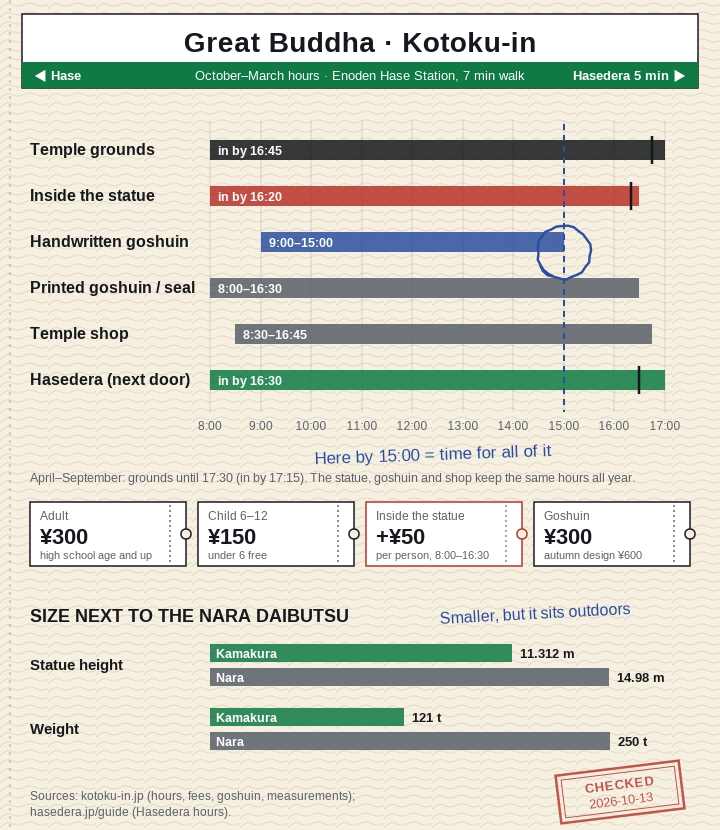
If you only remember one time for the Great Buddha, make it 15:00. That's when the temple stops writing handwritten goshuin (the temple stamp in your book), and it's a comfortable time to still get inside the statue, which closes at 16:30. The grounds stay open longer, until 17:00 from October to March (17:30 from April to September), with last entry 15 minutes before closing. Under-6s are free. Kotoku-in is a 7-minute walk from Enoden Hase Station, three Enoden stops from Kamakura. All of this comes from the temple's official site, read again on 2026-10-25.
Tours that include the Great Buddha
- Kamakura Great Buddha tours on Viator day tours from Tokyo with a guide, train or coach
- Kamakura tours and passes on Klook small-group day trips and rail passes
PR Affiliate links (disclosure): booking through them supports this site at no extra cost. Check whether a tour includes the ¥300 entry and the ¥50 interior fee before you book.
Entrance fee
| Ticket | Price | Notes |
|---|---|---|
| General admission | ¥300 | high school age and up; junior high students pay this too |
| Child (age 6–12) | ¥150 | |
| Under 6 | free | preschool and kindergarten groups also free |
| Inside the statue | +¥50 per person | on top of admission, 8:00–16:30 |
| Goshuin (temple stamp) | ¥300 | seasonal autumn design ¥600 |
- No group discount. The temple stopped group rates on 1 April 2017. A family of four pays the same per head as four strangers.
- Leaving means paying again. The FAQ says you can't re-enter without a new ticket, so use the toilets and buy drinks before you go out to Hase-dori.
- Free entry is given to holders of a Japanese disability ID booklet, and to tour conductors with ID. The full list is on the temple's FAQ.
Opening hours
| What | October–March | April–September |
|---|---|---|
| Temple grounds | 8:00–17:00 | 8:00–17:30 |
| Last entry to the grounds | 16:45 | 17:15 |
| Inside the statue | 8:00–16:30 (enter by 16:20) | same |
| Handwritten goshuin | 9:00–15:00 | same |
| Printed goshuin and seals | 8:00–16:30 | same |
| Temple shop | 8:30–16:45 | same |
Kotoku-in has no closing day listed and takes no reservations: you just walk up to the gate.
What a Great Buddha afternoon costs from Kamakura Station
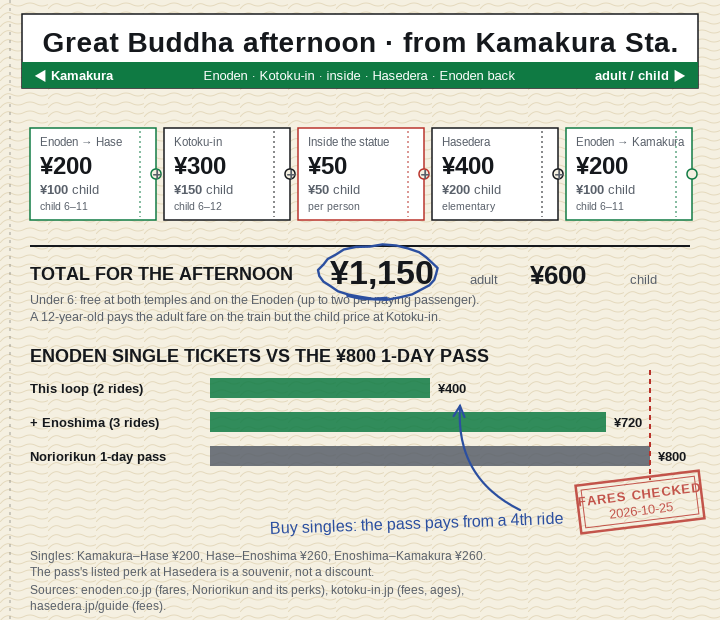
Kotoku-in sells nothing in advance and no pass covers temple entry, so the price of the classic afternoon is simple addition. Here it is for the usual loop: Enoden to Hase, the Great Buddha, a look inside, Hasedera, and the Enoden back.
| Item | Adult | Child |
|---|---|---|
| Enoden, Kamakura → Hase (4 min) | ¥200 | ¥100 (age 6–11) |
| Kotoku-in ticket | ¥300 | ¥150 (age 6–12) |
| Inside the statue | ¥50 | ¥50 |
| Hasedera ticket | ¥400 | ¥200 (elementary school) |
| Enoden, Hase → Kamakura | ¥200 | ¥100 |
| Total | ¥1,150 | ¥600 |
Three things the table hides. A 12-year-old pays the adult Enoden fare (child is 6–11 on the train) but still gets the child price at Kotoku-in (6–12). A child under 6 pays nothing anywhere: the temples are free and the Enoden carries up to two under-6s free per paying passenger. And the Enoden 1-day pass (Noriorikun, ¥800 adult, ¥400 child) loses money on this loop: you would ride ¥400 worth. Even if you add Enoshima on the way back (Hase → Enoshima ¥260, Enoshima → Kamakura ¥260), single tickets come to ¥720, still ¥80 under the pass. The pass starts paying on the fourth ride. Its listed perk at Hasedera is a souvenir, not a discount. Our Enoden 1-day pass guide runs the same sums for other routes.
Is going inside the Great Buddha worth ¥50?
Yes. It's the cheapest extra on any Kamakura day, and it's the one thing at Kotoku-in you can't see from a photo. Inside, the temple says you can see the lattice pattern left by the 40 separate castings that made the statue, and the seams where the parts were joined. It's a short visit, not a tour: you walk in, look up, and walk out.
Two rules for inside: no selfie sticks, and no filming. And remember it closes at 16:30, half an hour before the gate, so do it first if you arrive late.
How big is it?
The temple publishes the measurements next to the Great Buddha of Todai-ji in Nara, which is the one people usually compare it with:
| Kamakura (Kotoku-in) | Nara (Todai-ji) | |
|---|---|---|
| Height with platform | 13.35 m | 18.03 m |
| Statue | 11.312 m | 14.98 m |
| Face | 2.35 m | 5.33 m |
| Ears | 1.90 m | 2.54 m |
| Hair coils | 656 | 492 |
| Weight | 121 t | 250 t |
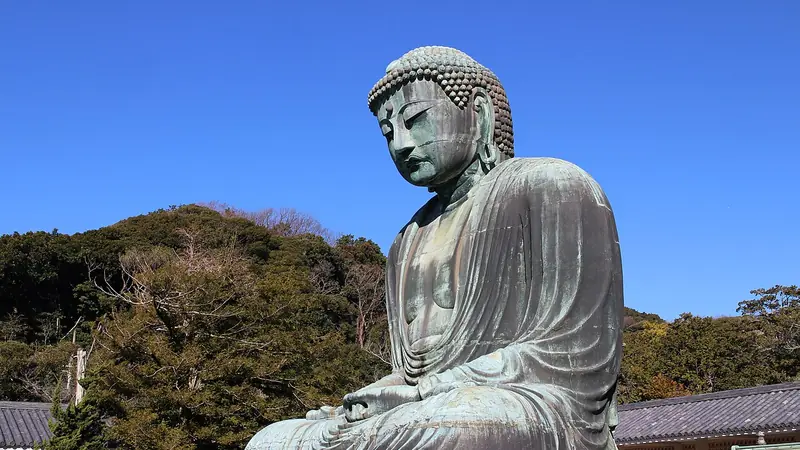
Nara's is taller and about twice as heavy. Kamakura's sits in the open air, which the temple notes is unusual for a large Buddha in Japan. That's the real difference on the day: in Nara you look at the statue inside a hall, in Kamakura you see it against the sky, from any angle in the courtyard. The temple also says traces of the original gold still show on both cheeks. Look for them.
Why it sits in the open air: the temple's own dates
The temple's history page gives four dates, and names the chronicles it takes them from. Popular English pages say a tsunami swept the hall away in 1495; Kotoku-in says a severe earthquake in 1498, citing the Taiheiki and the Kamakura-dainikki. We follow the temple.
| Year | What happened | The temple's source |
|---|---|---|
| 1252 | Work on the statue begins. The priest Joko is believed to have collected donations from ordinary people to pay for it | Azumakagami |
| 1334 and 1369 | Typhoons damage, then destroy, the hall (Daibutsu-den) that housed the statue | Taiheiki, Kamakura-dainikki |
| 1498 | A severe earthquake destroys the hall again. It is never rebuilt, and the statue has stood in the open since | Taiheiki, Kamakura-dainikki |
| mid Edo period (1603–1867) | Two Jodo priests, Yuten and Yokoku, repair the statue with money from the merchant Nojima Shinzaemon | temple history |
So the open-air setting you pay ¥300 for is not a design choice. It's what 500 years of weather left. The temple's full name, on the plaque at the Nio-mon gate, is Daii-san Kotoku-in Shojosen-ji; it belongs to the Jodo (Pure Land) sect founded by Honen.
On the grounds: 45 kg straw sandals and a hall said to come from a Seoul palace
The ticket also covers three things most visitors walk past on their way to the statue.
- The giant straw sandals (warazori) hang on the corridor wall to the right as you face the Buddha. Each is about 1.8 m long, 0.9 m wide and 45 kg. The Matsuzaka Children's Club of Hitachi-Ota, Ibaraki, first wove and donated a pair in 1951, with the wish that the Buddha would put them on and walk out to bring people happiness; the club has made them since 1956 and presents a new pair every three years.
- Kangetsu-do, the small hall behind the statue, is said to have been part of an imperial palace in Hanyang, today's Seoul. It holds a standing Kannon image.
- The Nio-mon gate at the entrance, with its pair of Nio guardians, is the one with the temple's official name on the plaque. A ramp beside it starts the barrier-free route: ticket office, the front of the statue, the gallery, then the accessible toilet, all on stone-paved paths with ramps past the bumpy parts.
How to get there
By Enoden from Kamakura (the usual way)
- From JR or Enoden Kamakura Station, take the Enoden toward Fujisawa. Hase is the third stop, about 5–7 minutes, ¥200 for adults (the temple says about 7).
- Walk 7 minutes from Hase Station along the main street. The temple has no parking, so this is how most people come.
- From the other end, Fujisawa to Hase takes 32 minutes on the Enoden timetable (¥310; the temple allows about 40), which suits you if you start from Enoshima or Odakyu.
By bus from Kamakura Station
From the East Exit, take the Enoden Bus (stop 1) or the Keikyu Bus (stop 6) to Daibutsu-mae, about 10 minutes. The stop is right by the gate, which helps if someone in your group can't walk far. The Enoden Bus ride is ¥240 per adult, and Suica works; the stop numbers and child fares are in our Kamakura bus guide. On busy weekends the road to Hase is slow, so the train is usually the safer bet.
From Tokyo
The JR Yokosuka Line runs from Tokyo Station to Kamakura without a change; pay with a Suica or other IC card. From Shinjuku, the Enoshima-Kamakura Freepass (¥1,640) covers the Odakyu train to Fujisawa and every Enoden ride, Hase included. Whether it beats single tickets depends on your route: our Kamakura and Enoshima cost guide and Enoden 1-day pass guide do the math.
Rules at the gate: food, drinks and pets
This catches people every day, because Hase-dori is lined with snack stalls right up to the temple.
- Eating and drinking are banned on the grounds, and so is carrying food or drinks in. A December 2025 notice adds that visitors eating while they walk are not let in.
- Sealed bottles (a water bottle, a flask) are fine. Cups (plastic or paper) are not, so finish that iced coffee outside.
- No bins inside. Take your rubbish with you.
- Pets only in a cage or carrier. Assistance dogs are welcome.
- Drones are banned. Photos for personal use are fine anywhere on the grounds.
Goshuin: dates when it's printed only
A goshuin is a temple stamp with handwritten calligraphy. Kotoku-in writes it in your book from 9:00 to 15:00. On crowded days it hands out printed sheets instead (¥300, or ¥600 for the seasonal autumn design). For autumn 2026, the temple has announced printed only on 10–12 October and 21–23 November (the long weekends), and says it may happen on other crowded days too. If the handwritten one matters to you, come on a weekday, and before 15:00.
Hasedera, 5 minutes away
Hasedera, the temple of the Hase Kannon, is about a 5-minute walk from the Great Buddha according to Kotoku-in (the prefecture's model course allows 10). It costs ¥400 for adults and ¥200 for elementary school children. From October to March it takes visitors until 16:30 and shuts at 17:00; from April to June, until 17:00. Our call: see the Great Buddha first, then Hasedera. The statue interior closes at 16:30 and the walk down to Hase Station is shorter from Hasedera.
Doing several temples in one day? The Kamakura temple fees calculator adds up your group's total, and our Kamakura day trip itinerary puts the Great Buddha in the right slot between Tsurugaoka Hachimangu and Enoshima. If you'd rather arrive on foot, the Daibutsu hiking course ends at the temple: see Kamakura hiking trails.
Frequently asked questions
Can I bring a stroller or wheelchair to the Great Buddha?
Yes. The grounds have ramps, but the temple warns that many areas are bumpy, so stay with the stroller or wheelchair user. The ticket counter lends wheelchairs from 9:00 to 16:00 (return by 16:30), for use inside the grounds only. There is one accessible toilet.
Can I park at Kotoku-in?
No. The temple has no parking, and its parking for disabled visitors has been discontinued. Only bicycles and 50cc scooters can park there. Use a public car park nearby or come by Enoden.
Is there a combined ticket for the Great Buddha and Hasedera?
No. Neither temple lists one, and the passes (the Enoden 1-day pass, the Enoshima-Kamakura Freepass) cover trains only. You pay ¥300 at the Kotoku-in gate and ¥400 at Hasedera's, five minutes apart.
Are there toilets and a free map inside Kotoku-in?
Toilets, yes: 16 for men, 16 for women and one accessible toilet, by the temple's count. A free map, no. Kotoku-in hands out no pamphlets; its guidebooks are sold at the temple shop (8:30–16:45).
Which Buddha is the Kamakura Great Buddha?
It's Amida Buddha (Amitabha), the main image of Kotoku-in. The statue is a National Treasure, cast in about 40 separate pours whose seams you can still see from inside. The temple says nobody knows who made it.
Official sources (checked 2026-10-25)
- Kotoku-in visitor guide: hours, fees, access, nearby spots (Kotoku-in)
- Kotoku-in FAQ: last entry, statue interior, group rates, re-entry, wheelchairs, parking, food rules (Kotoku-in)
- Kotoku-in announcements: goshuin dates for autumn 2026, food and drink rules (Kotoku-in)
- Measurements of the Great Buddha and Todai-ji, the 40 castings, the gold on the cheeks (Kotoku-in)
- History: 1252, the typhoons of 1334 and 1369, the earthquake of 1498, the Edo repair, the temple's full name (Kotoku-in)
- Grounds map, barrier-free route, the straw sandals, Kangetsu-do (Kotoku-in)
- Hasedera hours and fees (Hasedera)
- Enoden fares and the child rule (Enoshima Electric Railway)
- Enoden 1-day pass Noriorikun, ¥800/¥400, and its list of perks (Enoshima Electric Railway)
- Enoshima-Kamakura Freepass (Odakyu)
Photo: Suicasmo / CC BY-SA 4.0 (Wikimedia Commons; cropped to 16:9 and resized, shared under the same licence).

More for your trip
- Hakone Freepass calculator: single tickets vs the pass for your Hakone rides
- Enoshima & Kamakura calculator: single tickets vs Noriorikun vs Freepass
- Japan tax-free refund calculator: the new system from 1 Nov 2026
- Yokohama day trip cost calculator: single tickets vs the Minatomirai, JR and Tokyu passes
- Mt. Takao day trip cost calculator: single tickets vs the Mt. Takao Ticket
- Kawagoe day trip cost calculator: Koedo Kawagoe Coupon vs single tickets and the Premium pass
- Mt. Oyama day trip cost calculator: Tanzawa-Oyama Freepass A vs B vs single tickets
- Odawara day trip cost calculator: Odakyu vs Romancecar vs JR vs Shinkansen, plus Odawara Castle tickets
- Misaki Maguro Kippu calculator: does the Keikyu tuna ticket pay off for your trip
- Hayama Excursion Ticket calculator: Keikyu's Hayama Joshi-tabi Kippu: 2026 prices, the break-even point and the ¥1,000 cruise add-on
- Kamakura temple entrance fees calculator: Great Buddha, Hasedera, Hokokuji, Engakuji and Kenchoji for your group
- Enoshima island tickets calculator: escar, Sea Candle, Iwaya Caves and aquarium: single tickets vs the 1day and Area Passport
- Yokohama Cosmo World tickets calculator: ride prices and the cheapest discount ticket for your group
- Yokohama Anpanman Children's Museum tickets calculator: price by date, family total, sale date and cancellation fee
- Hako Ticket calculator: unlimited entry to 20 Hakone hot springs and museums: does it pay off for your plan
- Hakone Yunessun tickets calculator: price by date, Passport vs Mori no Yu, rentals and tattoo rules
- Hakone museums tickets calculator: Pola, Okada, Open-Air, Glass Forest and more: Freepass discounts and your group total
- Sagamiko Illumillion tickets calculator: winter lights: price by date, night free pass and the JR + bus route from Shinjuku
- Hakone Kamakura Pass calculator: one 3-day pass for both areas vs two Freepasses vs single tickets
- Sarushima Island ferry calculator: ferry and admission by fare day, timetable and the train from Tokyo
- Yokosuka Naval Port Tour calculator: cruise price by fare day, booking and whether the Mankitsu Kippu pays
- Hakone day trip from Tokyo: cost and route: three budgets and the loop in order
- Hakone Freepass: the break-even math
- Kamakura and Enoshima day trip: cost: which pass to buy
- Kamakura day trip itinerary: one-day route with Enoshima, closing times and cost
- Kamakura Station lockers and luggage storage: 74 large lockers (38 in the East Exit room), no cash, ¥500 to reserve, and the ¥700 any-size counter open until 17:00
- Hakone or Kamakura? Day trip compared: cost, time, closing times and a 3-question chart
- Hakone to Kamakura by train: Hakone-Yumoto to Odawara, JR to Ofuna, Yokosuka Line to Kamakura: minutes from the official timetables and which pass covers which leg
- Yokohama to Hakone by train: Tokaido Line or the Shinkansen from Shin-Yokohama to Odawara, the Tozan Train to Hakone-Yumoto, the Freepass sold at Odawara, and why the Yokohama bus no longer reaches Hakone
- Yokohama day trip with kids: family train cost: child fares and the cheapest ticket for a family
- Yokohama Red Brick Christmas Market 2026: dates, hours, the 9 special days at ¥1,000 and the 27 at ¥500, and who gets in free
- Ice skating at Yokohama Red Brick Warehouse (Art Rink 2026–27): 28 Nov – 14 Feb, ¥2,000 adults then ¥1,700 from 4 January, hours for every part of the season and the glove rule
- Yokohama illuminations 2026–27: dates, Yorunoyo show times, fireworks nights and a one-evening route
- Yomiuriland Jewellumination 2026–27: 29 Oct – 4 Apr, lights 16:00–20:30, ¥1,800 admission vs the ¥3,100 After Pass, the ¥300 gondola and the Keio passport
- Narita Airport to Yokohama: Narita Express or the YCAT bus, every direct departure, and the ¥5,200 round-trip ticket
- Haneda Airport to Kamakura: ¥840 with one change at Yokohama, and the direct bus that is suspended
- Narita Airport to Kamakura: Narita Express to Ofuna, or the direct rapid train with no change, departure by departure
- Haneda Airport to Enoshima: ¥1,100 by Keikyu, JR and the Enoden, the Ofuna and Fujisawa finishes, and the airport bus that is suspended
- Narita Airport to Enoshima: Narita Express to Ofuna and the Shonan Monorail (¥5,150), and why the ¥5,200 round-trip ticket makes the return ¥5,880
- Narita Airport to Hakone: Narita Express to Shinjuku and the Romancecar (¥5,800), or Shinagawa and the Shinkansen, with the round-trip ticket and Freepass sums
- Yokohama day trip itinerary: one-day route, opening hours and cost
- Hakone day trip itinerary: the one-day loop in order, ride times and the last boat
- Mt. Takao day trip itinerary: which trail, official hiking times and the last cable car
- Mt. Oyama day trip itinerary: four legs from Shinjuku, the last cable car, three plans and the 2026 autumn light-up
- Mt. Takao cable car vs chair lift: same ¥490 fare, hours by month, the ¥1,450 Mt. Takao Ticket and which ride to take
- Mt. Takao autumn leaves festival 2026: 24 Oct – 13 Dec, peak mid-Nov to early Dec, the Fri–Sun light-up along the cable car line and the ¥1,450 trip from Shinjuku
- Tokyo to Mt. Takao by train: Keio from Shinjuku or Shibuya for ¥430, the JR Chuo Line change at Takao, the Mt.TAKAO train times and the Mt. Takao Ticket price from every station
- Mt. Takao onsen: ¥1,100 weekday bath next to Takaosanguchi Station, hours, the strict tattoo rule and the ¥3,480 weekday Yuttari Kippu
- Hakone Romancecar tickets: price, how to book, observation seats and luggage
- Hakone day-use onsen: prices, hours and tattoo rules for a hot spring on a day trip
- Hakone luggage: storage and hotel delivery: drop times, prices and lockers for a suitcase in Hakone
- Kawagoe day trip itinerary: one-day route in loop-bus order, bus times, opening hours and cost
- Kawagoe Castle Honmaru Goten tickets: ¥100 entry, when the ¥370 and ¥600 combination tickets pay, and every closed date to March 2027 including the eight-day New Year closure
- Kitain Temple, Kawagoe: ¥400 entrance fee, hours that shorten on 24 November, closed dates and the walk from three stations
- SEIBU 1Day Pass + Nagatoro: ¥2,000 vs ¥2,700 on single tickets, why children should use an IC card, and Nagatoro's winter boats and ropeway
- Kawagoe Hikawa Shrine: free to visit, which bus from the station, the 8:08 good-match prayer and 8:30 monthly festival dates, New Year 2027
- Hakone pirate ship tickets: Lake Ashi cruise prices, which ticket is cheapest and the timetable
- Hakone Open-Air Museum tickets: counter vs online vs Freepass price, hours and access
- Hakone Shrine: hours, access and fees: bus or pirate ship to Moto-Hakone-ko, Treasure Hall and goshuin prices, Kuzuryu Shrine and Hakone Motomiya
- Hakone Checkpoint (Sekisho) tickets: ¥500 entry, ¥400 with the Freepass, hours and the 5-minute walk from the pirate ship pier
- Hakone Gora Park tickets: ¥650 or free with the Freepass, hours, the cheaper cable car stop and Craft House prices
- Hakone Ropeway tickets and Owakudani: flat fare, hours, which pass, black eggs and the guided nature trail
- Cup Noodles Museum Yokohama tickets: admission, make your own cup noodle, Chicken Ramen Factory booking and hours
- Hakone Tozan Railway tickets: fares for every station, the 1-day pass, IC cards and last trains
- Enoshima Aquarium tickets calculator: price, pass discounts, the Odakyu set ticket from Shinjuku and dolphin show times
- Hakkeijima Sea Paradise tickets: aquarium and ride passes, which one to buy and the cheap Keikyu ticket from Tokyo
- Yokohama Air Cabin tickets: ropeway prices, the Ferris wheel set ticket, hours and closing days
- Yokohama Sea Bass ferry: water bus fares between the four piers, which boats skip Red Brick, and boat vs train
- Yokohama bay cruise prices: ¥2,000 harbour loop, ¥3,000 night cruise, factory night cruise and Marine Rouge dinner: times, piers, child fares and booking rules
- Sankeien Garden tickets: entrance fee, hours, every bus route and the Minato Burari discount
- Minato Burari Ticket (Yokohama bus and subway day pass): ¥700 or ¥750 Wide, what it covers and what it does not, every single fare, the Akai Kutsu loop and four day plans with the math
- Akai Kutsu loop bus (Yokohama): ¥220 a ride from Sakuragicho bay 3, all 18 stops in order, minutes to Chinatown and Harbour View Park, and the last bus back from each stop
- Enoden 1-day pass (Noriorikun): price, every Enoden fare, where to buy and six day plans with the math
- Yokohama Marine Tower tickets: day and night prices, the 1-day pass, closing days and the Landmark Sky Garden closure
- Manyo Club Yokohama (Minatomirai hot spring): ¥3,500 admission, the ¥2,500 late-night fee after 3:00, what the set includes and the no-tattoo rule
- Hikawa Maru tickets (Yokohama museum ship): ¥300 cash only, hours, closed days to March 2027 and what is on each deck
- Hara Model Railway Museum tickets (Yokohama): ¥1,500 every day, timed-entry tickets sold on e+ and at FamilyMart rather than at the desk, the 16:00 last sale and the Thomas runs from 17 December
- THE MOVEUM YOKOHAMA tickets (Monet and Ukiyo-e): ¥3,000 online or ¥3,800 at the door, the ¥5,600 Pair ticket, kids free, the 45-minute show on the hour, no cash and the shuttle from Yamashita Pier
- Yokohama Museum of Art tickets: ¥500 collection exhibition, free Saturdays for teens, galleries shut 24 Nov–10 Dec and 29 Dec–3 Jan, every open day to 11 February 2027 and the free Grand Gallery
- Mitsubishi Minatomirai Industrial Museum: ¥500 cash, weekday last entry 14:30 (not 16:30), closed Tuesdays and Wednesdays, every closed date to 6 January 2027 and the Shinkai 6500 mock-up
- Nippon Maru and Yokohama Port Museum tickets: ¥800 combo or ¥400 ship only, students ¥100 on Saturdays, and the days the ship is shut to March 2027
- Yamate Western Houses (Yokohama, free): seven free houses on the Bluff, the Christmas 2026 country in each, closed Wednesdays by house to March 2027 and the walk from Ishikawacho
- Enoura Observatory tickets (Odawara): ¥3,300 booked ahead, ages 12 and over, every free shuttle time from Nebukawa Station and four trains from Tokyo from ¥1,120
- Nihon Minka-en tickets (Japan Open-Air Folk House Museum, Kawasaki): ¥550 at the gate, kids free, closed days to March 2027 and the 21, 22 and 28 November night opening
- Lalique Museum Hakone tickets: ¥1,500 at the door, ¥1,200 in advance, the ¥2,750 Orient Express tea you cannot book, hours and the January closing days
- Okada Museum of Art tickets (Hakone): ¥2,800 at the door, ¥2,550 bought at Hakone-Yumoto Station, foot bath included and the no-phones rule
- Hakone-en Aquarium tickets (Lake Ashi): ¥1,600 adults, ¥800 kids, seal feeding and diver show times, and the bus a Freepass covers
- Mt. Takao Monkey Park tickets: ¥600 since September 2026, not ¥500; hours, last entry and why the lift is no use after closing
- Takao Trick Art Museum (closing 30 November 2026): the 12 open days left, ¥1,650 since July 2026, the ¥200 printed coupon and why to visit after the mountain, not before
- Takaosan Yakuoin temple (Mt. Takao): goma fire ritual at 9:30, 11:00, 12:30, 14:00 and 15:30, ¥500 temple seal, shojin ryori lunch from ¥3,300 booked two days ahead, and New Year
- Kawasaki Daishi temple: ¥280 from Shinagawa or ¥330 from Haneda Airport, fire ritual times, hall hours, New Year 2027 and the 900th-anniversary festival in May 2027
- Nogeyama Zoo, Yokohama (free): shuts for rebuilding on 7 January 2027: every open day until then, the animals still there, keeper talk times and the walk from Sakuragicho
- Suzuhiro Kamaboko Museum (Odawara): ¥1,980 kamaboko-making class, not ¥1,500; every start time, when your kamaboko is ready, web booking from 130 days ahead and the ¥220 stop on the way to Hakone
- Romancecar Museum tickets (Ebina): ¥1,100 since March 2026, not ¥900; simulator fees, the six trains including the VSE, and why a Hakone Freepass makes the stop free
- Slam Dunk crossing, Kamakura (Kamakura-Koko-mae Station): Enoden fare from every station, when the ¥800 pass wins, where the city wants you to stand and how crowded it gets
- Battleship Mikasa tickets (Yokosuka): ¥800 not ¥600, last entry for every month, free weekend tours and the Keikyu train from Shinagawa
- Yokosuka day trip itinerary: Sarushima, Mikasa and the Naval Port Tour in clock order, winter boat times, ¥6,140 to ¥7,040 per adult and whether the Keikyu pass pays
- Shin-Yokohama Ramen Museum tickets: entrance fee, ¥750 mini bowls at every shop, payment rules and the subway from Yokohama
- Kirin Brewery Yokohama tour: ¥1,000 from Oct 2026, when booking opens, the tasting, drinking rules and the walk from Namamugi
- Hakone bus guide: route letters, which buses take the Freepass, fares and how to pay
- Hakone-Yumoto Station guide: which bus bay for Lake Ashi (bay 2, ¥1,210) or Togendai (bay 3, ¥1,330), why bay 1 takes no Freepass, the three platforms and the noon luggage deadline
- Hakone Old Tokaido road hike: walking times from Hatajuku and the Amazake-chaya teahouse to Lake Ashi, the K bus after its April 2026 change and teahouse prices
- Mt. Fuji views in Hakone: seven viewpoints priced: ropeway ¥2,000, pirate ship ¥1,700, Komagatake ¥2,200, Narukawa ¥1,500, and three free ones
- Mt. Kintoki hike: the 2 h 30 min loop to the 1,212 m Fuji viewpoint, the ¥2,400 direct bus from Shinjuku and the last bus back at 18:12
- Hakone to Gotemba Premium Outlets by bus: 10 buses a day from Gora (12 on weekends), 44 minutes, ¥1,120 or free with the Freepass, the one direct bus from Hakone-Yumoto, the 19:00 last bus back and the ¥2,000 bus on to Shinjuku
- Hakone to Kawaguchiko by bus: the change at Gotemba Station, G-Liner times and fares, which Hakone buses connect and the December 2026 fare rise
- Shinjuku to Hakone highway bus: ¥2,560 to Lake Ashi with no change: every stop and fare, booking in English and bus vs Romancecar
- Zoorasia (Yokohama Zoo) tickets: ¥800 adults, kids free on Saturdays, Tuesday closing, the bus from each station and Zoorasia vs Ueno Zoo
- Hokokuji bamboo temple: ¥400 garden, ¥600 matcha at the tea house, hours and the bus to Jomyoji
- Kamakura kimono rental prices: three shops compared with tax: ¥3,400 to ¥6,500 with hair styling, couples from ¥6,578, last dressing times, the 17:30 return and who charges to cancel
- Kamakura rickshaw prices (Ebisuya): ¥10,000 for 30 minutes per rickshaw, ¥5,000 each for two; what three riders or a family pay, the +¥1,000 English guide, walk-up or book
- Zeniarai Benten and Sasuke Inari: the free money-washing shrine: hours, the five washing steps, Snake days to 2027 and the 49 torii next door
- Kamakura hiking trails: Daibutsu, Tenen and Gion-yama courses: walking times, fees on the way and the free Tenen entrance
- Fujiko F. Fujio Museum (Doraemon Museum) tickets: price, when online sales open, the 60-minute entry rule and the shuttle bus from Noborito
- Hasedera temple, Kamakura: ¥400 entry, hours by season, the cave, hydrangea dates and goshuin
- Kita-Kamakura temples: Engakuji, Tokeiji, Jochiji, Meigetsuin and Kenchoji: fees, hours and the walk to Kamakura Station