Hasedera Temple, Kamakura: Entrance Fee, Opening Hours, the Cave, Hydrangea Season and Goshuin (2026)
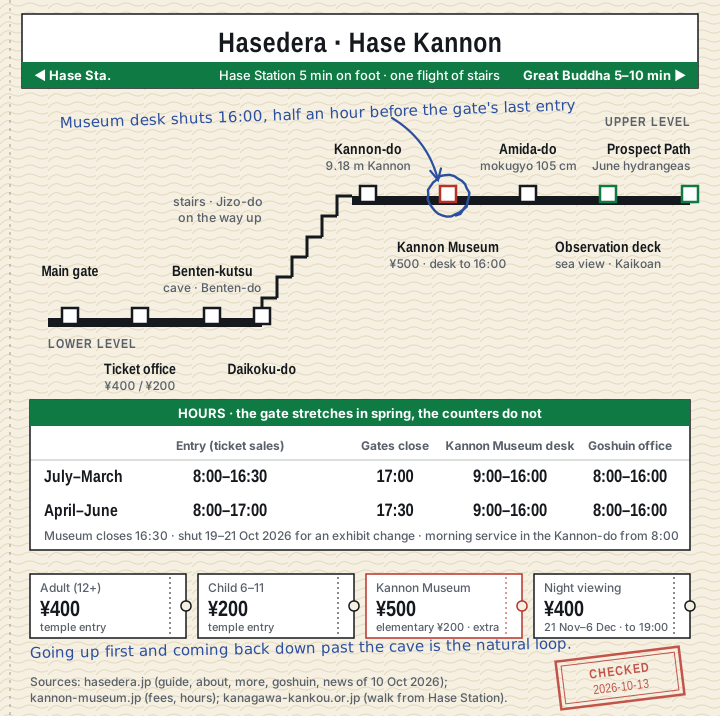
Hasedera runs on two clocks, and the second one is the one people miss. The gate takes visitors until 16:30 (17:00 from April to June), but the Kannon Museum inside stops selling tickets at 16:00 and the goshuin office shuts at 16:00 too. Entry is ¥400 for adults and ¥200 for children aged 6–11; the museum is ¥500 more (¥200 for elementary school children). The temple sits on a hillside called Kannon-zan, a 5-minute walk from Enoden Hase Station, and the Great Buddha is 5 to 10 minutes further up the road. Everything here is from the temple's and the museum's official pages, read on 2026-10-13.
Entrance fee
| Ticket | Price | Notes |
|---|---|---|
| Adult | ¥400 | junior high students pay this too |
| Child (age 6–11) | ¥200 | the fee table lists no price for younger children |
| Kannon Museum | ¥500 adult (junior high and up), ¥200 elementary | sold at the museum, on top of temple entry |
| Goshuin (temple stamp) | ¥300 | office 8:00–16:00 |
| Autumn night viewing | ¥400 adult, ¥200 child | 21 Nov–6 Dec 2026, sunset to 19:00 |
Two things about the museum price. First, the temple's own English map still says ¥300. The museum's site, which is the one that sells the ticket, says ¥500 for anyone of junior high age and up, so budget ¥500. Second, it has no fixed closing day but closes now and then to change exhibits: the next one is 19–21 October 2026. Check its calendar if the museum is the point of your visit.
Opening hours
| July–March | April–June | |
|---|---|---|
| Entry (ticket sales) | 8:00–16:30 | 8:00–17:00 |
| Gates close | 17:00 | 17:30 |
| Kannon Museum desk | 9:00–16:00 (museum closes 16:30) | same |
| Goshuin office | 8:00–16:00 | same |
| Morning service in the Kannon-do | from 8:00, about 30 minutes | same |
The longer hours in April, May and June are for the flowers: wisteria, peonies and then the hydrangeas. Note that the museum and the goshuin office don't stretch their hours with the gate. If you come at 16:15 in May you'll get in, see the Kannon and the view, and find both counters closed.
Our order for a late arrival: straight up the stairs to the Kannon-do and the museum, then the terrace, then back down to the cave. Arrive by 15:30 and nothing is shut.
What's on the hill
The grounds are on two levels. The ticket office, Benten-do and the cave are at the bottom. A flight of stairs, with the Jizo-do and its rows of small Jizo statues on the way, leads to the upper level, where the main halls and the sea view are.
The Kannon-do and the 9.18 m Kannon
The main hall holds the Hase Kannon, a standing wooden statue of the eleven-headed Kannon that the temple puts at 9.18 metres, one of the largest wooden Buddhist statues in Japan. The hall itself was rebuilt in reinforced concrete and finished in 1985. No photos or video inside the hall, and the same rule applies in the museum. Monks chant the morning service here at 8:00 every day; it lasts about 30 minutes and visitors may sit in.
The Kannon Museum
Three rooms of the temple's treasures. The pieces the museum singles out are the 1264 bell, the oldest object in the temple that carries the name Hasedera and, by the museum's count, the third-oldest bell in Kamakura after Jorakuji's and Kenchoji's; the six kakebotoke (large hanging bronze plaques showing the Hasedera-style Kannon, displayed together since the 2015 renovation); and the thirty-three forms of Kannon carved in the Muromachi period. Worth ¥500 if you like Buddhist sculpture, skippable if you came for the garden and the view. The desk closes at 16:00.
Amida-do, the bell and the sutra store
Next to the Kannon-do, the Amida-do houses the Yakuyoke Amida and what the temple says is Japan's largest mokugyo, the wooden fish drum, 105 cm across. The belfry's bell is the 1984 replacement (the original is in the museum) and it's struck at 8:00. The Kyozo sutra repository has a rotating bookshelf and a row of prayer wheels.
The observation platform and Kaikoan
The reason to climb. The platform on the upper level looks over the roofs of Kamakura to the sea. The Kaikoan restaurant beside it has the same view from its windows. Of the Kamakura temples we've written up, this is the only one with a sea view from inside the paying area.
Benten-kutsu cave
Back on the lower level, past the Benten-do, a low tunnel leads into the Benten-kutsu, the cave where the temple says Kobo Daishi meditated. Figures of Benzaiten are carved into the rock walls. It's short, and it's the part children remember.
Nagomi Jizo and the thousand Jizo
The round-faced Nagomi Jizo (placed in 2010) is the most photographed thing on the grounds, and three smaller Ryo-en Jizo are tucked into different corners for you to find. The Jizo-do on the stairs is surrounded by rows of small Jizo statues; it's a place of prayer, so keep the photo session for the Nagomi Jizo.
Hydrangea season: when to come
In June the Prospect Path becomes the hydrangea path, with more than 40 varieties by the temple's count. The temple's own weekly flower reports are the best guide to timing, and they say the same thing two years running:
| 2025 | 2026 | |
|---|---|---|
| Half open | 4 June | 4 June (40–50%) |
| Peak reported | 10–17 June | 11 June |
| Late varieties | 20 June | 19 June |
| "Peak has passed" | 27 June | 26 June |
So aim for the second week of June. In 2025 the path became a paid section from 6 June (the temple announced it in a flower report). The pages we could open don't give the path fee or how the queue is run, so check the temple's news page in late May before you plan a weekend visit. Expect the hours to be the April–June ones (entry until 17:00).
Autumn night viewing 2026
From 21 November to 6 December 2026 the temple opens again after dark for the maple light-up: sunset to a 19:00 gate closing (grounds clear by 19:30). Admission is the normal ¥400 / ¥200. It runs in rain, may be cancelled in severe weather, and may be extended if the leaves hold. No tripods in the walkways. Hase Station is a 5-minute walk, so you can do the Great Buddha by daylight, eat on Hase-dori and come back for the lights.
Goshuin: four months when it's paper only
The goshuin office is right after the entrance and is open 8:00–16:00 all year. Hand your book in there before you tour the grounds, so it's ready when you leave. One rule catches people: in January, April, May and June the temple gives out only pre-written paper goshuin and writes nothing in your book. If the handwritten version matters to you, come in another month. (The Bando pilgrimage book and the Seven Lucky Gods shikishi are the exceptions.) Seasonal embroidered and paper-cut goshuin appear in autumn and end when they sell out.
How to get there
- Enoden from Kamakura Station: three stops to Hase, 4 minutes on the timetable, ¥200. Then 5 minutes on foot.
- From Fujisawa or Enoshima: Hase is 32 minutes from Fujisawa (¥310) and 19 minutes from Enoshima (¥260) on the same Enoden line.
- With the Great Buddha: Kotoku-in says the two are about 5 minutes apart on foot; the prefecture's model course allows 10. Our Great Buddha guide covers that temple's hours and the ¥50 to go inside the statue.
- From Tokyo: the JR Yokosuka Line from Tokyo Station to Kamakura needs no change (pay with an IC card). From Shinjuku, the Enoshima-Kamakura Freepass (¥1,640) covers the Odakyu train to Fujisawa and every Enoden ride, Hase included. Our Kamakura and Enoshima cost guide shows when it beats single tickets, and the Enoden 1-day pass guide covers the ¥800 Noriorikun.
- By car: the temple car park is ¥350 per 30 minutes for cars (¥1,000 for buses), no reservations, and no motorcycles.
Practical things
- Lockers are near the car park. The barrier-free toilets (with an ostomate facility) are there too; there are more toilets on the grounds.
- Strollers can be parked under the main gate, on the right after the entrance. The temple's own warning: don't leave anything in them, the crows take things.
- Pets only in a carrier, cage or pet cart, and not into the halls. Assistance dogs are welcome everywhere.
- Free Wi-Fi in parts of the grounds, no password. Smoking only in the car park's smoking area.
- Fees for several temples in one day add up fast: the Kamakura temple fees calculator totals them for your group, and the Kamakura day trip itinerary puts Hasedera after the Great Buddha and before Enoshima.
Tours that stop at Hasedera
- Kamakura day tours from Tokyo on Viator most include Hasedera and the Great Buddha with a guide
- Kamakura tours and passes on Klook small-group day trips and the Odakyu passes
PR Affiliate links (disclosure): booking through them supports this site at no extra cost. Check whether a tour pays the ¥400 entry and whether it allows time for the museum.
Frequently asked questions
Can I take photos at Hasedera?
Yes on the grounds, the terrace and the cave, but not inside the Kannon-do hall or the Kannon Museum. During the autumn light-up, tripods are not allowed in the walkways.
Is there a bus to Hasedera from Kamakura Station?
The Enoden is the simple way: Hase Station is three stops and ¥200 from Kamakura. The Enoden's ¥900 Kamakura Free Kankyo Tegata covers the Kamakura–Hase train and the buses in central Kamakura, which helps only if you also ride to Hokokuji or Kita-Kamakura by bus.
Is Hasedera open every day?
The temple lists no closing day. The Kannon Museum has no fixed closing day either but closes for exhibit changes, next on 19–21 October 2026, and it changed its weekend hours during June 2026, so check the museum's calendar before a weekend visit.
Official sources (checked 2026-10-13)
- Hasedera admission, hours and parking, English (Hasedera)
- Hasedera 拝観のご案内: hours, fees, pets (Hasedera)
- Map of the grounds, the Kannon's height, the cave, the halls and the hydrangea path (Hasedera)
- Goshuin, strollers, lockers, photo rules, morning service, Wi-Fi (Hasedera)
- Goshuin office hours and the paper-only months (Hasedera)
- Autumn night viewing 2026 dates, hours and fees (Hasedera)
- Flower reports, June 2026 and June 2025 (Hasedera): hasedera.jp: 2026 06 and hasedera.jp: 2025 06
- Kannon Museum fees, hours and closures (Kannon Museum)
- Kannon Museum English leaflet: the 1264 bell and the kakebotoke (Kannon Museum)
- Enoden fares and guide times (Enoshima Electric Railway)
- Hase Station to Hasedera and Great Buddha walking times (Kanagawa Prefectural Tourism Association)
- Kotoku-in to Hasedera walking time (Kotoku-in)
- Enoshima-Kamakura Freepass (Odakyu)
More for your trip
- Hakone Freepass calculator: single tickets vs the pass for your Hakone rides
- Enoshima & Kamakura calculator: single tickets vs Noriorikun vs Freepass
- Japan tax-free refund calculator: the new system from 1 Nov 2026
- Yokohama day trip cost calculator: single tickets vs the Minatomirai, JR and Tokyu passes
- Mt. Takao day trip cost calculator: single tickets vs the Mt. Takao Ticket
- Kawagoe day trip cost calculator: Kawagoe Discount Pass vs Koedo Kawagoe Coupon
- Mt. Oyama day trip cost calculator: Tanzawa-Oyama Freepass A vs B vs single tickets
- Odawara day trip cost calculator: Odakyu vs Romancecar vs JR vs Shinkansen, plus Odawara Castle tickets
- Misaki Maguro Kippu calculator: does the Keikyu tuna ticket pay off for your trip
- Kamakura temple entrance fees calculator: Great Buddha, Hasedera, Hokokuji, Engakuji and Kenchoji for your group
- Enoshima island tickets calculator: escar, Sea Candle, Iwaya Caves and aquarium: single tickets vs the 1day and Area Passport
- Yokohama Cosmo World tickets calculator: ride prices and the cheapest discount ticket for your group
- Yokohama Anpanman Children's Museum tickets calculator: price by date, family total, sale date and cancellation fee
- Hako Ticket calculator: unlimited entry to 20 Hakone hot springs and museums: does it pay off for your plan
- Hakone Yunessun tickets calculator: price by date, Passport vs Mori no Yu, rentals and tattoo rules
- Hakone museums tickets calculator: Pola, Okada, Open-Air, Glass Forest and more: Freepass discounts and your group total
- Sagamiko Illumillion tickets calculator: winter lights: price by date, night free pass and the JR + bus route from Shinjuku
- Hakone Kamakura Pass calculator: one 3-day pass for both areas vs two Freepasses vs single tickets
- Sarushima Island ferry calculator: ferry and admission by fare day, timetable and the train from Tokyo
- Yokosuka Naval Port Tour calculator: cruise price by fare day, booking and whether the Mankitsu Kippu pays
- Hakone day trip from Tokyo: cost and route: three budgets and the loop in order
- Hakone Freepass: the break-even math
- Kamakura and Enoshima day trip: cost: which pass to buy
- Kamakura day trip itinerary: one-day route with Enoshima, closing times and cost
- Hakone or Kamakura? Day trip compared: cost, time, closing times and a 3-question chart
- Yokohama day trip with kids: family train cost: child fares and the cheapest ticket for a family
- Yokohama Red Brick Christmas Market 2026: dates, hours, ticket prices and free days
- Yokohama day trip itinerary: one-day route, opening hours and cost
- Hakone day trip itinerary: the one-day loop in order, ride times and the last boat
- Mt. Takao day trip itinerary: which trail, official hiking times and the last cable car
- Hakone Romancecar tickets: price, how to book, observation seats and luggage
- Hakone day-use onsen: prices, hours and tattoo rules for a hot spring on a day trip
- Hakone luggage: storage and hotel delivery: drop times, prices and lockers for a suitcase in Hakone
- Kawagoe day trip itinerary: one-day route in loop-bus order, bus times, opening hours and cost
- Hakone pirate ship tickets: Lake Ashi cruise prices, which ticket is cheapest and the timetable
- Hakone Open-Air Museum tickets: counter vs online vs Freepass price, hours and access
- Hakone Shrine: hours, access and fees: bus or pirate ship to Moto-Hakone-ko, Treasure Hall and goshuin prices, Kuzuryu Shrine and Hakone Motomiya
- Hakone Gora Park tickets: ¥650 or free with the Freepass, hours, the cheaper cable car stop and Craft House prices
- Hakone Ropeway tickets and Owakudani: flat fare, hours, which pass, black eggs and the guided nature trail
- Cup Noodles Museum Yokohama tickets: admission, make your own cup noodle, Chicken Ramen Factory booking and hours
- Hakone Tozan Railway tickets: fares for every station, the 1-day pass, IC cards and last trains
- Enoshima Aquarium tickets calculator: price, pass discounts, the Odakyu set ticket from Shinjuku and dolphin show times
- Hakkeijima Sea Paradise tickets: aquarium and ride passes, which one to buy and the cheap Keikyu ticket from Tokyo
- Yokohama Air Cabin tickets: ropeway prices, the Ferris wheel set ticket, hours and closing days
- Yokohama Sea Bass ferry: water bus fares between the four piers, which boats skip Red Brick, and boat vs train
- Sankeien Garden tickets: entrance fee, hours, every bus route and the Minato Burari discount
- Enoden 1-day pass (Noriorikun): price, every Enoden fare, where to buy and six day plans with the math
- Yokohama Marine Tower tickets: day and night prices, the 1-day pass, closing days and the Landmark Sky Garden closure
- Shin-Yokohama Ramen Museum tickets: entrance fee, ¥750 mini bowls at every shop, payment rules and the subway from Yokohama
- Kirin Brewery Yokohama tour: ¥1,000 from Oct 2026, when booking opens, the tasting, drinking rules and the walk from Namamugi
- Hakone bus guide: route letters, which buses take the Freepass, fares and how to pay
- Shinjuku to Hakone highway bus: ¥2,560 to Lake Ashi with no change: every stop and fare, booking in English and bus vs Romancecar
- Zoorasia (Yokohama Zoo) tickets: ¥800 adults, kids free on Saturdays, Tuesday closing, the bus from each station and Zoorasia vs Ueno Zoo
- Kamakura Great Buddha: ¥300 entry, ¥50 to go inside, hours, goshuin dates and the food rule at the gate
- Hokokuji bamboo temple: ¥400 garden, ¥600 matcha at the tea house, hours and the bus to Jomyoji
- Kamakura hiking trails: Daibutsu, Tenen and Gion-yama courses: walking times, fees on the way and the free Tenen entrance
- Fujiko F. Fujio Museum (Doraemon Museum) tickets: price, when online sales open, the 60-minute entry rule and the shuttle bus from Noborito