Zeniarai Benten, Kamakura 2026: Free Entry, 8:00–16:30, How the Money Washing Works and the Snake Days to March 2027
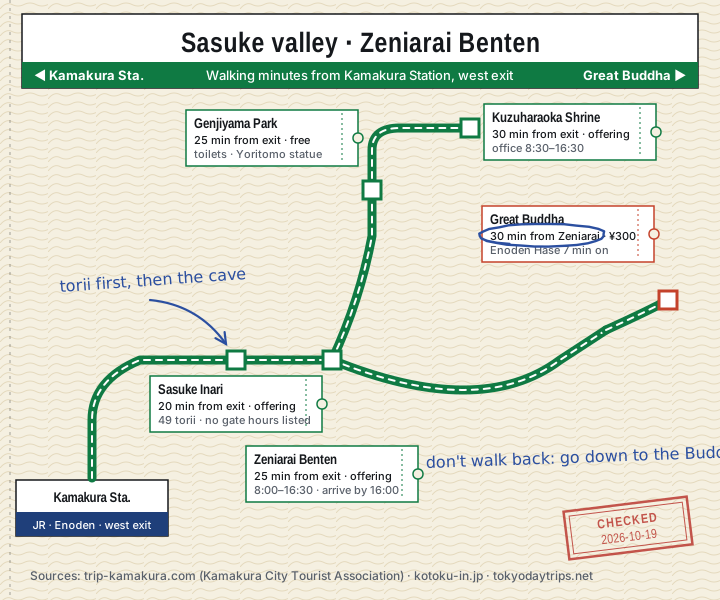
Zeniarai Benten is the one famous stop in Kamakura with no entrance fee at all: the Kanagawa tourism office lists it as free, the city's tourist association as shinou, an offering of whatever you choose. What you pay instead is the walk. The shrine sits at the dead end of the Sasuke valley, 25 minutes uphill from the west exit of Kamakura Station, open 8:00 to 16:30 with the city asking visitors to be inside by 16:00. You go in through a tunnel in the rock, borrow a bamboo basket at the office, carry it into the cave where the spring rises and ladle water over your money. The tourist association's figures also put Sasuke Inari and its 49 red torii 20 minutes from the same exit, and Kotoku-in says the Great Buddha is a 30-minute walk on from the shrine. Every number here comes from a public body or the temple's own page, read on 2026-10-19.
What is free, what is an offering, and when the gates matter
| Stop | From the west exit | Entry | Hours the sources give |
|---|---|---|---|
| Sasuke Inari Shrine | 20 min | offering | none published; the shrine lists no gate hours |
| Zeniarai Benten (Ugafuku Shrine) | 25 min | offering (listed as free by the prefecture) | 8:00–16:30, be in by 16:00 |
| Genjiyama Park | 25 min | free, public toilets | a city park |
| Kuzuharaoka Shrine | 30 min | offering | office 8:30–16:30 |
| Great Buddha, Kotoku-in | 30 min from Zeniarai Benten | ¥300, ¥150 for ages 6–12 | 8:00–17:00 Oct–Mar, 17:30 Apr–Sep |
The only clock that bites is Zeniarai Benten's. The 16:00 advice is there because the cave is at the far end of the grounds and the basket has to come back to the office before it shuts; arrive at 16:20 and you will be turned round at the tunnel. Sasuke Inari has no gate and publishes no hours, which in practice means the torii path is open when you get there, but the office that sells amulets keeps shorter days than the hill does.
Zeniarai Benten and Sasuke Inari are both reached from the same lane up the valley, so the 20 and 25 minutes are not two trips but one. The paid temples you may want on the same day, the Great Buddha, Hasedera and Hokokuji, are added up for your group in the Kamakura temple entrance fees calculator.
Washing your money, step by step
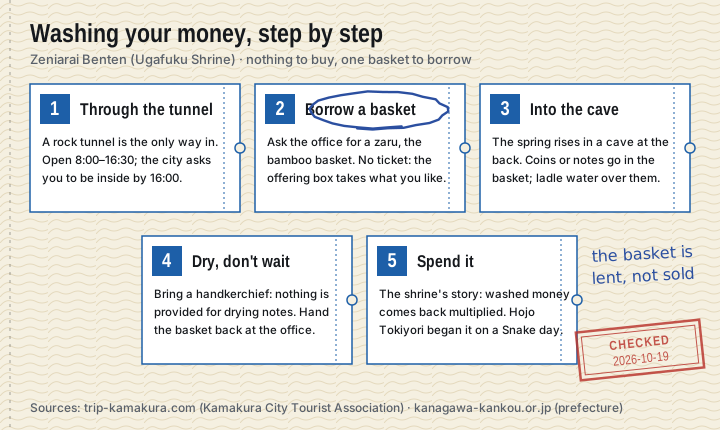
- Go in through the tunnel. The shrine is in a hollow the old records call a kakurezato, a hidden village, closed in by ridges on three sides, and the only way in on foot is a tunnel cut through the rock. The hours above apply from here.
- Borrow a basket. At the office, ask for a zaru, the shallow bamboo basket. This is where you drop your offering if you want to; there is no price list.
- Into the cave. The spring, Zeniarai-mizu, rises inside a cave at the back of the grounds and is counted among Kamakura's Five Famous Waters. Put your coins or notes in the basket and pour spring water over them with the ladle.
- Dry them and give the basket back. Bring a handkerchief. Notes come out limp and there is nothing provided to dry them on.
- Spend it. The tourist association's own wording is that money washed here "is said to increase". The custom is traced to Hojo Tokiyori, the shogunate's regent, who washed coins here on a Day of the Snake and told people to do the same.
The shrine itself is older than the custom. By the legend the city repeats, Minamoto no Yoritomo, the first shogun, was told in a dream in 1185 to find a spring in a hidden valley and honour the god there; the Kanagawa tourism office adds that the deity, Ugafukujin, is a water god shown with a snake's body and a human head. Until 1970 the place was a branch of Yasaka Shrine in Ogigayatsu, which is why a shrine this famous is this small. My reading of the ¥0: it is the shrine's choice, not an oversight. A ticket gate at the tunnel would turn a custom into an attraction, and the custom is what people come for.
Days of the Snake: the dates to March 2027, and why they matter
The Snake (mi) is Benzaiten's day, and the prefecture's page says plainly that a visit on one is held to bring the strongest luck. Snake days come every 12 days, by the same twelve-animal cycle that names the years. Every fifth one is a tsuchinoto-mi day, which comes round every 60 days and is the one the money-luck calendars circle. Those are the mornings the cave has a queue.
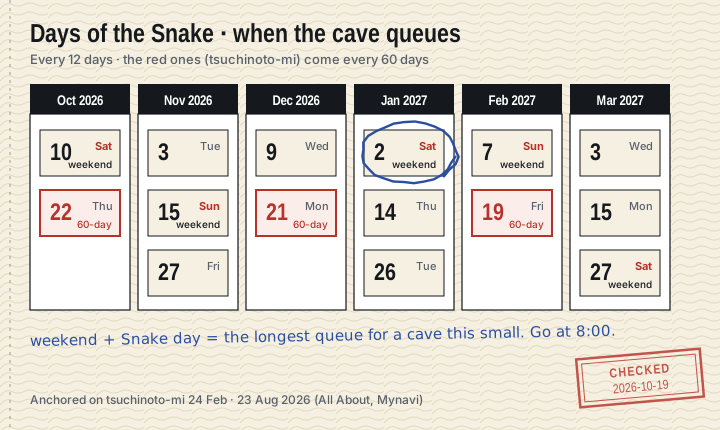
| Month | Days of the Snake | Falls on a weekend |
|---|---|---|
| October 2026 | 10, 22 | Sat 10 |
| November 2026 | 3, 15, 27 | Sun 15 |
| December 2026 | 9, 21 | — |
| January 2027 | 2, 14, 26 | Sat 2 |
| February 2027 | 7, 19 | Sun 7 |
| March 2027 | 3, 15, 27 | Sat 27 |
Bold is a tsuchinoto-mi day. The dates are worked out from the 60-day cycle, anchored on two published tsuchinoto-mi days, 24 February and 23 August 2026, and they agree with the monthly calendars I checked against. For a visit on a Snake day, be at the tunnel at 8:00: the cave holds a handful of people at a time and the ladles are shared. For a quiet visit, pick any of the other 11 days in the cycle and come on a weekday; the grounds are small enough that an hour covers everything, and the prefecture's suggested stay is 45 minutes.
Sasuke Inari: 49 torii, 20 minutes, no ticket either
The shrine you pass on the way up is worth the detour of a few minutes off the lane. Sasuke Inari's own site counts 49 vermilion torii on the steps up to the hall, hung with red banners, and the hall at the top was rebuilt in 1895. The story here is also Yoritomo's: exiled in Izu, he was urged in a dream by the Inari of the hidden village to raise his army, and the shrine took its name, Sasuke, from "helping Suke", his boyhood name. For 650-odd years it belonged to Tsurugaoka Hachimangu as an outlying shrine and only became independent in 1909, which is why it is still nicknamed the Inari of promotion, Shusse Inari.
Two practical points from the shrine itself: the spring in the grounds, Reiko-sen, may be bottled and taken home but is not for drinking, and there is no parking, so the station walk is the way in. Entry is an offering, as at Zeniarai Benten. The association's 20 minutes, counted at the west exit, is the right figure; the shrine's own page says "about 20 minutes from Kamakura Station" without naming the exit, and the east exit adds the walk round the station.
Walking on: the Great Buddha is downhill, the station is not
From Zeniarai Benten, Kotoku-in gives about 30 minutes on foot to the Great Buddha, and that is the way I would leave. Walking back to the station costs you 25 minutes and shows you the same lane twice; walking on costs five minutes more and ends at the Buddha, with Hasedera five minutes beyond it and Enoden Hase Station seven. Fees, the 16:30 cut-off for going inside the statue and the goshuin times are in Kamakura Great Buddha tickets.
The valley is also the middle of the city's Kuzuharaoka–Daibutsu hiking course: about 3 km, about 1 hour 30 minutes, rated for beginners, from Kita-Kamakura Station past Jochiji and Kuzuharaoka Shrine to Genjiyama Park and down to the Buddha. Genjiyama Park, 25 minutes up from the station, is where the course and the lane from the station meet; it has public toilets and the 2-metre statue of a young Yoritomo. Kuzuharaoka Shrine, five minutes further, keeps its office open 8:30 to 16:30 and sells the matchmaking charms the course is known for. The tourist association's warnings for the course are specific: a natural mountain path with slippery and steep sections, mud after rain, hornets from summer into autumn, and shoes fit for a hill. Section times for all three Kamakura courses are in Kamakura hiking trails, and how a Sasuke-valley morning fits with Enoshima in one day is in the Kamakura day trip itinerary. Fares from each Tokyo station are in Tokyo to Kamakura by train.
Kamakura tours and passes
- Kamakura day tours from Tokyo on Viator guided days that take in the Great Buddha; check whether Zeniarai Benten is on the route
- Kamakura tours and rail passes on Klook small-group walks and the Enoshima–Kamakura pass
PR Affiliate links (disclosure): booking through them supports this site at no extra cost. Zeniarai Benten and Sasuke Inari themselves sell no tickets, online or at the gate.
Frequently asked questions
Is Zeniarai Benten a temple or a shrine?
A Shinto shrine, Ugafuku Jinja, with Buddhist statues on the grounds. The prefecture's page calls it a fusion of the two religions, and the name people use, Benten, is the Buddhist goddess Benzaiten.
When are Sasuke Inari's festival days?
The Hatsuuma festival is in February, on the first Horse day of the month. The Eleven-headed Kannon in the small Kannon hall is shown only once a year, on 18 May; the rest of the year it is closed.
Is there another money-washing shrine on a Tokyo day trip?
Yes, in Hakone. Fukasawa Zeniarai Benten stands beside the platform of Tonosawa Station on the Hakone Tozan Railway, founded in 1926 after a visiting businessman said he had been told in a vision to build a shrine by the stream; the baskets sit in front of a small pool fed by it. It is a one-stop detour from Hakone-Yumoto, covered in Hakone Tozan Railway tickets.
Official sources (checked 2026-10-19)
- Zeniarai Benzaiten Ugafuku Shrine: hours 8:00–16:30, arrive by 16:00, offering, address, the legend and the Five Famous Waters (Kamakura City Tourist Association)
- Zeniarai Benzaiten: the 25-minute walk (west exit), borrowing the basket, the Day of the Snake (Kanagawa Prefectural Tourism Association, Japanese)
- Zeniarai Benzaiten: free, open every day, 45-minute visit, the water god (Kanagawa Prefectural Tourism Association, English)
- Sasuke Inari Shrine: 20-minute walk (west exit), offering, address (city tourist association)
- Sasuke Inari Shrine: 49 torii, independence in 1909, Reiko-sen water, no parking, Hatsuuma and the 18 May opening (the shrine)
- Kuzuharaoka Shrine: office hours, offering, 30-minute walk (west exit) (city tourist association)
- Genjiyama Park: 25-minute walk (west exit), toilets, the Yoritomo statue (city tourist association)
- Kuzuharaoka–Daibutsu hiking course: route, 3 km, 1 h 30 min, trail warnings (city tourist association)
- Kotoku-in: 30 minutes on foot from Zeniarai Benten, fees and hours (Kotoku-in)
- Fukasawa Zeniarai Benten at Tonosawa, founded 1926 (Ministry of Land, Infrastructure, Transport and Tourism, multilingual text)
- 24 February 2026 as a tsuchinoto-mi day, one anchor of the Snake-day calendar (All About)
- 23 August 2026 as a tsuchinoto-mi day, the second anchor (Mynavi News) The hours and the 16:00 advice are the city's figures, not the shrine's own. Confirm them on the day if you are cutting it fine.
More for your trip
- Hakone Freepass calculator: single tickets vs the pass for your Hakone rides
- Enoshima & Kamakura calculator: single tickets vs Noriorikun vs Freepass
- Japan tax-free refund calculator: the new system from 1 Nov 2026
- Yokohama day trip cost calculator: single tickets vs the Minatomirai, JR and Tokyu passes
- Mt. Takao day trip cost calculator: single tickets vs the Mt. Takao Ticket
- Kawagoe day trip cost calculator: Kawagoe Discount Pass vs Koedo Kawagoe Coupon
- Mt. Oyama day trip cost calculator: Tanzawa-Oyama Freepass A vs B vs single tickets
- Odawara day trip cost calculator: Odakyu vs Romancecar vs JR vs Shinkansen, plus Odawara Castle tickets
- Misaki Maguro Kippu calculator: does the Keikyu tuna ticket pay off for your trip
- Kamakura temple entrance fees calculator: Great Buddha, Hasedera, Hokokuji, Engakuji and Kenchoji for your group
- Enoshima island tickets calculator: escar, Sea Candle, Iwaya Caves and aquarium: single tickets vs the 1day and Area Passport
- Yokohama Cosmo World tickets calculator: ride prices and the cheapest discount ticket for your group
- Yokohama Anpanman Children's Museum tickets calculator: price by date, family total, sale date and cancellation fee
- Hako Ticket calculator: unlimited entry to 20 Hakone hot springs and museums: does it pay off for your plan
- Hakone Yunessun tickets calculator: price by date, Passport vs Mori no Yu, rentals and tattoo rules
- Hakone museums tickets calculator: Pola, Okada, Open-Air, Glass Forest and more: Freepass discounts and your group total
- Sagamiko Illumillion tickets calculator: winter lights: price by date, night free pass and the JR + bus route from Shinjuku
- Hakone Kamakura Pass calculator: one 3-day pass for both areas vs two Freepasses vs single tickets
- Sarushima Island ferry calculator: ferry and admission by fare day, timetable and the train from Tokyo
- Yokosuka Naval Port Tour calculator: cruise price by fare day, booking and whether the Mankitsu Kippu pays
- Hakone day trip from Tokyo: cost and route: three budgets and the loop in order
- Hakone Freepass: the break-even math
- Kamakura and Enoshima day trip: cost: which pass to buy
- Kamakura day trip itinerary: one-day route with Enoshima, closing times and cost
- Hakone or Kamakura? Day trip compared: cost, time, closing times and a 3-question chart
- Hakone to Kamakura by train: Hakone-Yumoto to Odawara, JR to Ofuna, Yokosuka Line to Kamakura: minutes from the official timetables and which pass covers which leg
- Yokohama to Hakone by train: Tokaido Line or the Shinkansen from Shin-Yokohama to Odawara, the Tozan Train to Hakone-Yumoto, the Freepass sold at Odawara, and why the Yokohama bus no longer reaches Hakone
- Yokohama day trip with kids: family train cost: child fares and the cheapest ticket for a family
- Yokohama Red Brick Christmas Market 2026: dates, hours, ticket prices and free days
- Yokohama day trip itinerary: one-day route, opening hours and cost
- Hakone day trip itinerary: the one-day loop in order, ride times and the last boat
- Mt. Takao day trip itinerary: which trail, official hiking times and the last cable car
- Mt. Takao cable car vs chair lift: same ¥490 fare, hours by month, the ¥1,450 Mt. Takao Ticket and which ride to take
- Mt. Takao autumn leaves festival 2026: 24 Oct – 13 Dec, peak mid-Nov to early Dec, the Fri–Sun light-up along the cable car line and the ¥1,450 trip from Shinjuku
- Tokyo to Mt. Takao by train: Keio from Shinjuku or Shibuya for ¥430, the JR Chuo Line change at Takao, the Mt.TAKAO train times and the Mt. Takao Ticket price from every station
- Mt. Takao onsen: ¥1,100 weekday bath next to Takaosanguchi Station, hours, the strict tattoo rule and the ¥3,480 weekday Yuttari Kippu
- Hakone Romancecar tickets: price, how to book, observation seats and luggage
- Hakone day-use onsen: prices, hours and tattoo rules for a hot spring on a day trip
- Hakone luggage: storage and hotel delivery: drop times, prices and lockers for a suitcase in Hakone
- Kawagoe day trip itinerary: one-day route in loop-bus order, bus times, opening hours and cost
- Hakone pirate ship tickets: Lake Ashi cruise prices, which ticket is cheapest and the timetable
- Hakone Open-Air Museum tickets: counter vs online vs Freepass price, hours and access
- Hakone Shrine: hours, access and fees: bus or pirate ship to Moto-Hakone-ko, Treasure Hall and goshuin prices, Kuzuryu Shrine and Hakone Motomiya
- Hakone Checkpoint (Sekisho) tickets: ¥500 entry, ¥400 with the Freepass, hours and the 5-minute walk from the pirate ship pier
- Hakone Gora Park tickets: ¥650 or free with the Freepass, hours, the cheaper cable car stop and Craft House prices
- Hakone Ropeway tickets and Owakudani: flat fare, hours, which pass, black eggs and the guided nature trail
- Cup Noodles Museum Yokohama tickets: admission, make your own cup noodle, Chicken Ramen Factory booking and hours
- Hakone Tozan Railway tickets: fares for every station, the 1-day pass, IC cards and last trains
- Enoshima Aquarium tickets calculator: price, pass discounts, the Odakyu set ticket from Shinjuku and dolphin show times
- Hakkeijima Sea Paradise tickets: aquarium and ride passes, which one to buy and the cheap Keikyu ticket from Tokyo
- Yokohama Air Cabin tickets: ropeway prices, the Ferris wheel set ticket, hours and closing days
- Yokohama Sea Bass ferry: water bus fares between the four piers, which boats skip Red Brick, and boat vs train
- Yokohama bay cruise prices: ¥2,000 harbour loop, ¥3,000 night cruise, factory night cruise and Marine Rouge dinner: times, piers, child fares and booking rules
- Sankeien Garden tickets: entrance fee, hours, every bus route and the Minato Burari discount
- Minato Burari Ticket (Yokohama bus and subway day pass): ¥700 or ¥750 Wide, what it covers and what it does not, every single fare, the Akai Kutsu loop and four day plans with the math
- Enoden 1-day pass (Noriorikun): price, every Enoden fare, where to buy and six day plans with the math
- Yokohama Marine Tower tickets: day and night prices, the 1-day pass, closing days and the Landmark Sky Garden closure
- Shin-Yokohama Ramen Museum tickets: entrance fee, ¥750 mini bowls at every shop, payment rules and the subway from Yokohama
- Kirin Brewery Yokohama tour: ¥1,000 from Oct 2026, when booking opens, the tasting, drinking rules and the walk from Namamugi
- Hakone bus guide: route letters, which buses take the Freepass, fares and how to pay
- Shinjuku to Hakone highway bus: ¥2,560 to Lake Ashi with no change: every stop and fare, booking in English and bus vs Romancecar
- Zoorasia (Yokohama Zoo) tickets: ¥800 adults, kids free on Saturdays, Tuesday closing, the bus from each station and Zoorasia vs Ueno Zoo
- Kamakura Great Buddha: ¥300 entry, ¥50 to go inside, hours, goshuin dates and the food rule at the gate
- Hokokuji bamboo temple: ¥400 garden, ¥600 matcha at the tea house, hours and the bus to Jomyoji
- Kamakura hiking trails: Daibutsu, Tenen and Gion-yama courses: walking times, fees on the way and the free Tenen entrance
- Fujiko F. Fujio Museum (Doraemon Museum) tickets: price, when online sales open, the 60-minute entry rule and the shuttle bus from Noborito
- Hasedera temple, Kamakura: ¥400 entry, hours by season, the cave, hydrangea dates and goshuin
- Kita-Kamakura temples: Engakuji, Tokeiji, Jochiji, Meigetsuin and Kenchoji: fees, hours and the walk to Kamakura Station