Kawagoe Hikawa Shrine: Bus, Prayer Dates and New Year
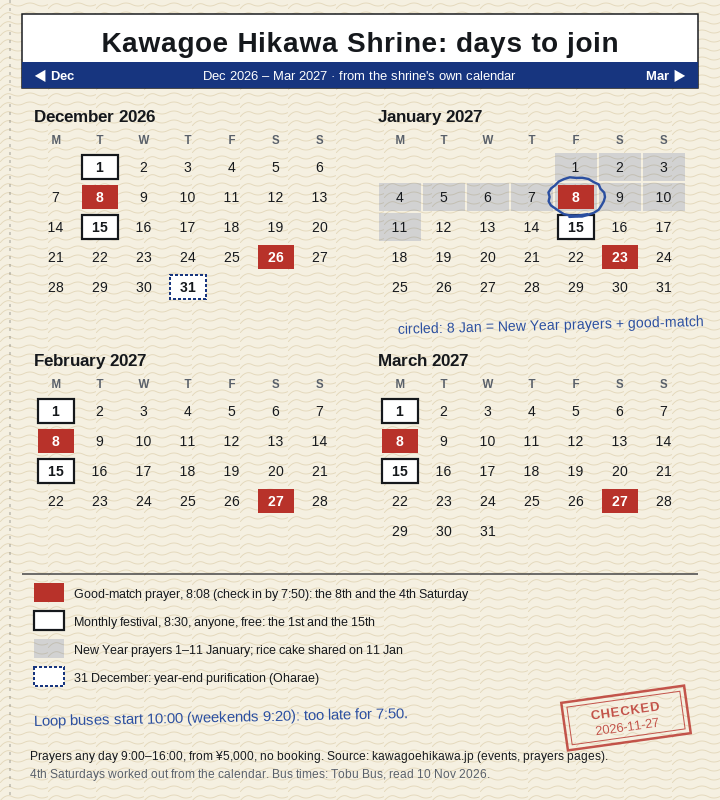
Most visitors reach Kawagoe Hikawa Shrine around noon on the loop bus, take a photo of the big torii and leave. The shrine's own calendar has two morning events that anyone can join. The good-match prayer (Ryoen Kigansai) starts at 8:08 a.m. on the 8th of every month and the 4th Saturday, and you must check in by 7:50. The monthly festival follows at 8:30 twice a month, on the 1st and 15th days; it's free, everyday clothes are fine, and you leave with the shrine's chopsticks. The catch is the bus. The tourist loop buses don't start until 10:00 on weekdays and 9:20 at weekends, so an early visit means the regular Tobu bus or your feet. Visiting the grounds costs nothing. Every date, time and rule here is from the shrine's official site, checked 2026-11-27.
What it costs
| Price | |
|---|---|
| Entering the grounds | free (the shrine says anyone may visit freely) |
| Formal prayer (gokigan), one person | from ¥5,000 |
| Formal prayer, company | from ¥10,000 |
| Shichi-go-san prayer, per child | ¥5,000 |
| Monthly festival on the 1st and 15th | free, no offering fee |
Formal prayers are received every day from 9:00 to 16:00. You don't book; you turn up and are taken in order of arrival. The shrine warns that Saturday and Sunday around midday can be busy. The fee goes in a noshi envelope, an amount "from the heart" starting at ¥5,000.
The shrine's pages don't list prices for charms, omikuji or the enmusubi-dama stone, or the hours of the charm desk. I haven't written any.
How to get there
The shrine sits north of the old town, and its page says to take a bus from the station. Several buses go there from Kawagoe and Hon-Kawagoe stations, each from its own stand, so check the stop number.
| From | Bus | Get off | Walk |
|---|---|---|---|
| Kawagoe Station (JR, Tobu) | Tobu Bus stop 7, towards Saitama Medical University, Ageo Station West Exit, Hirakata or Kawagoe Sports Park | Kawagoe Hikawa Jinja | 0 min |
| Kawagoe Station | Tobu Bus stop 1, towards Shinmeicho Garage or Josai High School | Kitamachi | 5 min |
| Kawagoe Station East Exit | Koedo Meisho Meguri loop bus (Tobu), stop 3 | Kawagoe Hikawa Jinja, about 20 min, ¥230 | 0 min |
| Kawagoe Station West Exit | Koedo Junkai Bus (sightseeing loop) | Hikawa Jinja-mae | 0 min |
| Hon-Kawagoe Station (Seibu) | Tobu Bus stop 5, same destinations as stop 7 | Kawagoe Hikawa Jinja | 0 min |
The Tobu loop bus fare and its 20 minutes are from Tobu Bus's page, which I read on 10 November; Suica and cash both work. The shrine's page doesn't give the fare for the ordinary Tobu buses, so pay with an IC card and check the fare screen on board.
Two of the bus names look alike and are easy to mix up. The Koedo Meisho Meguri bus is Tobu's and leaves from the East Exit. The Koedo Junkai bus is a separate sightseeing loop that leaves from the West Exit. Both stop at the shrine.
For a morning prayer, ignore both loops. The Tobu loop bus leaves Kawagoe Station at 10:00 on weekdays and 9:20 at weekends, which is more than an hour after the 7:50 check-in. Use the stop 7 bus or walk.
There is no free car park. The shrine sends drivers to coin parking nearby. It also doesn't post charms by mail: you get them at the shrine or not at all.
The good-match prayer at 8:08
The shrine is known as a place to pray for a good partner. Its five gods are one family, two married couples among them, which is why people come here for marriage and family luck.
The Ryoen Kigansai is the shrine's own ceremony for that wish. It is held twice a month, on the 8th and the 4th Saturday, at 8:08 a.m., because eight is a lucky number in Japan (the character widens towards the bottom, like a future opening up). The steps, from the shrine's page:
- Arrive and finish reception by 7:50.
- Fill in the form at the desk in front of the shrine office.
- Pay the fee at the office and take a numbered ticket.
You come away with an ofuda, an enmusubi-dama, a charm made for this ceremony, an ema, chopsticks and offerings. The page doesn't state the fee for this ceremony. My guess is that it follows the ¥5,000 starting point for prayers, but I can't confirm that, so bring enough and ask at the office.
Next dates: 8 and 26 December 2026, 8 January (the New Year one), 23 January, 8 and 27 February, 8 and 27 March 2027.
Reaching Kawagoe by 7:50 from central Tokyo is the hard part, not the ceremony. Ikebukuro to Kawagoe is about 30 minutes on the Tobu Tojo Line, so you are looking at a train around 7:00 or earlier, then the bus. It suits someone staying in Ikebukuro, or in Kawagoe itself.
The enmusubi-dama
The shrine has an old saying: take home a small pebble from the grounds, treasure it, and you will meet a good match. The enmusubi-dama is that pebble made into a charm. Shrine maidens pick up the stones one by one and wrap them in hemp net, and a priest purifies them every morning.
The part most guides leave out is the ending. When you meet your partner, the two of you come back together and return the stone. The shrine gives you a different charm in its place, one for a long and steady bond. So this is a charm with a return trip built in.
The shrine's pages don't say how many are given out each day or at what time. Other sites quote a daily number. I couldn't find it on the shrine's own site, so I've left it out. The page does say the 8:08 prayer includes one.
The monthly festival: free at 8:30
On the 1st and 15th of each month, at 8:30 a.m., priests pray for the imperial family, the region and everyone at the shrine. Anyone can take part: no fee, everyday clothes. Each person offers a tamagushi (a sacred branch) and bows. Afterwards you get Hikawa chopsticks, sweets and sake from the offerings.
It skips 1 January (the New Year ceremony takes that day) and 15 October (the autumn grand festival). If you'd like to keep coming, the office sells a small sake bottle (heishi) for ¥500; bring it to the next festival and it comes back filled.
Next dates: 1 and 15 December 2026, 15 January, 1 and 15 February, 1 and 15 March 2027.
For a first-time visitor, I think this is the better of the two morning events. It costs nothing, needs no Japanese form, and you see a shrine ceremony from inside instead of from behind a rope. It also starts 22 minutes later.
New Year 2027
| Date | What happens |
|---|---|
| 31 December | Shiwasu no Oharae, the year-end purification. Visitors are invited to join. |
| 1 – 11 January | Saitansai and Ganchosai, the New Year prayers. The shrine calls these its most precious prayers of the year. |
| 8 January | New Year good-match prayer, the first 8:08 ceremony of the year, inside the New Year prayer period. |
| 11 January | Kagami-biraki: the round rice cake from the altar is shared out. |
Kawagoe is a popular place for hatsumode, the first shrine visit of the year. The shrine's site doesn't give crowd numbers or special New Year hours, so I'm not going to guess at them. One thing to plan around: the Koedo Kawagoe 1-day bus ticket can't be used from 31 December to 3 January, so pay per ride on those days.
If you're doing a New Year day trip, notice that Kitain, two stops back on the loop bus, keeps its paid Edo Castle rooms shut from 25 December to 8 January. The shrine is the part of Kawagoe that's fully open then. The temple's dates are in the Kitain guide.
Rules for visitors
The shrine lists what it won't allow in the grounds. The ones that catch visitors:
- No pets. Guide dogs and assistance dogs are fine.
- No wedding photo shoots unless you married at this shrine. That includes pre-wedding and location shoots.
- No commercial photos, filming or drawing without permission.
- Don't photograph the shrine maidens or other visitors without asking. Take care with tripods and monopods.
- No reselling of charms or goshuin.
- Smoking only in the set place.
- The shrine may refuse entry in clothes it finds unsuitable for a place of worship.
Rented kimono are part of a normal Kawagoe day, and the list doesn't mention them. The rule to watch is the photo one: a couple in kimono doing a posed "wedding-style" shoot with a hired photographer is the kind of thing the shrine is guarding against. The Kawagoe kimono rental prices page has the shops and return times.
Fitting it into a Kawagoe day
The Tobu loop bus runs one way only: Kitain → Honmaru Goten → Hikawa Shrine → Fudanotsuji → Ichibangai. So the shrine comes after the castle palace and before the warehouse street.
| Leg | Bus fare | On foot |
|---|---|---|
| Kitain-mae → Kawagoe Hikawa Jinja | ¥220 | n/a |
| Kawagoe Hikawa Jinja → Ichibangai | ¥220 | about 10 min |
| Kawagoe Hikawa Jinja → Kashiya Yokocho (candy alley) | n/a | about 14 min |
| Kawagoe Hikawa Jinja → Kawagoe Station | ¥230 | n/a |
The walking minutes are from the Kawagoe tourist association's standard walking course. I'd walk from the shrine to Ichibangai: ten minutes is about what you'd spend waiting for the next bus. The full route with bus times is in the Kawagoe day trip itinerary. To see whether a pass pays off, there's the Kawagoe passes page. Honmaru Goten's ¥100 ticket and closed days are in the Honmaru Goten guide.
One adult from Ikebukuro, shrine only: ¥490 + ¥490 on the Tobu Tojo Line, plus ¥230 on the loop bus, is ¥1,210, or ¥980 if you walk from the station. The shrine adds nothing. Routes from Shinjuku and Shibuya are in Tokyo to Kawagoe by train, and the Kawagoe day trip cost calculator totals a whole day for your group.
What to look at
- The great torii at the entrance, 15 m of wood, which the tourist association counts among the largest wooden torii in Japan.
- The main hall (honden). Built in stages from the Tenpo era (1830s–40s) into the Meiji era, it is covered in fine carvings modelled on the doll figures that rode the festival floats when it was built. In May 2026 Japan's Council for Cultural Affairs recommended it for designation as a national Important Cultural Property; it becomes one when the official gazette publishes it.
- Yasaka Shrine, a small hall in the grounds. The third shogun, Tokugawa Iemitsu, built it in 1637 as a Toshogu inside Edo Castle, in the Ninomaru enclosure. It was moved here in 1872. The shrine describes it as a surviving religious building from inside Edo Castle and the only hall of its kind in Japan. Kitain's guest hall also came from Edo Castle, so one Kawagoe day puts you inside two buildings that once stood in the shogun's castle.
- The ema tunnel, where good-match plaques are tied up in rows. The plaque's picture of two horses leaning together was donated by the illustrator Ichio Otsuka.
The shrine traces its founding to 541. After Kawagoe Castle was built in 1457 it became the guardian of the castle town. Its October festival floats are a national Important Intangible Folk Cultural Property (2005) and on UNESCO's list (2016).
In summer the shrine hangs about 2,000 Edo wind chimes for the Enmusubi Furin event. In 2026 it ran from 27 June to 6 September. The 2027 dates aren't out yet.
Kawagoe tours and passes
- Kawagoe tours on Viator guided day trips from Tokyo; check whether Hikawa Shrine is on the route
- Kawagoe kimono rental and passes on Klook kimono for the day, rail passes and tours
PR Affiliate links (disclosure): booking through them supports this site at no extra cost. The shrine itself is free; prayers and charms are paid at the shrine.
Frequently asked questions
Is there an entrance fee at Kawagoe Hikawa Shrine?
No. The shrine says anyone may visit freely. You pay only if you ask for a formal prayer (from ¥5,000) or buy charms.
How do I get to Kawagoe Hikawa Shrine from Kawagoe Station?
Take Tobu Bus from stop 7 towards Saitama Medical University or Ageo Station West Exit and get off at Kawagoe Hikawa Jinja. Or take Tobu's Koedo Meisho Meguri loop bus from the East Exit, stop 3: about 20 minutes for ¥230.
When is the good-match prayer?
Twice a month: the 8th and the 4th Saturday, starting 8:08 in the morning. Reception closes at 7:50. The next dates are 8 and 26 December 2026 and 8 and 23 January 2027.
Can tourists join the monthly festival?
Yes. It begins at 8:30 each 1st and 15th of the month (except 1 January and 15 October). Anyone may take part in everyday clothes, with no fee, and you receive chopsticks, sweets and sake afterwards.
Can I bring my dog to Kawagoe Hikawa Shrine?
No. Pets are not allowed in the grounds. Guide dogs and assistance dogs are the exception.
Can I buy Kawagoe Hikawa Shrine charms online?
No. The shrine does not send charms by post. They are only given at the shrine.
Official sources (checked 2026-11-27)
- Access: bus stops, routes, parking (Kawagoe Hikawa Shrine)
- Visiting: free visits, rules, photography, enmusubi-dama and other charms (Kawagoe Hikawa Shrine)
- Prayers: reception 9:00–16:00, fees, the 8:08 good-match prayer (Kawagoe Hikawa Shrine)
- History, gods, treasures incl. Yasaka Shrine, yearly events and the monthly festival (Kawagoe Hikawa Shrine)
- Enmusubi Furin wind chimes, 2026 dates (Kawagoe Hikawa Shrine)
- Main hall recommended as Important Cultural Property, May 2026 (Kawagoe Hikawa Shrine news)
- Koedo Meisho Meguri loop bus: stop 3, fares, first buses (Tobu Bus)
- Koedo Kawagoe 1-day bus ticket, not valid 31 Dec – 3 Jan (Tobu Bus)
- Great torii 15 m (Koedo Kawagoe Tourist Association)
- Tobu Tojo Line fare table, Ikebukuro to Kawagoe ¥490 (Tobu Railway)
More for your trip
- Hakone Freepass calculator: single tickets vs the pass for your Hakone rides
- Enoshima & Kamakura calculator: single tickets vs Noriorikun vs Freepass
- Japan tax-free refund calculator: the new system from 1 Nov 2026
- Yokohama day trip cost calculator: single tickets vs the Minatomirai, JR and Tokyu passes
- Mt. Takao day trip cost calculator: single tickets vs the Mt. Takao Ticket
- Kawagoe day trip cost calculator: Koedo Kawagoe Coupon vs single tickets and the Premium pass
- Mt. Oyama day trip cost calculator: Tanzawa-Oyama Freepass A vs B vs single tickets
- Odawara day trip cost calculator: Odakyu vs Romancecar vs JR vs Shinkansen, plus Odawara Castle tickets
- Misaki Maguro Kippu calculator: does the Keikyu tuna ticket pay off for your trip
- Hayama Excursion Ticket calculator: Keikyu's Hayama Joshi-tabi Kippu: 2026 prices, the break-even point and the ¥1,000 cruise add-on
- Kamakura temple entrance fees calculator: Great Buddha, Hasedera, Hokokuji, Engakuji and Kenchoji for your group
- Enoshima island tickets calculator: escar, Sea Candle, Iwaya Caves and aquarium: single tickets vs the 1day and Area Passport
- Yokohama Cosmo World tickets calculator: ride prices and the cheapest discount ticket for your group
- Yokohama Anpanman Children's Museum tickets calculator: price by date, family total, sale date and cancellation fee
- Hako Ticket calculator: unlimited entry to 20 Hakone hot springs and museums: does it pay off for your plan
- Hakone Yunessun tickets calculator: price by date, Passport vs Mori no Yu, rentals and tattoo rules
- Hakone museums tickets calculator: Pola, Okada, Open-Air, Glass Forest and more: Freepass discounts and your group total
- Sagamiko Illumillion tickets calculator: winter lights: price by date, night free pass and the JR + bus route from Shinjuku
- Hakone Kamakura Pass calculator: one 3-day pass for both areas vs two Freepasses vs single tickets
- Sarushima Island ferry calculator: ferry and admission by fare day, timetable and the train from Tokyo
- Yokosuka Naval Port Tour calculator: cruise price by fare day, booking and whether the Mankitsu Kippu pays
- Hakone day trip from Tokyo: cost and route: three budgets and the loop in order
- Hakone Freepass: the break-even math
- Kamakura and Enoshima day trip: cost: which pass to buy
- Kamakura day trip itinerary: one-day route with Enoshima, closing times and cost
- Kamakura Station lockers and luggage storage: 74 large lockers (38 in the East Exit room), no cash, ¥500 to reserve, and the ¥700 any-size counter open until 17:00
- Hakone or Kamakura? Day trip compared: cost, time, closing times and a 3-question chart
- Hakone to Kamakura by train: Hakone-Yumoto to Odawara, JR to Ofuna, Yokosuka Line to Kamakura: minutes from the official timetables and which pass covers which leg
- Yokohama to Hakone by train: Tokaido Line or the Shinkansen from Shin-Yokohama to Odawara, the Tozan Train to Hakone-Yumoto, the Freepass sold at Odawara, and why the Yokohama bus no longer reaches Hakone
- Yokohama day trip with kids: family train cost: child fares and the cheapest ticket for a family
- Yokohama Red Brick Christmas Market 2026: dates, hours, the 9 special days at ¥1,000 and the 27 at ¥500, and who gets in free
- Ice skating at Yokohama Red Brick Warehouse (Art Rink 2026–27): 28 Nov – 14 Feb, ¥2,000 adults then ¥1,700 from 4 January, hours for every part of the season and the glove rule
- Yokohama illuminations 2026–27: dates, Yorunoyo show times, fireworks nights and a one-evening route
- Yomiuriland Jewellumination 2026–27: 29 Oct – 4 Apr, lights 16:00–20:30, ¥1,800 admission vs the ¥3,100 After Pass, the ¥300 gondola and the Keio passport
- Narita Airport to Yokohama: Narita Express or the YCAT bus, every direct departure, and the ¥5,200 round-trip ticket
- Haneda Airport to Kamakura: ¥840 with one change at Yokohama, and the direct bus that is suspended
- Narita Airport to Kamakura: Narita Express to Ofuna, or the direct rapid train with no change, departure by departure
- Haneda Airport to Enoshima: ¥1,100 by Keikyu, JR and the Enoden, the Ofuna and Fujisawa finishes, and the airport bus that is suspended
- Narita Airport to Enoshima: Narita Express to Ofuna and the Shonan Monorail (¥5,150), and why the ¥5,200 round-trip ticket makes the return ¥5,880
- Narita Airport to Hakone: Narita Express to Shinjuku and the Romancecar (¥5,800), or Shinagawa and the Shinkansen, with the round-trip ticket and Freepass sums
- Yokohama day trip itinerary: one-day route, opening hours and cost
- Hakone day trip itinerary: the one-day loop in order, ride times and the last boat
- Mt. Takao day trip itinerary: which trail, official hiking times and the last cable car
- Mt. Oyama day trip itinerary: four legs from Shinjuku, the last cable car, three plans and the 2026 autumn light-up
- Mt. Takao cable car vs chair lift: same ¥490 fare, hours by month, the ¥1,450 Mt. Takao Ticket and which ride to take
- Mt. Takao autumn leaves festival 2026: 24 Oct – 13 Dec, peak mid-Nov to early Dec, the Fri–Sun light-up along the cable car line and the ¥1,450 trip from Shinjuku
- Tokyo to Mt. Takao by train: Keio from Shinjuku or Shibuya for ¥430, the JR Chuo Line change at Takao, the Mt.TAKAO train times and the Mt. Takao Ticket price from every station
- Mt. Takao onsen: ¥1,100 weekday bath next to Takaosanguchi Station, hours, the strict tattoo rule and the ¥3,480 weekday Yuttari Kippu
- Hakone Romancecar tickets: price, how to book, observation seats and luggage
- Hakone day-use onsen: prices, hours and tattoo rules for a hot spring on a day trip
- Hakone luggage: storage and hotel delivery: drop times, prices and lockers for a suitcase in Hakone
- Kawagoe day trip itinerary: one-day route in loop-bus order, bus times, opening hours and cost
- Kawagoe Castle Honmaru Goten tickets: ¥100 entry, when the ¥370 and ¥600 combination tickets pay, and every closed date to March 2027 including the eight-day New Year closure
- Kitain Temple, Kawagoe: ¥400 entrance fee, hours that shorten on 24 November, closed dates and the walk from three stations
- SEIBU 1Day Pass + Nagatoro: ¥2,000 vs ¥2,700 on single tickets, why children should use an IC card, and Nagatoro's winter boats and ropeway
- Hakone pirate ship tickets: Lake Ashi cruise prices, which ticket is cheapest and the timetable
- Hakone Open-Air Museum tickets: counter vs online vs Freepass price, hours and access
- Hakone Shrine: hours, access and fees: bus or pirate ship to Moto-Hakone-ko, Treasure Hall and goshuin prices, Kuzuryu Shrine and Hakone Motomiya
- Hakone Checkpoint (Sekisho) tickets: ¥500 entry, ¥400 with the Freepass, hours and the 5-minute walk from the pirate ship pier
- Hakone Gora Park tickets: ¥650 or free with the Freepass, hours, the cheaper cable car stop and Craft House prices
- Hakone Ropeway tickets and Owakudani: flat fare, hours, which pass, black eggs and the guided nature trail
- Cup Noodles Museum Yokohama tickets: admission, make your own cup noodle, Chicken Ramen Factory booking and hours
- Hakone Tozan Railway tickets: fares for every station, the 1-day pass, IC cards and last trains
- Enoshima Aquarium tickets calculator: price, pass discounts, the Odakyu set ticket from Shinjuku and dolphin show times
- Hakkeijima Sea Paradise tickets: aquarium and ride passes, which one to buy and the cheap Keikyu ticket from Tokyo
- Yokohama Air Cabin tickets: ropeway prices, the Ferris wheel set ticket, hours and closing days
- Yokohama Sea Bass ferry: water bus fares between the four piers, which boats skip Red Brick, and boat vs train
- Yokohama bay cruise prices: ¥2,000 harbour loop, ¥3,000 night cruise, factory night cruise and Marine Rouge dinner: times, piers, child fares and booking rules
- Sankeien Garden tickets: entrance fee, hours, every bus route and the Minato Burari discount
- Minato Burari Ticket (Yokohama bus and subway day pass): ¥700 or ¥750 Wide, what it covers and what it does not, every single fare, the Akai Kutsu loop and four day plans with the math
- Akai Kutsu loop bus (Yokohama): ¥220 a ride from Sakuragicho bay 3, all 18 stops in order, minutes to Chinatown and Harbour View Park, and the last bus back from each stop
- Enoden 1-day pass (Noriorikun): price, every Enoden fare, where to buy and six day plans with the math
- Yokohama Marine Tower tickets: day and night prices, the 1-day pass, closing days and the Landmark Sky Garden closure
- Manyo Club Yokohama (Minatomirai hot spring): ¥3,500 admission, the ¥2,500 late-night fee after 3:00, what the set includes and the no-tattoo rule
- Hikawa Maru tickets (Yokohama museum ship): ¥300 cash only, hours, closed days to March 2027 and what is on each deck
- Hara Model Railway Museum tickets (Yokohama): ¥1,500 every day, timed-entry tickets sold on e+ and at FamilyMart rather than at the desk, the 16:00 last sale and the Thomas runs from 17 December
- THE MOVEUM YOKOHAMA tickets (Monet and Ukiyo-e): ¥3,000 online or ¥3,800 at the door, the ¥5,600 Pair ticket, kids free, the 45-minute show on the hour, no cash and the shuttle from Yamashita Pier
- Yokohama Museum of Art tickets: ¥500 collection exhibition, free Saturdays for teens, galleries shut 24 Nov–10 Dec and 29 Dec–3 Jan, every open day to 11 February 2027 and the free Grand Gallery
- Mitsubishi Minatomirai Industrial Museum: ¥500 cash, weekday last entry 14:30 (not 16:30), closed Tuesdays and Wednesdays, every closed date to 6 January 2027 and the Shinkai 6500 mock-up
- Nippon Maru and Yokohama Port Museum tickets: ¥800 combo or ¥400 ship only, students ¥100 on Saturdays, and the days the ship is shut to March 2027
- Yamate Western Houses (Yokohama, free): seven free houses on the Bluff, the Christmas 2026 country in each, closed Wednesdays by house to March 2027 and the walk from Ishikawacho
- Enoura Observatory tickets (Odawara): ¥3,300 booked ahead, ages 12 and over, every free shuttle time from Nebukawa Station and four trains from Tokyo from ¥1,120
- Nihon Minka-en tickets (Japan Open-Air Folk House Museum, Kawasaki): ¥550 at the gate, kids free, closed days to March 2027 and the 21, 22 and 28 November night opening
- Lalique Museum Hakone tickets: ¥1,500 at the door, ¥1,200 in advance, the ¥2,750 Orient Express tea you cannot book, hours and the January closing days
- Okada Museum of Art tickets (Hakone): ¥2,800 at the door, ¥2,550 bought at Hakone-Yumoto Station, foot bath included and the no-phones rule
- Hakone-en Aquarium tickets (Lake Ashi): ¥1,600 adults, ¥800 kids, seal feeding and diver show times, and the bus a Freepass covers
- Mt. Takao Monkey Park tickets: ¥600 since September 2026, not ¥500; hours, last entry and why the lift is no use after closing
- Takao Trick Art Museum (closing 30 November 2026): the 12 open days left, ¥1,650 since July 2026, the ¥200 printed coupon and why to visit after the mountain, not before
- Takaosan Yakuoin temple (Mt. Takao): goma fire ritual at 9:30, 11:00, 12:30, 14:00 and 15:30, ¥500 temple seal, shojin ryori lunch from ¥3,300 booked two days ahead, and New Year
- Kawasaki Daishi temple: ¥280 from Shinagawa or ¥330 from Haneda Airport, fire ritual times, hall hours, New Year 2027 and the 900th-anniversary festival in May 2027
- Nogeyama Zoo, Yokohama (free): shuts for rebuilding on 7 January 2027: every open day until then, the animals still there, keeper talk times and the walk from Sakuragicho
- Suzuhiro Kamaboko Museum (Odawara): ¥1,980 kamaboko-making class, not ¥1,500; every start time, when your kamaboko is ready, web booking from 130 days ahead and the ¥220 stop on the way to Hakone
- Romancecar Museum tickets (Ebina): ¥1,100 since March 2026, not ¥900; simulator fees, the six trains including the VSE, and why a Hakone Freepass makes the stop free
- Slam Dunk crossing, Kamakura (Kamakura-Koko-mae Station): Enoden fare from every station, when the ¥800 pass wins, where the city wants you to stand and how crowded it gets
- Battleship Mikasa tickets (Yokosuka): ¥800 not ¥600, last entry for every month, free weekend tours and the Keikyu train from Shinagawa
- Yokosuka day trip itinerary: Sarushima, Mikasa and the Naval Port Tour in clock order, winter boat times, ¥6,140 to ¥7,040 per adult and whether the Keikyu pass pays
- Shin-Yokohama Ramen Museum tickets: entrance fee, ¥750 mini bowls at every shop, payment rules and the subway from Yokohama
- Kirin Brewery Yokohama tour: ¥1,000 from Oct 2026, when booking opens, the tasting, drinking rules and the walk from Namamugi
- Hakone bus guide: route letters, which buses take the Freepass, fares and how to pay
- Hakone-Yumoto Station guide: which bus bay for Lake Ashi (bay 2, ¥1,210) or Togendai (bay 3, ¥1,330), why bay 1 takes no Freepass, the three platforms and the noon luggage deadline
- Hakone Old Tokaido road hike: walking times from Hatajuku and the Amazake-chaya teahouse to Lake Ashi, the K bus after its April 2026 change and teahouse prices
- Mt. Fuji views in Hakone: seven viewpoints priced: ropeway ¥2,000, pirate ship ¥1,700, Komagatake ¥2,200, Narukawa ¥1,500, and three free ones
- Mt. Kintoki hike: the 2 h 30 min loop to the 1,212 m Fuji viewpoint, the ¥2,400 direct bus from Shinjuku and the last bus back at 18:12
- Hakone to Gotemba Premium Outlets by bus: 10 buses a day from Gora (12 on weekends), 44 minutes, ¥1,120 or free with the Freepass, the one direct bus from Hakone-Yumoto, the 19:00 last bus back and the ¥2,000 bus on to Shinjuku
- Hakone to Kawaguchiko by bus: the change at Gotemba Station, G-Liner times and fares, which Hakone buses connect and the December 2026 fare rise
- Shinjuku to Hakone highway bus: ¥2,560 to Lake Ashi with no change: every stop and fare, booking in English and bus vs Romancecar
- Zoorasia (Yokohama Zoo) tickets: ¥800 adults, kids free on Saturdays, Tuesday closing, the bus from each station and Zoorasia vs Ueno Zoo
- Kamakura Great Buddha: ¥300 entry, ¥50 to go inside, hours, goshuin dates and the food rule at the gate
- Hokokuji bamboo temple: ¥400 garden, ¥600 matcha at the tea house, hours and the bus to Jomyoji
- Kamakura kimono rental prices: three shops compared with tax: ¥3,400 to ¥6,500 with hair styling, couples from ¥6,578, last dressing times, the 17:30 return and who charges to cancel
- Kamakura rickshaw prices (Ebisuya): ¥10,000 for 30 minutes per rickshaw, ¥5,000 each for two; what three riders or a family pay, the +¥1,000 English guide, walk-up or book
- Zeniarai Benten and Sasuke Inari: the free money-washing shrine: hours, the five washing steps, Snake days to 2027 and the 49 torii next door
- Kamakura hiking trails: Daibutsu, Tenen and Gion-yama courses: walking times, fees on the way and the free Tenen entrance
- Fujiko F. Fujio Museum (Doraemon Museum) tickets: price, when online sales open, the 60-minute entry rule and the shuttle bus from Noborito
- Hasedera temple, Kamakura: ¥400 entry, hours by season, the cave, hydrangea dates and goshuin
- Kita-Kamakura temples: Engakuji, Tokeiji, Jochiji, Meigetsuin and Kenchoji: fees, hours and the walk to Kamakura Station