Yokohama Chinatown from Tokyo: Which Station, the 10 Gates, Temple Hours and Fares (2026)
Yokohama Chinatown costs nothing to enter and sits at the far end of the Minatomirai Line, so the only two decisions are which station to get off at and whether to arrive by one Tokyu train from Shibuya (¥540, no change) or by JR to Ishikawacho (free with a Japan Rail Pass). Inside, ten gates mark the streets, and the two temples are the fixed points: Kanteibyo opens 8:00 to 18:00 under hours that changed on 1 November 2026, Masobyo 9:00 to 19:00. The Chinatown association's directory lists more than 400 businesses and the city's visitors' guide puts restaurants and shops above 600, so shop hours are the one thing nobody can give you in a single number. Fares, exits, gate names and temple hours below come from the railway, the association and the temples' own pages, checked 2026-11-09.
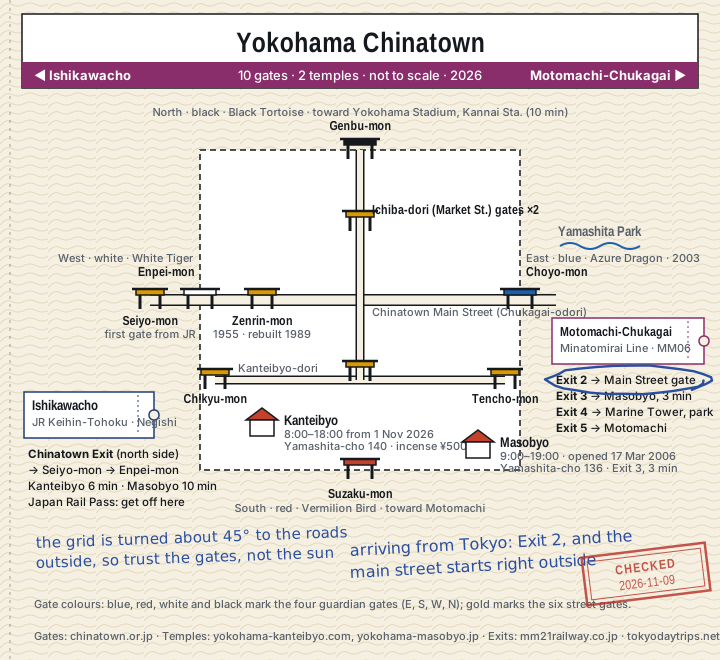
Which station: Motomachi-Chukagai or Ishikawacho?
| Station | Line | Exit to use | Walk to the temples | Use it if |
|---|---|---|---|---|
| Motomachi-Chukagai (MM06) | Minatomirai Line; Tokyu Toyoko Line trains from Shibuya run straight through | Exit 2 for Chinatown Main Street; Exit 3 for Masobyo; Exit 4 for the Marine Tower and Yamashita Park; Exit 5 for Motomachi shopping street | Masobyo 3 min from Exit 3, Kanteibyo 5 min | You are coming from Shibuya, Yokohama Station or anywhere on the Tokyu line |
| Ishikawacho | JR Keihin-Tohoku Line, same train onto the Negishi Line | Chinatown Exit (north side) | Kanteibyo 6 min, Masobyo 10 min | You hold a Japan Rail Pass, or you are already on a JR train from Tokyo Station |
| Kannai | JR and Blue Line subway | South exit | Kanteibyo 10 min | You walked over from Yokohama Stadium or Bashamichi |
Motomachi-Chukagai is the better arrival for almost everyone: the gates are in the station's name, the exits are numbered to the sights, and Yamashita Park and the Marine Tower are on the other side of the same station. Ishikawacho earns its place only through the Japan Rail Pass, which covers the whole JR ride from Tokyo Station and nothing on the Minatomirai Line.
What the ride from Tokyo costs
The Tokyu train from Shibuya does not change at Yokohama, but the fare does: Tokyu charges ¥310 to Yokohama and the Minatomirai Railway charges ¥230 for the last 4.1 km, so the one ride costs ¥540 by paper ticket (¥309 + ¥224 by IC card). Minatomirai Railway publishes typical daytime times from Yokohama Station of about 35 minutes to Shibuya, 43 to Shinjuku-sanchome and 49 to Ikebukuro; the Chinatown end of the line is one more stretch beyond Yokohama.
| From | Route | Change | Adult one way | Children 6–11 |
|---|---|---|---|---|
| Shibuya | Tokyu Toyoko Line, through onto the Minatomirai Line to Motomachi-Chukagai | None | ¥540 (¥310 + ¥230) | ¥160 + ¥120 |
| Shinagawa | Keikyu to Yokohama, then the Minatomirai Line | Yokohama | ¥550 (¥320 + ¥230) | ¥160 + ¥120 |
| Shinagawa | JR to Yokohama, then the Minatomirai Line | Yokohama | ¥580 (¥350 + ¥230) | ¥170 + ¥120 |
| Shibuya | JR to Yokohama, then the Minatomirai Line | Yokohama | ¥670 (¥440 + ¥230) | ¥220 + ¥120 |
| Tokyo Station | JR Keihin-Tohoku Line through to Ishikawacho | None | JR fare at the gate; ¥0 with the Japan Rail Pass | half |
| Yokohama Station | Minatomirai Line to the last stop | None | ¥230 (IC ¥224) | ¥120 |
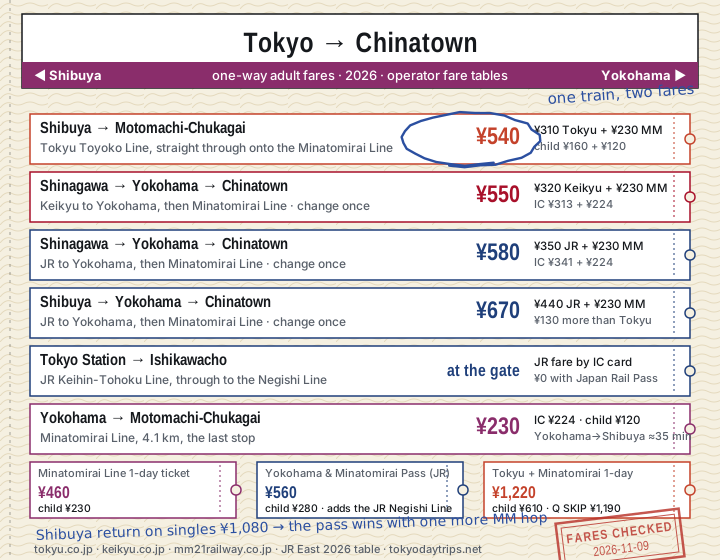
Three day passes touch this trip. The Minatomirai Line one-day ticket, ¥460 (child ¥230), pays once you make three hops along the harbour, since every ride is ¥200 or ¥230. JR East's Yokohama & Minatomirai Pass, ¥560 (child ¥280), adds the Negishi Line between Yokohama and Shin-Sugita for people arriving at Yokohama by JR. The Tokyu Line & Minatomirai Line One-Day Pass, ¥1,220 (child ¥610; ¥1,190 as a Q SKIP digital ticket) covers the Shibuya trip both ways plus the whole Minatomirai Line. A Shibuya round trip on single fares is ¥1,080, so one extra Minatomirai Line ride, Chinatown to the Red Brick Warehouse at Bashamichi for example, tips the pass into profit. Without that hop, buy singles. Odakyu, Keikyu and the Tokyu pass are all compared for a full harbour day in the Yokohama day trip itinerary.
The 10 gates and what the colours mean
Yokohama's Chinatown association counts ten gates (paifang) standing today. Four of them sit on the district's four sides and carry the four guardian creatures of Chinese cosmology, each with its own colour; the other six stand on the streets inside.
| Gate | Where | Colour and guardian | Note |
|---|---|---|---|
| Choyo-mon | East, facing Yamashita Park | Blue, Azure Dragon | Completed 1 February 2003; the first gate you meet from Motomachi-Chukagai Station |
| Suzaku-mon | South, toward Motomachi | Red, Vermilion Bird | Masobyo stands near this corner |
| Enpei-mon | West, toward Ishikawacho | White, White Tiger | Second gate from Ishikawacho Station |
| Genbu-mon | North, toward Yokohama Stadium | Black, Black Tortoise | The way in from Kannai |
| Zenrin-mon | Chinatown Main Street (Chukagai-odori) | — | The first gate of all, 1955; present form and name since 1989 |
| Seiyo-mon | Westernmost, outside Enpei-mon | — | First gate from Ishikawacho Station |
| Tencho-mon and Chikyu-mon | East and west ends of the street with Kanteibyo | — | A matched pair |
| Ichiba-dori gates (two) | Market Street | — | Two smaller gates on one lane |
The association also notes that the street grid is turned about 45 degrees to the roads around it, which is why the "east" gate seems to face south-east on a phone map. Treat the colours as the compass: blue is the station and the park side, white is the JR side.
Kanteibyo and Masobyo: hours, history, the ¥500 incense
Kanteibyo (Yamashita-cho 140) is dedicated to Guan Yu, the general worshipped for loyalty and good business. Its hours became 8:00 to 18:00, every day, from 1 November 2026; until 31 October they were 9:00 to 19:00, which is the figure most older guides still print. Over the New Year it stays open late: until 3:00 on the night of 31 December, until 21:00 on 1 to 3 January, until 2:00 on the night before the lunar New Year and until 21:00 on the lunar New Year's Day. Worship is done with incense bought at the reception desk for ¥500, offered at five burners in a set order that starts with the Jade Emperor, who has no statue and is prayed to facing the south gate. The present building is the fourth: the first small shrine went up in 1862, the earthquake of 1923, the air raid of 29 May 1945 and a fire on New Year's Day 1986 each destroyed its predecessor, and the current hall opened on 14 August 1990.
Masobyo (Yamashita-cho 136) is dedicated to Mazu, goddess of the sea, and is the younger temple: it opened on 17 March 2006 on the former site of the Qing consulate, and around a thousand bricks dug up during construction, dated to before the 1923 earthquake, were built into the foundations of its drum and bell towers. Hours are 9:00 to 19:00, until 2:00 on the night of 31 December and until 1:00 on the night before the lunar New Year. Incense and gold paper are sold at its reception desk too, and staff walk first-time visitors through the order of the burners. Neither temple lists an admission fee on its pages.
When to go: the lantern season and the Spring Festival
The association's Spring Festival Lantern Illumination runs from 1 November 2026 to 20 February 2027, so any evening visit this winter is a lit one. Chinese New Year itself falls on 6 February 2027, and that is the one date to plan around rather than wander into: both temples keep late hours the night before, and the association posts the parade and lion-dance programme on its event page as the date approaches. Through November 2026 the association's food festival is running a Shanghai crab fair (1 to 30 November).
For shop hours there is no single answer, and the city's own visitors' guide lists Chinatown's hours as "varies depending on the store". Two fixed points from that guide: Yokohama Daisekai, the souvenir and trick-art building, opens 9:30 to 22:00 every day, and the restaurants it lists mostly run lunch and dinner until 22:00 or later. My rule for a day trip: arrive for a late lunch after 13:00, do the temples before Kanteibyo's 18:00 close, and eat dinner under the lanterns.
Fitting Chinatown into a Yokohama day
Chinatown is the eastern end of the harbour walk, which is why the Yokohama day trip itinerary puts it last: Cup Noodles Museum and Minatomirai in the morning, the Red Brick Warehouse and Osanbashi Pier in the afternoon, Yamashita Park and Chinatown at dusk. The Marine Tower is through Exit 4 of the same station and sells a night ticket, so the view can come after dinner. Arriving from Haneda, the route is in Haneda Airport to Yokohama; from Tokyo Station, Shinagawa or Shibuya, Tokyo to Yokohama by train compares the lines minute by minute. If you plan to ride the red Akai Kutsu loop bus between the Red Brick Warehouse and Chinatown, the Minato Burari Ticket guide works out when the ¥700 bus pass pays.
What I would do
- From Shibuya: the Tokyu through train to Motomachi-Chukagai, ¥533 by IC card tap (¥540 by paper ticket), Exit 2, and no pass unless the Red Brick Warehouse is on the list too.
- With a Japan Rail Pass: Keihin-Tohoku Line from Tokyo Station to Ishikawacho, out of the Chinatown Exit, in through Seiyo-mon; the pass covers the ride home as well.
- Temples first, food second: Kanteibyo now closes at 18:00, earlier than the restaurants, so see it in daylight and keep ¥500 in coins for the incense.
- This winter: go after dark once for the lanterns (until 20 February 2027), and if you are in Japan on 6 February 2027, be here.
Food tours and Yokohama tickets
- Yokohama Chinatown food tours on Viator guided tasting walks; check whether the food itself is included in the price
- Yokohama tickets and activities on Klook Marine Tower, cruises and passes, paid in your own currency
PR Affiliate links (disclosure): booking through them supports this site at no extra cost. You do not need a tour for Chinatown itself: the streets, gates and temples are free to enter.
Frequently asked questions
Is Yokohama Chinatown free to visit?
Yes. The streets and the ten gates are public, and neither Kanteibyo nor Masobyo lists an admission fee. The only fixed cost at the temples is the ¥500 incense at Kanteibyo's reception desk if you want to worship.
How long does it take from Tokyo?
Minatomirai Railway gives about 35 minutes from Yokohama Station to Shibuya, 43 to Shinjuku-sanchome and 49 to Ikebukuro as typical daytime times, and Motomachi-Chukagai is 4.1 km beyond Yokohama on the same line. The Japan National Tourism Organization puts both Chinatown stations within about an hour of central Tokyo.
Can I use Suica or PASMO the whole way?
Yes. Tokyu, the Minatomirai Line, Keikyu and JR all take the transport IC cards, and the Shibuya ride is ¥533 by card (¥309 + ¥224) against ¥540 by paper ticket. The Tokyu and Minatomirai day pass is loaded onto a physical PASMO card, not onto a phone.
Official sources (checked 2026-11-09)
- The ten gates, their positions, guardians and years (Yokohama Chinatown Development Association)
- Shop directory with category counts, and the events page (Yokohama Chinatown Development Association)
- Spring Festival Lantern Illumination, 1 November 2026 to 20 February 2027 (Yokohama Chinatown Development Association)
- Bus access to the Chinatown Entrance stop (Yokohama Chinatown Development Association)
- Kanteibyo hours, New Year hours and access (Yokohama Kanteibyo)
- Kanteibyo hours change to 8:00–18:00 from 1 November 2026 (Yokohama Kanteibyo)
- Kanteibyo worship and the ¥500 incense (Yokohama Kanteibyo)
- Kanteibyo history, 1862 to 1990 (Yokohama Kanteibyo)
- Masobyo hours and access (Yokohama Masobyo)
- Masobyo opening on 17 March 2006 and the reused bricks (Yokohama Masobyo)
- Motomachi-Chukagai Station fares (Yokohama Minatomirai Railway)
- Motomachi-Chukagai Station exits and nearby places (Yokohama Minatomirai Railway)
- Typical daytime travel times from Yokohama Station (Yokohama Minatomirai Railway)
- Minatomirai Line one-day ticket, ¥460 (Yokohama Minatomirai Railway)
- Shibuya–Yokohama fare, ¥310 (Tokyu)
- Tokyu Line & Minatomirai Line One-Day Pass (Tokyu)
- Yokohama & Minatomirai Pass (JR East)
- Special-section fare table from March 2026, Shinagawa and Shibuya to Yokohama (JR East)
- Chinatown access and the 1859 origin (Japan National Tourism Organization)
- Chinese New Year dates, 17 February 2026 and 6 February 2027 (Office Holidays) Hours and fares change. Confirm with the operator or the temple before you travel.
More for your trip
- Hakone Freepass calculator: single tickets vs the pass for your Hakone rides
- Enoshima & Kamakura calculator: single tickets vs Noriorikun vs Freepass
- Japan tax-free refund calculator: the new system from 1 Nov 2026
- Yokohama day trip cost calculator: single tickets vs the Minatomirai, JR and Tokyu passes
- Mt. Takao day trip cost calculator: single tickets vs the Mt. Takao Ticket
- Kawagoe day trip cost calculator: Koedo Kawagoe Coupon vs single tickets and the Premium pass
- Mt. Oyama day trip cost calculator: Tanzawa-Oyama Freepass A vs B vs single tickets
- Odawara day trip cost calculator: Odakyu vs Romancecar vs JR vs Shinkansen, plus Odawara Castle tickets
- Misaki Maguro Kippu calculator: does the Keikyu tuna ticket pay off for your trip
- Kamakura temple entrance fees calculator: Great Buddha, Hasedera, Hokokuji, Engakuji and Kenchoji for your group
- Enoshima island tickets calculator: escar, Sea Candle, Iwaya Caves and aquarium: single tickets vs the 1day and Area Passport
- Yokohama Cosmo World tickets calculator: ride prices and the cheapest discount ticket for your group
- Yokohama Anpanman Children's Museum tickets calculator: price by date, family total, sale date and cancellation fee
- Hako Ticket calculator: unlimited entry to 20 Hakone hot springs and museums: does it pay off for your plan
- Hakone Yunessun tickets calculator: price by date, Passport vs Mori no Yu, rentals and tattoo rules
- Hakone museums tickets calculator: Pola, Okada, Open-Air, Glass Forest and more: Freepass discounts and your group total
- Sagamiko Illumillion tickets calculator: winter lights: price by date, night free pass and the JR + bus route from Shinjuku
- Hakone Kamakura Pass calculator: one 3-day pass for both areas vs two Freepasses vs single tickets
- Sarushima Island ferry calculator: ferry and admission by fare day, timetable and the train from Tokyo
- Yokosuka Naval Port Tour calculator: cruise price by fare day, booking and whether the Mankitsu Kippu pays
- Hakone day trip from Tokyo: cost and route: three budgets and the loop in order
- Hakone Freepass: the break-even math
- Kamakura and Enoshima day trip: cost: which pass to buy
- Kamakura day trip itinerary: one-day route with Enoshima, closing times and cost
- Hakone or Kamakura? Day trip compared: cost, time, closing times and a 3-question chart
- Hakone to Kamakura by train: Hakone-Yumoto to Odawara, JR to Ofuna, Yokosuka Line to Kamakura: minutes from the official timetables and which pass covers which leg
- Yokohama to Hakone by train: Tokaido Line or the Shinkansen from Shin-Yokohama to Odawara, the Tozan Train to Hakone-Yumoto, the Freepass sold at Odawara, and why the Yokohama bus no longer reaches Hakone
- Yokohama day trip with kids: family train cost: child fares and the cheapest ticket for a family
- Yokohama Red Brick Christmas Market 2026: dates, hours, ticket prices and free days
- Yokohama day trip itinerary: one-day route, opening hours and cost
- Hakone day trip itinerary: the one-day loop in order, ride times and the last boat
- Mt. Takao day trip itinerary: which trail, official hiking times and the last cable car
- Mt. Takao cable car vs chair lift: same ¥490 fare, hours by month, the ¥1,450 Mt. Takao Ticket and which ride to take
- Mt. Takao autumn leaves festival 2026: 24 Oct – 13 Dec, peak mid-Nov to early Dec, the Fri–Sun light-up along the cable car line and the ¥1,450 trip from Shinjuku
- Tokyo to Mt. Takao by train: Keio from Shinjuku or Shibuya for ¥430, the JR Chuo Line change at Takao, the Mt.TAKAO train times and the Mt. Takao Ticket price from every station
- Mt. Takao onsen: ¥1,100 weekday bath next to Takaosanguchi Station, hours, the strict tattoo rule and the ¥3,480 weekday Yuttari Kippu
- Hakone Romancecar tickets: price, how to book, observation seats and luggage
- Hakone day-use onsen: prices, hours and tattoo rules for a hot spring on a day trip
- Hakone luggage: storage and hotel delivery: drop times, prices and lockers for a suitcase in Hakone
- Kawagoe day trip itinerary: one-day route in loop-bus order, bus times, opening hours and cost
- Hakone pirate ship tickets: Lake Ashi cruise prices, which ticket is cheapest and the timetable
- Hakone Open-Air Museum tickets: counter vs online vs Freepass price, hours and access
- Hakone Shrine: hours, access and fees: bus or pirate ship to Moto-Hakone-ko, Treasure Hall and goshuin prices, Kuzuryu Shrine and Hakone Motomiya
- Hakone Checkpoint (Sekisho) tickets: ¥500 entry, ¥400 with the Freepass, hours and the 5-minute walk from the pirate ship pier
- Hakone Gora Park tickets: ¥650 or free with the Freepass, hours, the cheaper cable car stop and Craft House prices
- Hakone Ropeway tickets and Owakudani: flat fare, hours, which pass, black eggs and the guided nature trail
- Cup Noodles Museum Yokohama tickets: admission, make your own cup noodle, Chicken Ramen Factory booking and hours
- Hakone Tozan Railway tickets: fares for every station, the 1-day pass, IC cards and last trains
- Enoshima Aquarium tickets calculator: price, pass discounts, the Odakyu set ticket from Shinjuku and dolphin show times
- Hakkeijima Sea Paradise tickets: aquarium and ride passes, which one to buy and the cheap Keikyu ticket from Tokyo
- Yokohama Air Cabin tickets: ropeway prices, the Ferris wheel set ticket, hours and closing days
- Yokohama Sea Bass ferry: water bus fares between the four piers, which boats skip Red Brick, and boat vs train
- Yokohama bay cruise prices: ¥2,000 harbour loop, ¥3,000 night cruise, factory night cruise and Marine Rouge dinner: times, piers, child fares and booking rules
- Sankeien Garden tickets: entrance fee, hours, every bus route and the Minato Burari discount
- Minato Burari Ticket (Yokohama bus and subway day pass): ¥700 or ¥750 Wide, what it covers and what it does not, every single fare, the Akai Kutsu loop and four day plans with the math
- Enoden 1-day pass (Noriorikun): price, every Enoden fare, where to buy and six day plans with the math
- Yokohama Marine Tower tickets: day and night prices, the 1-day pass, closing days and the Landmark Sky Garden closure
- Hikawa Maru tickets (Yokohama museum ship): ¥300 cash only, hours, closed days to March 2027 and what is on each deck
- Shin-Yokohama Ramen Museum tickets: entrance fee, ¥750 mini bowls at every shop, payment rules and the subway from Yokohama
- Kirin Brewery Yokohama tour: ¥1,000 from Oct 2026, when booking opens, the tasting, drinking rules and the walk from Namamugi
- Hakone bus guide: route letters, which buses take the Freepass, fares and how to pay
- Shinjuku to Hakone highway bus: ¥2,560 to Lake Ashi with no change: every stop and fare, booking in English and bus vs Romancecar
- Zoorasia (Yokohama Zoo) tickets: ¥800 adults, kids free on Saturdays, Tuesday closing, the bus from each station and Zoorasia vs Ueno Zoo
- Kamakura Great Buddha: ¥300 entry, ¥50 to go inside, hours, goshuin dates and the food rule at the gate
- Hokokuji bamboo temple: ¥400 garden, ¥600 matcha at the tea house, hours and the bus to Jomyoji
- Zeniarai Benten and Sasuke Inari: the free money-washing shrine: hours, the five washing steps, Snake days to 2027 and the 49 torii next door
- Kamakura hiking trails: Daibutsu, Tenen and Gion-yama courses: walking times, fees on the way and the free Tenen entrance
- Fujiko F. Fujio Museum (Doraemon Museum) tickets: price, when online sales open, the 60-minute entry rule and the shuttle bus from Noborito
- Hasedera temple, Kamakura: ¥400 entry, hours by season, the cave, hydrangea dates and goshuin
- Kita-Kamakura temples: Engakuji, Tokeiji, Jochiji, Meigetsuin and Kenchoji: fees, hours and the walk to Kamakura Station