Tsurugaoka Hachimangu, Kamakura 2026: Free Entry, Gate 6:00–20:00, and the Three Buildings That Charge (¥200, ¥800, ¥1,000)
Tsurugaoka Hachimangu charges nothing at the gate. The Kamakura City Tourist Association lists no fee for the grounds and gives the gate hours as 6:00 to 20:00, which is a longer day than any temple in the city keeps. The money is in three buildings inside: the shrine's own Treasure House (¥200, 9:00–16:00), the shrine's Tsurugaoka Museum (¥800 for the current exhibition, 10:00–16:30) and the city-run Kamakura Museum of National Treasures, the Kokuhokan (¥1,000 for its autumn show, 9:00–16:30), which reopens after building works on 24 October 2026. All three stop letting people in by 16:00, so the paid part of a visit is a daytime thing and the grounds after that are free and quiet. The shrine is 10 minutes on foot from the east exit of Kamakura Station. Every figure here is from the tourist association, the prefecture or the two museums' own pages, checked 2026-10-20.
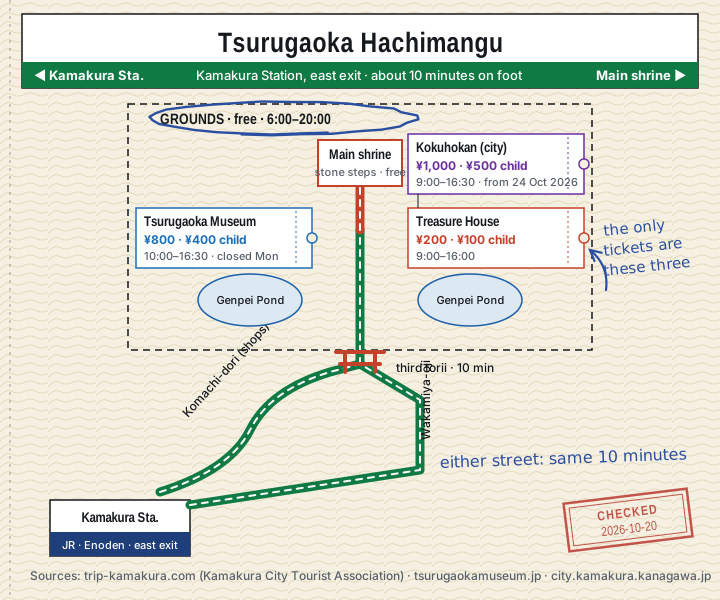
What costs money, and what does not
| Place | Adult | Child | Hours | Closed |
|---|---|---|---|---|
| Grounds, main shrine, Genpei Ponds | free | free | gate 6:00–20:00 | never |
| Treasure House (宝物殿) | ¥200 | ¥100 (elementary) | 9:00–16:00 | only for exhibition changes |
| Tsurugaoka Museum (鎌倉文華館 鶴岡ミュージアム) | ¥800 | ¥400 (elementary and junior high) | 10:00–16:30, last entry 16:00 | Mondays, 26 Nov 2026 (part), 28 Dec–5 Jan |
| Kamakura Museum of National Treasures (鎌倉国宝館, city) | ¥1,000 | ¥500 (elementary and junior high) | 9:00–16:30, last entry 16:00 | Mondays, 24 Nov 2026, 29 Dec–3 Jan; shut for works until 23 Oct 2026 |
| Peony garden (神苑ぼたん庭園) | separate fee | 9:00–16:30, last entry 16:00 | open only in the winter and spring peony seasons |
Three things to read into that table:
- The Treasure House price is the shrine's own and does not change. Groups of 25 or more pay ¥120 and ¥40. A Japanese disability handbook gets the holder and one companion in free.
- The two museum prices are exhibition prices. The Tsurugaoka Museum's basic-information page says the fee changes with each show; ¥800 is for Sacred Treasures of Tsurugaoka Hachimangu, 9 October 2026 to 24 January 2027. The city museum's standard range is ¥400 to ¥1,000 for adults and ¥150 to ¥500 for children; ¥1,000 is the top of it, for the special exhibition Zuisenji 700 Years, 24 October to 6 December 2026. Groups of 20 pay ¥900 and ¥400 there. If you are reading this after those dates, expect different numbers.
- The peony garden has a fee the public pages do not print. The prefecture's listing says only that entry costs extra. The garden opens for the New Year peonies in winter and again in spring; outside those seasons there is nothing to pay for by the pond.
My reading of the ¥0 at the gate: this is the city's central shrine, and the whole east side of Kamakura is laid out as its approach. A ticket booth at the torii would turn the town's main street into a queue. The shrine charges for what it keeps indoors, and leaves the stone steps to everyone.
The one clock that matters is 16:00
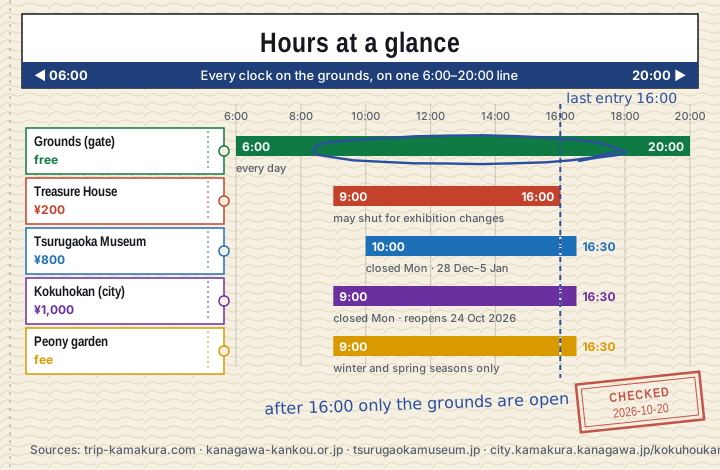
The gate hours, 6:00 to 20:00, have applied since 1 April 2024 "until further notice", in the association's words. In practice that means two kinds of visit:
- Before 9:00 or after 16:00: the grounds, the steps and the main shrine, for nothing. On a day-trip from Tokyo this is the slot I would use for the shrine, because it is the only stop in Kamakura that is still open when the temples have locked up. The Great Buddha closes at 17:00 from October to March, Hokokuji's bamboo garden at 16:00.
- Between 10:00 and 16:00: the only window in which all three paid buildings are open at once. The Treasure House opens an hour before the Tsurugaoka Museum, and the city museum opens at 9:00 too.
Mondays need care. Both museums close on Monday, and when Monday is a public holiday they open and close on the next weekday instead. During the city museum's autumn exhibition that produces one odd date: it is open on Monday 23 November 2026 (a holiday) and closed on Tuesday 24 November. The Treasure House has no weekly closing day.
Two streets from the station, same ten minutes
From the east exit of Kamakura Station (JR Yokosuka Line, Shonan-Shinjuku Line and the Enoden share the station) you can walk up either side of the same block:
- Komachi-dori, the narrow shopping street, starts just left of the exit and comes out beside the shrine's third torii. This is the busy way, and the one to take if you want a snack on the way.
- Wakamiya-oji, the wide avenue one block to the right, runs straight at the torii with the raised, tree-lined Dankazura walkway down its middle. Quieter, and the way the shrine was meant to be approached.
Both take about 10 minutes to the torii, the association's figure for the shrine; the city gives 12 minutes to the Kokuhokan, which is the far side of the grounds. By bus, the city museum is 3 minutes from the Daigaku-mae stop (Keikyu Bus) or Kamakura-Hachimangu-mae (Enoden Bus). The shrine has paid parking, including for coaches; the city museum has none. Fares from each Tokyo station are in Tokyo to Kamakura by train.
Which of the three to pay for
Pay for one, not three, unless the Kamakura period is why you came.
- ¥200, the Treasure House. The cheap one, and the one that belongs to the shrine: festival palanquins, armour and craft pieces connected to Hachimangu, in a hall near the main shrine. It is the add-on I would make on any visit, because it costs less than a coffee and is open on Mondays.
- ¥800, the Tsurugaoka Museum. This autumn and winter the show is the shrine's own sacred treasures, with some pieces swapped partway through (the museum's partial changeover is 26 November). A disability handbook takes ¥100 off for the holder and one companion.
- ¥1,000, the Kokuhokan. The city museum, reopening on 24 October 2026 after five months of works with Zuisenji 700 Years, treasures of the Zuisenji temple and works linked to its founder Muso Soseki. Free for Kamakura residents, for students at Kamakura schools, and for a disability-handbook holder with one companion.
If I had to pick one of the two museums for a first visit, I would take the ¥800 show: it is about the place you are standing in. The ¥1,000 exhibition is for people who already know Zuisenji, which is a separate temple on the other side of town.
What the free part includes
The association's history page is the shortest version worth knowing. In 1063 Minamoto no Yoriyoshi enshrined a branch of Iwashimizu Hachimangu at Yuigahama, by the beach. In 1180 Minamoto no Yoritomo, about to found the shogunate, moved it to the present site, and after a fire in 1191 rebuilt it on the hill behind in roughly its present form. The shrine the city grew around is that 1191 layout: the two Genpei Ponds either side of the approach, the Great Stone Steps up to the main shrine, the Masako Stone named for Yoritomo's wife, and the yabusame riding ground where mounted archery is still held.
The great ginkgo beside the steps, the tree in every old photo, was blown down early on 10 March 2010. Saplings grew from its roots and a parent tree was replanted beside them; a section of the old trunk is kept in the museum's café and shop, where you can see it without an exhibition ticket. The prefecture suggests about an hour for the grounds. Allow another hour for each building you pay for.
Kamakura tours and passes
- Kamakura day tours from Tokyo on Viator guided days that start at Hachimangu and walk down to the Great Buddha
- Kamakura walks and the Enoshima–Kamakura pass on Klook the pass covers the Enoden, not the museums
PR Affiliate links (disclosure): booking through them supports this site at no extra cost. The shrine sells no tickets online; the three buildings sell at their own doors.
Fitting it into a Kamakura day
The shrine is the natural first or last stop, because the station is at its feet. Coming from Kita-Kamakura's five temples you arrive at the back of the grounds and walk out through the torii to the station. Coming by the Enoden from Enoshima you arrive at the station and walk up. The Kamakura day trip itinerary puts it in the morning; after reading the hours above I would put it last on a short winter day, when the temples close at 16:00 or 16:30 and the gate here stays open to 20:00. Add the Treasure House, the Great Buddha and Hasedera for your group in the Kamakura temple entrance fees calculator. Hokokuji's bamboo garden is about 10 minutes by bus from the shrine; see Hokokuji bamboo temple.
Frequently asked questions
Is Tsurugaoka Hachimangu free?
Yes. The grounds, the main shrine and the ponds have no entrance fee. The Treasure House costs ¥200 (¥100 for elementary school children), and the two museums on the grounds charge by exhibition: ¥800 at the Tsurugaoka Museum and ¥1,000 at the city's Kokuhokan in autumn 2026.
What time does Tsurugaoka Hachimangu open and close?
The gate is open 6:00 to 20:00. The Treasure House is open 9:00 to 16:00, the Tsurugaoka Museum 10:00 to 16:30 (last entry 16:00) and the Kokuhokan 9:00 to 16:30 (last entry 16:00).
Do I need a ticket in advance?
No. Nothing at the shrine is sold online. The three buildings sell tickets at their own entrances, and the grounds have no gate check at all.
Is the Kamakura Museum of National Treasures open?
From 24 October 2026, yes. It closed on 19 May 2026 for building works and reopens with the special exhibition Zuisenji 700 Years, which runs to 6 December 2026. Adults pay ¥1,000, children ¥500.
How far is Tsurugaoka Hachimangu from Kamakura Station?
About 10 minutes on foot from the east exit, by either Komachi-dori or Wakamiya-oji. The city museum, on the far side of the grounds, is 12 minutes.
Is the peony garden open?
Only in the winter and spring peony seasons, 9:00 to 16:30 with last entry at 16:00, for a separate fee that the public listings do not print. Outside those seasons it is closed.
Official sources (checked 2026-10-20)
- Hours, fees, access and history of Tsurugaoka Hachimangu (Kamakura City Tourist Association, Japanese)
- Facility hours including the Treasure House, museum and peony garden (Kanagawa Prefectural Tourism Association, Japanese)
- Tsurugaoka Hachimangu, Treasure House fees and the one-hour visit (Kanagawa Prefecture, English)
- Current exhibition and admission (Kamakura Bunkakan Tsurugaoka Museum)
- Opening hours and closed days (Kamakura Bunkakan Tsurugaoka Museum)
- Visitor information, hours and fee range (Kokuhokan, Kamakura City)
- Special exhibition Zuisenji 700 Years, dates and fees (Kokuhokan, Kamakura City) Hours and exhibition prices change. Confirm with the shrine or the museum before you go.
More for your trip
- Hakone Freepass calculator: single tickets vs the pass for your Hakone rides
- Enoshima & Kamakura calculator: single tickets vs Noriorikun vs Freepass
- Japan tax-free refund calculator: the new system from 1 Nov 2026
- Yokohama day trip cost calculator: single tickets vs the Minatomirai, JR and Tokyu passes
- Mt. Takao day trip cost calculator: single tickets vs the Mt. Takao Ticket
- Kawagoe day trip cost calculator: Kawagoe Discount Pass vs Koedo Kawagoe Coupon
- Mt. Oyama day trip cost calculator: Tanzawa-Oyama Freepass A vs B vs single tickets
- Odawara day trip cost calculator: Odakyu vs Romancecar vs JR vs Shinkansen, plus Odawara Castle tickets
- Misaki Maguro Kippu calculator: does the Keikyu tuna ticket pay off for your trip
- Kamakura temple entrance fees calculator: Great Buddha, Hasedera, Hokokuji, Engakuji and Kenchoji for your group
- Enoshima island tickets calculator: escar, Sea Candle, Iwaya Caves and aquarium: single tickets vs the 1day and Area Passport
- Yokohama Cosmo World tickets calculator: ride prices and the cheapest discount ticket for your group
- Yokohama Anpanman Children's Museum tickets calculator: price by date, family total, sale date and cancellation fee
- Hako Ticket calculator: unlimited entry to 20 Hakone hot springs and museums: does it pay off for your plan
- Hakone Yunessun tickets calculator: price by date, Passport vs Mori no Yu, rentals and tattoo rules
- Hakone museums tickets calculator: Pola, Okada, Open-Air, Glass Forest and more: Freepass discounts and your group total
- Sagamiko Illumillion tickets calculator: winter lights: price by date, night free pass and the JR + bus route from Shinjuku
- Hakone Kamakura Pass calculator: one 3-day pass for both areas vs two Freepasses vs single tickets
- Sarushima Island ferry calculator: ferry and admission by fare day, timetable and the train from Tokyo
- Yokosuka Naval Port Tour calculator: cruise price by fare day, booking and whether the Mankitsu Kippu pays
- Hakone day trip from Tokyo: cost and route: three budgets and the loop in order
- Hakone Freepass: the break-even math
- Kamakura and Enoshima day trip: cost: which pass to buy
- Kamakura day trip itinerary: one-day route with Enoshima, closing times and cost
- Hakone or Kamakura? Day trip compared: cost, time, closing times and a 3-question chart
- Hakone to Kamakura by train: Hakone-Yumoto to Odawara, JR to Ofuna, Yokosuka Line to Kamakura: minutes from the official timetables and which pass covers which leg
- Yokohama to Hakone by train: Tokaido Line or the Shinkansen from Shin-Yokohama to Odawara, the Tozan Train to Hakone-Yumoto, the Freepass sold at Odawara, and why the Yokohama bus no longer reaches Hakone
- Yokohama day trip with kids: family train cost: child fares and the cheapest ticket for a family
- Yokohama Red Brick Christmas Market 2026: dates, hours, ticket prices and free days
- Yokohama day trip itinerary: one-day route, opening hours and cost
- Hakone day trip itinerary: the one-day loop in order, ride times and the last boat
- Mt. Takao day trip itinerary: which trail, official hiking times and the last cable car
- Mt. Takao cable car vs chair lift: same ¥490 fare, hours by month, the ¥1,450 Mt. Takao Ticket and which ride to take
- Mt. Takao autumn leaves festival 2026: 24 Oct – 13 Dec, peak mid-Nov to early Dec, the Fri–Sun light-up along the cable car line and the ¥1,450 trip from Shinjuku
- Tokyo to Mt. Takao by train: Keio from Shinjuku or Shibuya for ¥430, the JR Chuo Line change at Takao, the Mt.TAKAO train times and the Mt. Takao Ticket price from every station
- Mt. Takao onsen: ¥1,100 weekday bath next to Takaosanguchi Station, hours, the strict tattoo rule and the ¥3,480 weekday Yuttari Kippu
- Hakone Romancecar tickets: price, how to book, observation seats and luggage
- Hakone day-use onsen: prices, hours and tattoo rules for a hot spring on a day trip
- Hakone luggage: storage and hotel delivery: drop times, prices and lockers for a suitcase in Hakone
- Kawagoe day trip itinerary: one-day route in loop-bus order, bus times, opening hours and cost
- Hakone pirate ship tickets: Lake Ashi cruise prices, which ticket is cheapest and the timetable
- Hakone Open-Air Museum tickets: counter vs online vs Freepass price, hours and access
- Hakone Shrine: hours, access and fees: bus or pirate ship to Moto-Hakone-ko, Treasure Hall and goshuin prices, Kuzuryu Shrine and Hakone Motomiya
- Hakone Checkpoint (Sekisho) tickets: ¥500 entry, ¥400 with the Freepass, hours and the 5-minute walk from the pirate ship pier
- Hakone Gora Park tickets: ¥650 or free with the Freepass, hours, the cheaper cable car stop and Craft House prices
- Hakone Ropeway tickets and Owakudani: flat fare, hours, which pass, black eggs and the guided nature trail
- Cup Noodles Museum Yokohama tickets: admission, make your own cup noodle, Chicken Ramen Factory booking and hours
- Hakone Tozan Railway tickets: fares for every station, the 1-day pass, IC cards and last trains
- Enoshima Aquarium tickets calculator: price, pass discounts, the Odakyu set ticket from Shinjuku and dolphin show times
- Hakkeijima Sea Paradise tickets: aquarium and ride passes, which one to buy and the cheap Keikyu ticket from Tokyo
- Yokohama Air Cabin tickets: ropeway prices, the Ferris wheel set ticket, hours and closing days
- Yokohama Sea Bass ferry: water bus fares between the four piers, which boats skip Red Brick, and boat vs train
- Yokohama bay cruise prices: ¥2,000 harbour loop, ¥3,000 night cruise, factory night cruise and Marine Rouge dinner: times, piers, child fares and booking rules
- Sankeien Garden tickets: entrance fee, hours, every bus route and the Minato Burari discount
- Minato Burari Ticket (Yokohama bus and subway day pass): ¥700 or ¥750 Wide, what it covers and what it does not, every single fare, the Akai Kutsu loop and four day plans with the math
- Enoden 1-day pass (Noriorikun): price, every Enoden fare, where to buy and six day plans with the math
- Yokohama Marine Tower tickets: day and night prices, the 1-day pass, closing days and the Landmark Sky Garden closure
- Shin-Yokohama Ramen Museum tickets: entrance fee, ¥750 mini bowls at every shop, payment rules and the subway from Yokohama
- Kirin Brewery Yokohama tour: ¥1,000 from Oct 2026, when booking opens, the tasting, drinking rules and the walk from Namamugi
- Hakone bus guide: route letters, which buses take the Freepass, fares and how to pay
- Shinjuku to Hakone highway bus: ¥2,560 to Lake Ashi with no change: every stop and fare, booking in English and bus vs Romancecar
- Zoorasia (Yokohama Zoo) tickets: ¥800 adults, kids free on Saturdays, Tuesday closing, the bus from each station and Zoorasia vs Ueno Zoo
- Kamakura Great Buddha: ¥300 entry, ¥50 to go inside, hours, goshuin dates and the food rule at the gate
- Hokokuji bamboo temple: ¥400 garden, ¥600 matcha at the tea house, hours and the bus to Jomyoji
- Zeniarai Benten and Sasuke Inari: the free money-washing shrine: hours, the five washing steps, Snake days to 2027 and the 49 torii next door
- Kamakura hiking trails: Daibutsu, Tenen and Gion-yama courses: walking times, fees on the way and the free Tenen entrance
- Fujiko F. Fujio Museum (Doraemon Museum) tickets: price, when online sales open, the 60-minute entry rule and the shuttle bus from Noborito
- Hasedera temple, Kamakura: ¥400 entry, hours by season, the cave, hydrangea dates and goshuin
- Kita-Kamakura temples: Engakuji, Tokeiji, Jochiji, Meigetsuin and Kenchoji: fees, hours and the walk to Kamakura Station