Mt. Takao in Winter (December–February): Last Cable Car 17:15, Sunset 16:31, Official Temperatures, Diamond Fuji Week and the New Year Dates
Nothing on Mt. Takao closes for the winter, and only two things change their price: the Mt. Takao Ticket is not sold from 31 December to 3 January, and the onsen by the station charges its ¥1,300 peak rate from 29 December to 3 January. What does change is the light. The cable car's last run down is 17:15 on weekdays and 17:30 at weekends from December through February, and the sun is down at 16:31 on 21 December in the Tokyo table of the National Astronomical Observatory. The chair lift stops at 16:00. The cold is measured, not guessed: the Meteorological Agency's normals put Hachioji, the station at the foot of the mountain, at a January average of 3.4 °C with nights at −1.8 °C, two degrees under Tokyo. Hours, dates and prices on this page come from the operators, the temple and the agencies, checked 2026-10-29.
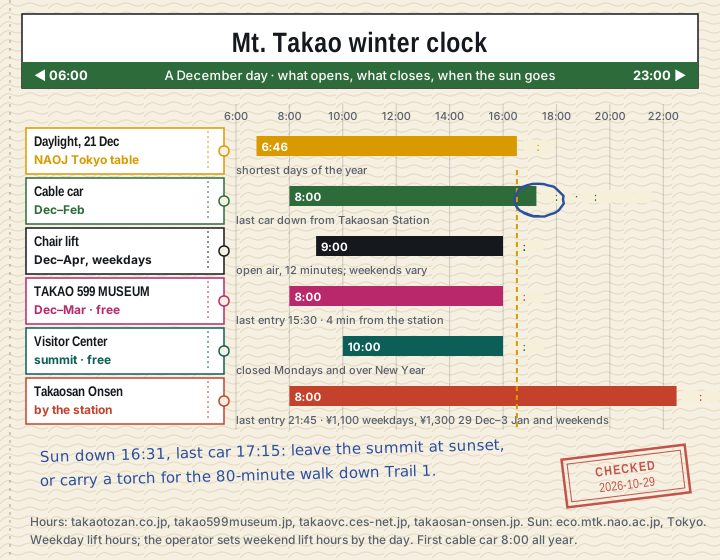
Winter hours: what stops when
| December | January–February | Notes | |
|---|---|---|---|
| Cable car, first car up | 8:00 | 8:00 | about every 15 minutes, every 7 when busy |
| Cable car, last car down | 17:15 weekdays / 17:30 weekends and holidays | 17:15 / 17:30 | the earliest last car of the year; March moves to 17:30 / 18:00 |
| Chair lift, last ride down | 16:00 on weekdays | 16:00 on weekdays | from 9:00; weekend hours are set by the day |
| TAKAO 599 MUSEUM (foot of the mountain) | 8:00–16:00, last entry 15:30 | same | free; 4 minutes from Takaosanguchi Station; closed 3 December 2026 and 4 March 2027 |
| Takao Visitor Center (summit) | 10:00–16:00 | same | free; closed Mondays and over the New Year holidays |
| Keio Takaosan Onsen Gokurakuyu | 8:00–22:30, last entry 21:45 | same | open every day; ¥1,300 instead of ¥1,100 from 29 December to 3 January |
Sunset from the observatory's Tokyo table: 16:28 on 1 December, 16:31 on the 21st, 16:37 on the 31st, 16:38 on 1 January, 17:07 on the 31st, 17:08 on 1 February and 17:35 on the 28th. Sunrise goes the other way, 6:32 on 1 December to 6:50 on 1 January, then back to 6:42 by the end of January.
Put the two together and December has a 75-minute gap between sunset and the last cable car. That gap is the summit walk. Takao Tozan's own advice, quoted in the day trip itinerary, is to be off the mountain before sunset because the forest goes completely dark. Trail 1 from the summit to the foot is 80 minutes on the official course map, and the cable car's upper station is partway down it, so a summit sunset at 16:31 means walking the upper part of Trail 1 in the dusk to make the 17:15 car. A small torch turns that from a worry into a plan. The chair lift is not an option after 16:00.
How cold it is: Hachioji against Tokyo, from the agency's own table
The Meteorological Agency has no gauge on the summit. Its nearest station is Hachioji, in the city at the foot of the mountain, and its 1991–2020 normals are below with Tokyo for comparison.
| Month | Hachioji: mean / daily high / daily low | Tokyo: mean / daily high / daily low | Precipitation, Hachioji / Tokyo |
|---|---|---|---|
| December | 5.9 / 11.7 / 0.8 °C | 7.7 / 12.0 / 3.8 °C | 53.1 / 57.9 mm |
| January | 3.4 / 9.3 / −1.8 °C | 5.4 / 9.8 / 1.2 °C | 54.1 / 59.7 mm |
| February | 4.5 / 10.3 / −0.9 °C | 6.1 / 10.9 / 2.1 °C | 46.1 / 56.5 mm |
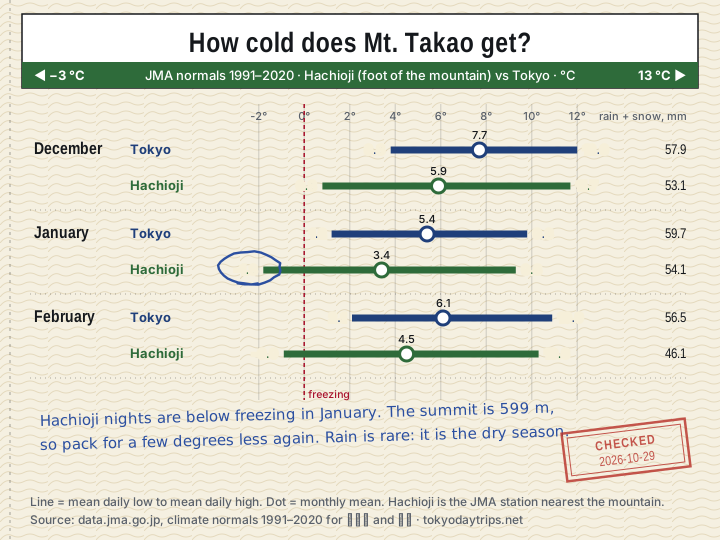
Three things follow from the table. First, the afternoons are mild: Hachioji's daily high in January is 9.3 °C, almost Tokyo's 9.8 °C, so the walk up in the midday sun is a jumper-and-windbreaker walk, not an expedition. Second, the nights are the difference. Hachioji's daily low is below zero in January and February, and the summit is 599 m above sea level, well above the city station, so expect the top to run a few degrees under the table again (our estimate from the height difference; the agency publishes no summit figure). Ground that froze overnight stays frozen in the shade until late morning. That is the cold the Visitor Center's winter list counts on for its "ice flowers", the ice ribbons that grow on the stems of the shimobashira plant, and it is where shoes with grip earn their place. Third, it is the dry season: 46–54 mm a month at Hachioji is under half of what the Hakone gauge collects in the same months, so a wet day is the exception and a snowy one rarer still. The Hachioji table records precipitation, not snow depth, so there is no official snow average to give you.
Which trail in winter
- Trail 1 (Omotesando, 3.8 km, 100 minutes up, 80 down) is the main route, with Yakuoin, five toilets and the shops at the cable car station on the way. It has the most people and the most facilities, and it is the one to walk down in the dusk.
- Trail 6 (Biwa Waterfall, 3.3 km) is one-way uphill all day from 31 October to 6 December under the Visitor Center's notice, so until then it is an up route only. It follows the stream, and the waterfall is where you may see ascetics doing their water training even in winter.
- Trail 5, the 900 m loop around the summit, is the short cold-morning walk for the view; it is flat, and the Visitor Center is on it.
- The Inariyama ridge (3.1 km, no toilets) and Trail 4 (suspension bridge) are open too; the Visitor Center's trail page carries any closure.
The full table of every trail's length, time and toilets is in the day trip itinerary. Riding instead of walking? The cable car vs chair lift guide explains why the lift is the better ride on a cold clear morning and the worse one after 16:00.
Diamond Fuji week: the sun sets on Fuji's summit
The Ministry of Land's Kanto Fuji-view register lists the Takao–Jinba park for exactly this: around the winter solstice, seen from Mt. Takao's summit, the sun sets onto the peak of Mt. Fuji. The Visitor Center lists it among its seasonal sights, and its winter page adds that the air is at its clearest in these months, which is why the view west is better in January than in May.
The arithmetic of seeing it is the arithmetic of the clock above. Sunset is 16:31 on the solstice, 22 December 2026, and the viewing is the quarter hour before. The last cable car down is 17:15 on a weekday and 17:30 at the weekend, from a station partway down Trail 1. Check Takao Tozan's news page in December for the viewing days and for any extra evening cars before you fix the day; the summit observation deck, facing west, is the spot. On the solstice itself Yakuoin holds its Hoshi Matsuri (star festival) on 22 December in the main hall, so the temple is busy on the way down.
What a winter day costs
Winter does not change the fares. The two exceptions are the New Year days.
| Price | Winter note | |
|---|---|---|
| Keio, Shinjuku to Takaosanguchi | ¥430 each way (child ¥220) | same all year |
| Cable car or chair lift | ¥490 one way, ¥980 return (child ¥250 / ¥500) | same fare on both; lift stops at 16:00 |
| Mt. Takao Ticket from Shinjuku (train both ways + ride both ways) | ¥1,450 (child ¥740); ¥1,090 with a one-way ride | not sold 31 December–3 January |
| Keio Takaosan Onsen Gokurakuyu | ¥1,100 weekdays, ¥1,300 weekends and holidays (child ¥550 / ¥650) | ¥1,300 every day from 29 December to 3 January |
| TAKAO 599 MUSEUM, Visitor Center | free | museum closed 3 December and 4 March |
So a weekday in January with the cable car both ways and a bath is ¥1,450 + ¥1,100 = ¥2,550 per adult with the Mt. Takao Ticket, the same as in October. On 2 January the same day is ¥430 × 2 + ¥980 + ¥1,300 = ¥3,140, because the ticket is off sale and the onsen is on its peak rate. The Mt. Takao cost calculator prices the other combinations, and the onsen guide has the bath's rules, including the tattoo ban. The train itself is the same on a winter morning as any other; the Tokyo to Mt. Takao train guide covers the Keio fare bands and the Mt. TAKAO reserved-seat train.
Dates inside the season
From Yakuoin's 2026 calendar and the Hachioji tourism association:
- 8 December: Jodo-e, the enlightenment day service, at the stupa.
- 19 December: Nosatsu Kuyo, the great fire rite that burns the year's returned amulets, in the car-blessing hall plaza at the mountain's base.
- 22 December: Hoshi Matsuri on the winter solstice, main hall. Diamond Fuji week.
- 31 December: Ninen-mairi, the year-crossing visit, at Yakuoin.
- 1 January: Geiko-sai, the first-sunrise service, in the plaza in front of the goma reception. Sunrise in the Tokyo table is 6:50. The regular cable car starts at 8:00, so a summit sunrise means walking up in the dark unless the operator's New Year notice lists night cars; Takao Tozan posts that notice in December.
- 29 December–3 January: onsen peak rate. 31 December–3 January: no Mt. Takao Ticket.
- 3 February: Setsubun service at the main hall. 15 February: Nehan-e at the stupa.
- Mid-February to mid-March: the Takao Baigo plum groves come into flower, on the association's winter list. Its winter soba campaign (¥100 off a bowl of ¥800 or more at 14 shops, with a flyer from Keio stations) ran from 7 February to 15 March in 2026; the 2027 dates go up on the same page.
- Second Sunday of March (14 March 2027): Hiwatari-sai, the fire-walking festival, in the same plaza at the base. The temple's page says members of the public may walk the embers after the ascetics; the fire-crossing certificate worn for it is ¥500 on the day.
Want the winter lights as well? One JR stop past Takao, the Sagamiko Illumillion runs through the season; the Sagamiko Illumillion calculator prices it by date and shows the bus. And if you are weighing Takao against Hakone for a cold-season day, the Hakone in winter guide is the same kind of page for the other mountain: there, the ropeway's 16:15 is the clock.
Rather have a guide on a winter morning?
- Mt. Takao hiking tours on Viator guided hikes from Tokyo, some with the onsen afterwards
- Mt. Takao tours and tickets on Klook day tours and combination listings
PR Affiliate links (disclosure): booking through them supports this site at no extra cost. Prices on partner sites may differ from the official prices on this page.
Frequently asked questions
Is Mt. Takao open in winter?
Yes. The cable car and chair lift run every day, Yakuoin is open, the Visitor Center at the summit keeps its 10:00–16:00 hours (closed Mondays and over the New Year holidays), and the TAKAO 599 MUSEUM moves to 8:00–16:00 from December to March. Only the Beer Mount, the summer-season terrace, is closed. What shortens is the day: last cable car 17:15 on weekdays, 17:30 at weekends.
Does it snow on Mt. Takao?
The Meteorological Agency's Hachioji station averages 53–54 mm of precipitation in December and January, well under half of Hakone's, with a January mean of 3.4 °C, so most winter days are dry and clear. The station records precipitation, not snow depth, so there is no official snowfall average for the mountain. When snow does fall it lies longest on the shaded upper sections, where the daily lows are below zero.
Can I see Mt. Fuji from Mt. Takao in winter?
Winter is the season for it. The summit is on the Ministry of Land's Kanto Fuji-view register, and the Visitor Center's winter page says the air is clearest in these months. Around the solstice the setting sun lands on Fuji's peak (Diamond Fuji); see the section above for the timing against the last cable car.
Is the onsen more expensive in winter?
Only on six days. Keio Takaosan Onsen Gokurakuyu charges ¥1,100 on weekdays and ¥1,300 on weekends and holidays all year, and its peak rate of ¥1,300 applies every day from 29 December to 3 January. Hours stay 8:00–22:30 with last entry at 21:45.
Why is the Mt. Takao Ticket not sold at New Year?
Keio's discount page lists 31 December to 3 January as the days it is not on sale. On those days pay the regular ¥430 fare each way and ¥980 for the ride both ways, ¥390 more per adult than the ticket.
Official sources (checked 2026-10-29)
- Cable car and chair lift fares and first and last departures by month (Takao Tozan Electric Railway, Japanese)
- TAKAO 599 MUSEUM: hours by season, admission, closed days, access
- Takao Visitor Center: hours, closed days, admission, trail notices
- Trail 6 one-way uphill, 31 October to 6 December 2026 (Takao Visitor Center)
- Seasonal nature information, winter views and Diamond Fuji (Takao Visitor Center)
- Yakuoin annual calendar 2026: December, New Year, Setsubun and Nehan-e dates (Takaosan Yakuoin, Japanese)
- Fire-walking festival: second Sunday of March, public participation, certificate fee (Takaosan Yakuoin, Japanese)
- Winter on Mt. Takao: plum groves, winter soba campaign (Hachioji Tourism Convention Association, Japanese)
- Kanto Fuji-view register no. 55, Takao–Jinba park: Diamond Fuji around the solstice (MLIT Kanto Regional Development Bureau, Japanese)
- Climate normals 1991–2020, Hachioji (Japan Meteorological Agency, Japanese)
- Climate normals 1991–2020, Tokyo (Japan Meteorological Agency, Japanese)
- Sunrise and sunset in Tokyo, December 2026 (National Astronomical Observatory of Japan)
- Sunrise and sunset in Tokyo, January 2027 (National Astronomical Observatory of Japan)
- Sunrise and sunset in Tokyo, February 2027 (National Astronomical Observatory of Japan)
- Keio fares and the Mt. Takao Ticket, including the days it is not sold (Keio, English)
- Keio Takaosan Onsen Gokurakuyu: admission, peak days, hours (Japanese) Hours, dates and prices change. Always confirm with the operator before you travel.
More for your trip
- Hakone Freepass calculator: single tickets vs the pass for your Hakone rides
- Enoshima & Kamakura calculator: single tickets vs Noriorikun vs Freepass
- Japan tax-free refund calculator: the new system from 1 Nov 2026
- Yokohama day trip cost calculator: single tickets vs the Minatomirai, JR and Tokyu passes
- Mt. Takao day trip cost calculator: single tickets vs the Mt. Takao Ticket
- Kawagoe day trip cost calculator: Kawagoe Discount Pass vs Koedo Kawagoe Coupon
- Mt. Oyama day trip cost calculator: Tanzawa-Oyama Freepass A vs B vs single tickets
- Odawara day trip cost calculator: Odakyu vs Romancecar vs JR vs Shinkansen, plus Odawara Castle tickets
- Misaki Maguro Kippu calculator: does the Keikyu tuna ticket pay off for your trip
- Kamakura temple entrance fees calculator: Great Buddha, Hasedera, Hokokuji, Engakuji and Kenchoji for your group
- Enoshima island tickets calculator: escar, Sea Candle, Iwaya Caves and aquarium: single tickets vs the 1day and Area Passport
- Yokohama Cosmo World tickets calculator: ride prices and the cheapest discount ticket for your group
- Yokohama Anpanman Children's Museum tickets calculator: price by date, family total, sale date and cancellation fee
- Hako Ticket calculator: unlimited entry to 20 Hakone hot springs and museums: does it pay off for your plan
- Hakone Yunessun tickets calculator: price by date, Passport vs Mori no Yu, rentals and tattoo rules
- Hakone museums tickets calculator: Pola, Okada, Open-Air, Glass Forest and more: Freepass discounts and your group total
- Sagamiko Illumillion tickets calculator: winter lights: price by date, night free pass and the JR + bus route from Shinjuku
- Hakone Kamakura Pass calculator: one 3-day pass for both areas vs two Freepasses vs single tickets
- Sarushima Island ferry calculator: ferry and admission by fare day, timetable and the train from Tokyo
- Yokosuka Naval Port Tour calculator: cruise price by fare day, booking and whether the Mankitsu Kippu pays
- Hakone day trip from Tokyo: cost and route: three budgets and the loop in order
- Hakone Freepass: the break-even math
- Kamakura and Enoshima day trip: cost: which pass to buy
- Kamakura day trip itinerary: one-day route with Enoshima, closing times and cost
- Hakone or Kamakura? Day trip compared: cost, time, closing times and a 3-question chart
- Hakone to Kamakura by train: Hakone-Yumoto to Odawara, JR to Ofuna, Yokosuka Line to Kamakura: minutes from the official timetables and which pass covers which leg
- Yokohama to Hakone by train: Tokaido Line or the Shinkansen from Shin-Yokohama to Odawara, the Tozan Train to Hakone-Yumoto, the Freepass sold at Odawara, and why the Yokohama bus no longer reaches Hakone
- Yokohama day trip with kids: family train cost: child fares and the cheapest ticket for a family
- Yokohama Red Brick Christmas Market 2026: dates, hours, ticket prices and free days
- Yokohama day trip itinerary: one-day route, opening hours and cost
- Hakone day trip itinerary: the one-day loop in order, ride times and the last boat
- Mt. Takao day trip itinerary: which trail, official hiking times and the last cable car
- Mt. Takao cable car vs chair lift: same ¥490 fare, hours by month, the ¥1,450 Mt. Takao Ticket and which ride to take
- Mt. Takao autumn leaves festival 2026: 24 Oct – 13 Dec, peak mid-Nov to early Dec, the Fri–Sun light-up along the cable car line and the ¥1,450 trip from Shinjuku
- Tokyo to Mt. Takao by train: Keio from Shinjuku or Shibuya for ¥430, the JR Chuo Line change at Takao, the Mt.TAKAO train times and the Mt. Takao Ticket price from every station
- Mt. Takao onsen: ¥1,100 weekday bath next to Takaosanguchi Station, hours, the strict tattoo rule and the ¥3,480 weekday Yuttari Kippu
- Hakone Romancecar tickets: price, how to book, observation seats and luggage
- Hakone day-use onsen: prices, hours and tattoo rules for a hot spring on a day trip
- Hakone luggage: storage and hotel delivery: drop times, prices and lockers for a suitcase in Hakone
- Kawagoe day trip itinerary: one-day route in loop-bus order, bus times, opening hours and cost
- Hakone pirate ship tickets: Lake Ashi cruise prices, which ticket is cheapest and the timetable
- Hakone Open-Air Museum tickets: counter vs online vs Freepass price, hours and access
- Hakone Shrine: hours, access and fees: bus or pirate ship to Moto-Hakone-ko, Treasure Hall and goshuin prices, Kuzuryu Shrine and Hakone Motomiya
- Hakone Checkpoint (Sekisho) tickets: ¥500 entry, ¥400 with the Freepass, hours and the 5-minute walk from the pirate ship pier
- Hakone Gora Park tickets: ¥650 or free with the Freepass, hours, the cheaper cable car stop and Craft House prices
- Hakone Ropeway tickets and Owakudani: flat fare, hours, which pass, black eggs and the guided nature trail
- Cup Noodles Museum Yokohama tickets: admission, make your own cup noodle, Chicken Ramen Factory booking and hours
- Hakone Tozan Railway tickets: fares for every station, the 1-day pass, IC cards and last trains
- Enoshima Aquarium tickets calculator: price, pass discounts, the Odakyu set ticket from Shinjuku and dolphin show times
- Hakkeijima Sea Paradise tickets: aquarium and ride passes, which one to buy and the cheap Keikyu ticket from Tokyo
- Yokohama Air Cabin tickets: ropeway prices, the Ferris wheel set ticket, hours and closing days
- Yokohama Sea Bass ferry: water bus fares between the four piers, which boats skip Red Brick, and boat vs train
- Yokohama bay cruise prices: ¥2,000 harbour loop, ¥3,000 night cruise, factory night cruise and Marine Rouge dinner: times, piers, child fares and booking rules
- Sankeien Garden tickets: entrance fee, hours, every bus route and the Minato Burari discount
- Minato Burari Ticket (Yokohama bus and subway day pass): ¥700 or ¥750 Wide, what it covers and what it does not, every single fare, the Akai Kutsu loop and four day plans with the math
- Enoden 1-day pass (Noriorikun): price, every Enoden fare, where to buy and six day plans with the math
- Yokohama Marine Tower tickets: day and night prices, the 1-day pass, closing days and the Landmark Sky Garden closure
- Shin-Yokohama Ramen Museum tickets: entrance fee, ¥750 mini bowls at every shop, payment rules and the subway from Yokohama
- Kirin Brewery Yokohama tour: ¥1,000 from Oct 2026, when booking opens, the tasting, drinking rules and the walk from Namamugi
- Hakone bus guide: route letters, which buses take the Freepass, fares and how to pay
- Shinjuku to Hakone highway bus: ¥2,560 to Lake Ashi with no change: every stop and fare, booking in English and bus vs Romancecar
- Zoorasia (Yokohama Zoo) tickets: ¥800 adults, kids free on Saturdays, Tuesday closing, the bus from each station and Zoorasia vs Ueno Zoo
- Kamakura Great Buddha: ¥300 entry, ¥50 to go inside, hours, goshuin dates and the food rule at the gate
- Hokokuji bamboo temple: ¥400 garden, ¥600 matcha at the tea house, hours and the bus to Jomyoji
- Zeniarai Benten and Sasuke Inari: the free money-washing shrine: hours, the five washing steps, Snake days to 2027 and the 49 torii next door
- Kamakura hiking trails: Daibutsu, Tenen and Gion-yama courses: walking times, fees on the way and the free Tenen entrance
- Fujiko F. Fujio Museum (Doraemon Museum) tickets: price, when online sales open, the 60-minute entry rule and the shuttle bus from Noborito
- Hasedera temple, Kamakura: ¥400 entry, hours by season, the cave, hydrangea dates and goshuin
- Kita-Kamakura temples: Engakuji, Tokeiji, Jochiji, Meigetsuin and Kenchoji: fees, hours and the walk to Kamakura Station