Hakone in Winter (December–February): Ropeway Until 16:15, Replacement-Bus Dates, Official Temperatures and What the Day Costs
Winter takes about 45 minutes off a Hakone day. From December to January the Hakone Ropeway stops boarding at 16:15 instead of 17:00, and the sun is down at 16:28 on 1 December in the Tokyo table of the National Astronomical Observatory, so the clockwise loop (train, cable car, ropeway, boat, bus) has to reach Sounzan by about 15:30. The second thing winter changes is the ropeway itself: the operator has announced that Owakudani–Sounzan is a replacement bus from 7 to 24 December 2026, and Togendai–Ubako–Owakudani from 12 January to 26 February 2027. The Freepass is valid on those buses. The cold is real but measured: Hakone Navi's own table gives Hakone-machi a January average of 0.4 °C against Tokyo's 5.4 °C in the Meteorological Agency's normals, with lows of −9.1 °C. The prices do not move. Everything here is from the operators' and agencies' pages, checked 2026-10-23.
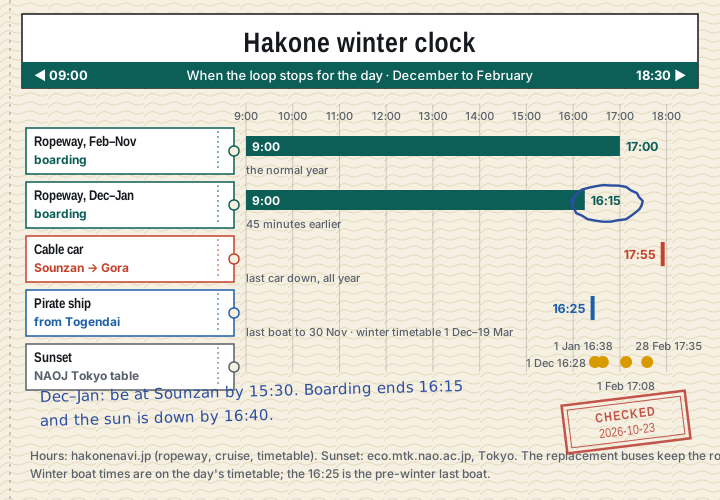
The day is shorter: last departures in winter
| Service | February–November | December–January | Source |
|---|---|---|---|
| Hakone Ropeway, boarding | 9:00–17:00 | 9:00–16:15 | Hakone Navi, ropeway page |
| Cable car, last car down Sounzan → Gora | 17:55 | 17:55 | Hakone Navi timetable |
| Pirate ship, last boat from Togendai | 16:25 (to 30 November) | winter timetable 1 December–19 March; some sailings take longer | Hakone Navi, cruise page |
| Replacement buses during the ropeway closures | – | run during ropeway hours, about every 15 minutes | Odakyu Hakone notice, July 2026 |
Sunset, from the observatory's Tokyo table: 16:28 on 1 December, 16:37 on 31 December, 16:38 on 1 January, 17:07 on 31 January, 17:08 on 1 February, 17:35 on 28 February. December is the dark month; by late February the evening is back to where it was in early November. The sunrise moves the other way, from 6:32 on 1 December to 6:50 at the turn of the year, so an early Romancecar still arrives in daylight.
What this means for the order you ride: the Hakone day trip itinerary runs the loop clockwise, Yumoto → Gora → Sounzan → Owakudani → Togendai → Moto-Hakone → Yumoto. In winter the ropeway's 16:15 is the gate, and the lake is in shadow before that; a boat at 15:00 or so gives you light on the water, which puts you at Sounzan by about 14:00 and at Yumoto on a morning Romancecar. Anticlockwise (bus to Moto-Hakone first, boat, then ropeway up) is the riskier direction in winter, because the ropeway is the last ride and the first to shut.
Two ropeway sections become a bus
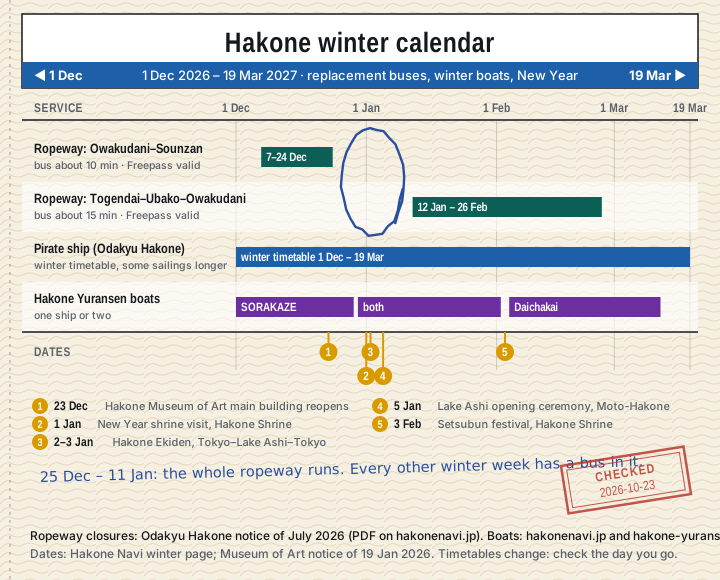
The Hakone Ropeway closes part of its line every winter for inspection. For 2026–27 the operator's notice (July 2026) says:
- 7–24 December 2026 (18 days): Owakudani ⇄ Sounzan closed. Replacement bus, about 10 minutes one way, roughly every 15 minutes, during ropeway hours.
- 12 January–26 February 2027 (46 days): Togendai ⇄ Ubako ⇄ Owakudani closed. Replacement bus, about 15 minutes one way, same frequency.
Ropeway tickets and the Hakone Freepass are valid on the buses. The notice warns that the buses get crowded and that the road can be slow, and it suggests riding the section that is still open. Owakudani stays reachable in both periods, from the other side. The ropeway and Owakudani guide has the fares (¥2,000 one way for any distance) and the stopover rule.
The boats change too. The Odakyu Hakone pirate ship uses a winter timetable from 1 December to 19 March, and its page says some sailings take longer in that period. The other company on the lake, Hakone Yuransen, sails the SORAKAZE alone until 29 December (last Moto-Hakone-bound boat 16:30 from Sekisho-ato), both ships from 30 December to 2 February, and the Daichakai alone from 4 February to 12 March, when the last loop ends at Moto-Hakone at 16:00. The Lake Ashi cruise guide compares the two companies.
How cold: the official monthly figures, side by side
Hakone Navi, the Odakyu Hakone group's site, publishes monthly temperatures for Hakone-machi on its winter page. The Japan Meteorological Agency's 1991–2020 normals give Tokyo and Odawara for comparison. The agency's Hakone gauge records rain and snow water but not temperature, so Hakone-machi is the operator's figure and the other two are the agency's.
| Month | Hakone-machi: average / high / low (Hakone Navi) | Odawara: mean, daily max, daily min (JMA) | Tokyo: mean, daily max, daily min (JMA) | Precipitation, Hakone / Tokyo (JMA) |
|---|---|---|---|---|
| December | 3.4 / 14.5 / −6.9 °C | 7.8 / 13.0 / 3.1 °C | 7.7 / 12.0 / 3.8 °C | 107.9 / 57.9 mm |
| January | 0.4 / 10.1 / −9.1 °C | 5.3 / 10.6 / 0.6 °C | 5.4 / 9.8 / 1.2 °C | 127.7 / 59.7 mm |
| February | 1.7 / 13.2 / −8.3 °C | 6.1 / 11.3 / 1.3 °C | 6.1 / 10.9 / 2.1 °C | 151.3 / 56.5 mm |
Two readings. First, Hakone-machi's January average is 5 °C below Tokyo's. The operator's page does not say whether its high and low are daily averages or the month's extremes; set against Odawara's daily-average low of 0.6 °C, the −9.1 °C reads as the coldest night of the month, not a typical afternoon on the ropeway. Second, the agency's Hakone gauge collects two to nearly three times Tokyo's winter precipitation, and with the average near freezing some of it falls as snow: Hakone Navi's own words are "there are snowy days during winter in Hakone" and "high-elevation regions are especially chilly". Owakudani is the highest station on the ropeway. A coat, hat and gloves are what the operator asks you to bring; shoes with grip are for paths that can freeze overnight at those lows. Odawara, at the bottom of the Tozan line, is as mild as Tokyo.
What the day costs in winter
The Hakone Freepass has one price table all year (valid from 1 October 2025), and the replacement buses are inside it.
| Single tickets | With the Hakone Freepass | |
|---|---|---|
| Shinjuku to Hakone-Yumoto by Romancecar | ¥1,270 fare + ¥1,200 seat fee = ¥2,470 each way | 2-day pass from Shinjuku ¥7,100 (child ¥1,600); 3-day ¥7,500 (child ¥1,850); the seat fee is extra |
| Starting at Odawara | – | 2-day pass from Odawara ¥6,000 (child ¥1,500); 3-day ¥6,400 (child ¥1,750) |
| Tozan Train, cable car, ropeway, boat, bus: the loop from Yumoto on single tickets | ¥5,800 | included, replacement buses included |
| Ropeway alone | ¥2,000 one way, ¥3,000 round trip | included |
The loop on single tickets costs ¥5,800 from Yumoto, so the ¥6,000 pass from Odawara is already even on the loop alone and the ¥7,100 pass from Shinjuku beats two Romancecar fares plus the loop (¥2,540 + ¥5,800 = ¥8,340 on single tickets, seat fees aside). The Freepass break-even guide runs the cases where it does not pay. For the Romancecar itself, winter seats are the same ¥1,200 fee; the Romancecar ticket guide covers booking.
A winter day in Hakone usually has an onsen in it. The day-use onsen guide compares three baths with official prices and hours, and the Yunessun ticket calculator prices the swimsuit hot spring park by date.
Dates inside the season
- 23 December 2026: the Hakone Museum of Art's main building reopens after its renovation (annex and café already open since 30 October at a ¥1,000 pre-opening rate). Closed Thursdays.
- 1 January: New Year shrine visit (hatsumode) and the Seven Gods of Fortune round at Hakone Shrine and others, on Hakone Navi's winter list.
- 2–3 January: the Hakone Ekiden, the university relay from Tokyo to Lake Ashi and back, 217.1 km in ten legs. The outward race finishes at the lake on the 2nd and the return starts there on the 3rd. The road through Hakone is the course, so expect crowds and traffic controls around Moto-Hakone and Hakone-Yumoto on both mornings; the race organiser's traffic notices go up on its site before the race.
- 5 January: Lake Ashi opening ceremony at Moto-Hakone, on Hakone Navi's list.
- 3 February: Setsubun festival at Hakone Shrine.
- 1 December–19 March: pirate ship winter timetable. 7–24 December and 12 January–26 February: ropeway replacement buses (above).
If the ropeway matters more to you than the New Year, the weeks to pick are 25 December to 11 January: the only part of winter when all three sections run. If you would rather not meet the Ekiden crowd, keep off 2 and 3 January; if you want to see it, Moto-Hakone on the morning of the 2nd is where the first day ends.
Rather have the winter connections arranged?
- Hakone day tours from Tokyo on Viator coach tours that fix the order and the times, replacement buses included
- Hakone Freepass and tours on Klook Freepass, Romancecar and tour listings
PR Affiliate links (disclosure): booking through them supports this site at no extra cost. Prices on partner sites may differ from the official prices on this page.
Frequently asked questions
Is the Hakone Ropeway open in winter?
Yes, with shorter hours (boarding 9:00–16:15 in December and January) and one section replaced by a bus for two periods: Owakudani–Sounzan from 7 to 24 December 2026 and Togendai–Ubako–Owakudani from 12 January to 26 February 2027. The whole line runs from 25 December to 11 January. It also stops for wind of 30 m/s or more and in extreme weather; check the operator's status page on the day.
Does it snow in Hakone?
Hakone Navi says there are snowy days in winter and that the high areas are the coldest. The Meteorological Agency's Hakone gauge averages 128 mm of precipitation in January against Tokyo's 60 mm, with Hakone-machi's January average at 0.4 °C on the operator's table, so some of it is snow. Snow depth is not recorded at that gauge, so there is no official average to quote.
What time does a Hakone day end in December?
Ropeway boarding ends at 16:15, the sun sets at 16:28 on 1 December and 16:37 on the 31st, and the last cable car down from Sounzan is at 17:55. Be at Sounzan by about 15:30 if you are riding the loop clockwise.
Is the Hakone Freepass worth it in winter?
The price is the same as in any season: ¥7,100 for 2 days from Shinjuku, ¥6,000 from Odawara. The loop on single tickets is ¥5,800 from Yumoto, and the replacement buses are covered by the pass, so the arithmetic does not change with the season.
What happens in Hakone on 2 and 3 January?
The Hakone Ekiden runs from Tokyo to Lake Ashi on the 2nd and back on the 3rd. The finish and the next day's start are at the lake, so Moto-Hakone and the road from Hakone-Yumoto are busy both mornings.
Official sources (checked 2026-10-23)
- Hakone Ropeway: hours by month, ride times, suspension conditions (Odakyu Hakone, English)
- Ropeway inspection closures 2026–27 and replacement buses (Odakyu Hakone notice, July 2026, PDF)
- Hakone Sightseeing Cruise: winter timetable period, sailing times, weather rule (Odakyu Hakone, English)
- Winter in Hakone: monthly temperatures for Hakone-machi, snow, New Year dates (Odakyu Hakone, English)
- Hakone Freepass prices from 1 October 2025 (Odakyu Hakone, English)
- Hakone Yuransen winter schedule (Izuhakone Railway, Japanese)
- Hakone Museum of Art renovation closure and staged reopening
- Hakone Ekiden: course and distance (Kanto Student Athletic Federation, Japanese)
- Climate normals 1991–2020, Hakone gauge (Japan Meteorological Agency, Japanese)
- Climate normals 1991–2020, Odawara (Japan Meteorological Agency, Japanese)
- Climate normals 1991–2020, Tokyo (Japan Meteorological Agency, Japanese)
- Sunrise and sunset in Tokyo, December 2026 (National Astronomical Observatory of Japan)
- Sunrise and sunset in Tokyo, January 2027 (National Astronomical Observatory of Japan)
- Sunrise and sunset in Tokyo, February 2027 (National Astronomical Observatory of Japan)
- Romancecar fares and seat fees (Odakyu) Hours, dates and prices change. Always confirm with the operator before you travel.
More for your trip
- Hakone Freepass calculator: single tickets vs the pass for your Hakone rides
- Enoshima & Kamakura calculator: single tickets vs Noriorikun vs Freepass
- Japan tax-free refund calculator: the new system from 1 Nov 2026
- Yokohama day trip cost calculator: single tickets vs the Minatomirai, JR and Tokyu passes
- Mt. Takao day trip cost calculator: single tickets vs the Mt. Takao Ticket
- Kawagoe day trip cost calculator: Kawagoe Discount Pass vs Koedo Kawagoe Coupon
- Mt. Oyama day trip cost calculator: Tanzawa-Oyama Freepass A vs B vs single tickets
- Odawara day trip cost calculator: Odakyu vs Romancecar vs JR vs Shinkansen, plus Odawara Castle tickets
- Misaki Maguro Kippu calculator: does the Keikyu tuna ticket pay off for your trip
- Kamakura temple entrance fees calculator: Great Buddha, Hasedera, Hokokuji, Engakuji and Kenchoji for your group
- Enoshima island tickets calculator: escar, Sea Candle, Iwaya Caves and aquarium: single tickets vs the 1day and Area Passport
- Yokohama Cosmo World tickets calculator: ride prices and the cheapest discount ticket for your group
- Yokohama Anpanman Children's Museum tickets calculator: price by date, family total, sale date and cancellation fee
- Hako Ticket calculator: unlimited entry to 20 Hakone hot springs and museums: does it pay off for your plan
- Hakone Yunessun tickets calculator: price by date, Passport vs Mori no Yu, rentals and tattoo rules
- Hakone museums tickets calculator: Pola, Okada, Open-Air, Glass Forest and more: Freepass discounts and your group total
- Sagamiko Illumillion tickets calculator: winter lights: price by date, night free pass and the JR + bus route from Shinjuku
- Hakone Kamakura Pass calculator: one 3-day pass for both areas vs two Freepasses vs single tickets
- Sarushima Island ferry calculator: ferry and admission by fare day, timetable and the train from Tokyo
- Yokosuka Naval Port Tour calculator: cruise price by fare day, booking and whether the Mankitsu Kippu pays
- Hakone day trip from Tokyo: cost and route: three budgets and the loop in order
- Hakone Freepass: the break-even math
- Kamakura and Enoshima day trip: cost: which pass to buy
- Kamakura day trip itinerary: one-day route with Enoshima, closing times and cost
- Hakone or Kamakura? Day trip compared: cost, time, closing times and a 3-question chart
- Hakone to Kamakura by train: Hakone-Yumoto to Odawara, JR to Ofuna, Yokosuka Line to Kamakura: minutes from the official timetables and which pass covers which leg
- Yokohama to Hakone by train: Tokaido Line or the Shinkansen from Shin-Yokohama to Odawara, the Tozan Train to Hakone-Yumoto, the Freepass sold at Odawara, and why the Yokohama bus no longer reaches Hakone
- Yokohama day trip with kids: family train cost: child fares and the cheapest ticket for a family
- Yokohama Red Brick Christmas Market 2026: dates, hours, ticket prices and free days
- Yokohama day trip itinerary: one-day route, opening hours and cost
- Hakone day trip itinerary: the one-day loop in order, ride times and the last boat
- Mt. Takao day trip itinerary: which trail, official hiking times and the last cable car
- Mt. Takao cable car vs chair lift: same ¥490 fare, hours by month, the ¥1,450 Mt. Takao Ticket and which ride to take
- Mt. Takao autumn leaves festival 2026: 24 Oct – 13 Dec, peak mid-Nov to early Dec, the Fri–Sun light-up along the cable car line and the ¥1,450 trip from Shinjuku
- Tokyo to Mt. Takao by train: Keio from Shinjuku or Shibuya for ¥430, the JR Chuo Line change at Takao, the Mt.TAKAO train times and the Mt. Takao Ticket price from every station
- Mt. Takao onsen: ¥1,100 weekday bath next to Takaosanguchi Station, hours, the strict tattoo rule and the ¥3,480 weekday Yuttari Kippu
- Hakone Romancecar tickets: price, how to book, observation seats and luggage
- Hakone day-use onsen: prices, hours and tattoo rules for a hot spring on a day trip
- Hakone luggage: storage and hotel delivery: drop times, prices and lockers for a suitcase in Hakone
- Kawagoe day trip itinerary: one-day route in loop-bus order, bus times, opening hours and cost
- Hakone pirate ship tickets: Lake Ashi cruise prices, which ticket is cheapest and the timetable
- Hakone Open-Air Museum tickets: counter vs online vs Freepass price, hours and access
- Hakone Shrine: hours, access and fees: bus or pirate ship to Moto-Hakone-ko, Treasure Hall and goshuin prices, Kuzuryu Shrine and Hakone Motomiya
- Hakone Checkpoint (Sekisho) tickets: ¥500 entry, ¥400 with the Freepass, hours and the 5-minute walk from the pirate ship pier
- Hakone Gora Park tickets: ¥650 or free with the Freepass, hours, the cheaper cable car stop and Craft House prices
- Hakone Ropeway tickets and Owakudani: flat fare, hours, which pass, black eggs and the guided nature trail
- Cup Noodles Museum Yokohama tickets: admission, make your own cup noodle, Chicken Ramen Factory booking and hours
- Hakone Tozan Railway tickets: fares for every station, the 1-day pass, IC cards and last trains
- Enoshima Aquarium tickets calculator: price, pass discounts, the Odakyu set ticket from Shinjuku and dolphin show times
- Hakkeijima Sea Paradise tickets: aquarium and ride passes, which one to buy and the cheap Keikyu ticket from Tokyo
- Yokohama Air Cabin tickets: ropeway prices, the Ferris wheel set ticket, hours and closing days
- Yokohama Sea Bass ferry: water bus fares between the four piers, which boats skip Red Brick, and boat vs train
- Yokohama bay cruise prices: ¥2,000 harbour loop, ¥3,000 night cruise, factory night cruise and Marine Rouge dinner: times, piers, child fares and booking rules
- Sankeien Garden tickets: entrance fee, hours, every bus route and the Minato Burari discount
- Minato Burari Ticket (Yokohama bus and subway day pass): ¥700 or ¥750 Wide, what it covers and what it does not, every single fare, the Akai Kutsu loop and four day plans with the math
- Enoden 1-day pass (Noriorikun): price, every Enoden fare, where to buy and six day plans with the math
- Yokohama Marine Tower tickets: day and night prices, the 1-day pass, closing days and the Landmark Sky Garden closure
- Shin-Yokohama Ramen Museum tickets: entrance fee, ¥750 mini bowls at every shop, payment rules and the subway from Yokohama
- Kirin Brewery Yokohama tour: ¥1,000 from Oct 2026, when booking opens, the tasting, drinking rules and the walk from Namamugi
- Hakone bus guide: route letters, which buses take the Freepass, fares and how to pay
- Shinjuku to Hakone highway bus: ¥2,560 to Lake Ashi with no change: every stop and fare, booking in English and bus vs Romancecar
- Zoorasia (Yokohama Zoo) tickets: ¥800 adults, kids free on Saturdays, Tuesday closing, the bus from each station and Zoorasia vs Ueno Zoo
- Kamakura Great Buddha: ¥300 entry, ¥50 to go inside, hours, goshuin dates and the food rule at the gate
- Hokokuji bamboo temple: ¥400 garden, ¥600 matcha at the tea house, hours and the bus to Jomyoji
- Zeniarai Benten and Sasuke Inari: the free money-washing shrine: hours, the five washing steps, Snake days to 2027 and the 49 torii next door
- Kamakura hiking trails: Daibutsu, Tenen and Gion-yama courses: walking times, fees on the way and the free Tenen entrance
- Fujiko F. Fujio Museum (Doraemon Museum) tickets: price, when online sales open, the 60-minute entry rule and the shuttle bus from Noborito
- Hasedera temple, Kamakura: ¥400 entry, hours by season, the cave, hydrangea dates and goshuin
- Kita-Kamakura temples: Engakuji, Tokeiji, Jochiji, Meigetsuin and Kenchoji: fees, hours and the walk to Kamakura Station