Kamakura in Winter: Gates Shut 16:00–16:45, Sunset 16:28
Winter does two things to a Kamakura day. It closes the temple gates earlier than you expect, and it clears the sky. From December to February Engakuji stops letting people in at 16:00 (16:30 the rest of the year), the Great Buddha's gate shuts at 16:45, Hasedera's at 16:30, and the sun is down at 16:28 on 1 December in the Tokyo table of the National Astronomical Observatory. At the same time January is the sunniest month of the year on the coast: 192.7 hours in the Meteorological Agency's Yokohama normals, against 135.9 in June. It is cold but not Hakone-cold: Yokohama's January average is 6.1 °C, Tokyo's 5.4 °C, Hakone-machi's 0.4 °C. The train fares and the passes cost the same as in any season. Everything here is from the temples', operators' and agencies' own pages, checked 2026-11-07.
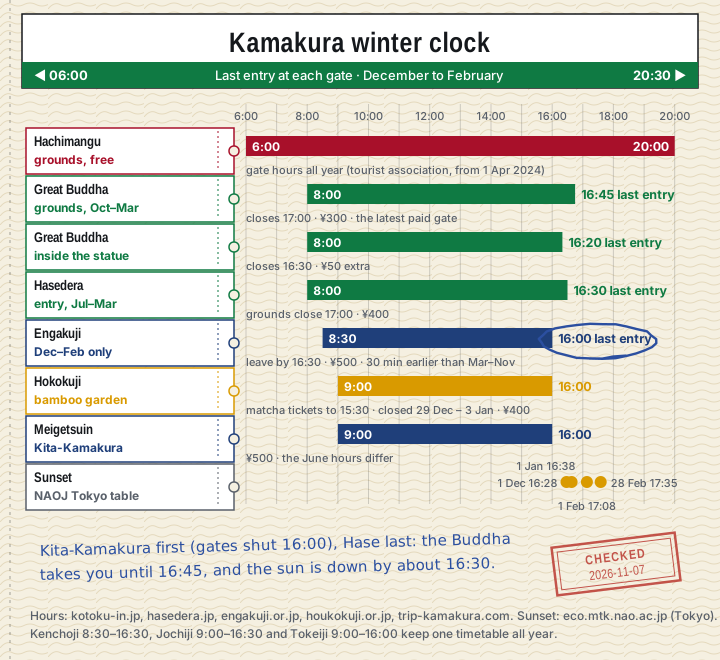
The gates: last entry in winter
| Place | Winter hours | Last entry | Fee (adult / child) | Source |
|---|---|---|---|---|
| Great Buddha (Kotoku-in), grounds | 8:00–17:00 (October–March) | 16:45 (15 minutes before closing) | ¥300 / ¥150 (6–12) | Kotoku-in, English site |
| Great Buddha, inside the statue | 8:00–16:30 all year | 16:20 (10 minutes before) | ¥50 extra per person | Kotoku-in |
| Hasedera | entry 8:00–16:30, grounds close 17:00 (July–March) | 16:30 | ¥400 / ¥200 | Hasedera, admission guide |
| Engakuji | 8:30–16:00, leave by 16:30 (December–February only) | 16:00 | ¥500 / ¥200 | Engakuji, access page |
| Kenchoji | 8:30–16:30 all year | 16:30 | ¥500 / ¥200 | Kenchoji |
| Meigetsuin | 9:00–16:00 | 16:00 | ¥500 / ¥300 | city tourist association |
| Hokokuji (bamboo garden) | 9:00–16:00; closed 29 December–3 January | 16:00 (matcha tickets to 15:30) | ¥400 / ¥200 | Hokokuji, guide page |
| Tokeiji / Jochiji | 9:00–16:00 / 9:00–16:30 | 16:00 / 16:30 | free (offering) / ¥300 | each temple's site |
| Tsurugaoka Hachimangu, grounds | 6:00–20:00 | – | free | trip-kamakura.com |
Only Engakuji prints a winter timetable; the Great Buddha's October–March hours are the same ones that start in autumn. The practical point is the order. The Kamakura day trip itinerary starts at Kita-Kamakura and walks south to Hachimangu, then rides the Enoden to Hase. In winter that is the only order that works: Engakuji and Meigetsuin close their gates at 16:00, Hasedera at 16:30, and the Great Buddha, seven minutes' walk from Hase Station, takes you until 16:45. Done the other way round, the last Kita-Kamakura gate is shut before 16:00 and you are standing outside it in the dark.
Sunset, from the observatory's Tokyo table: 16:28 on 1 December, 16:37 on 31 December, 16:38 on 1 January, 17:07 on 31 January, 17:08 on 1 February, 17:35 on 28 February. Kamakura is 45 km south-west of Tokyo, so its times differ by about a minute. December and early January are the dark weeks; by late February the evening is back to early November. Sunrise moves the other way, from 6:32 on 1 December to 6:50 at the turn of the year, which is the hour Hachimangu's gate opens.
How cold, and how clear: the official monthly figures
The Japan Meteorological Agency's station nearest to Kamakura with a full climate record is Yokohama, 20 km up the coast. Its 1991–2020 normals, next to Tokyo's and to the Hakone-machi figures published by the Hakone operator:
| Month | Yokohama: mean, daily max, daily min | Tokyo: mean, daily max, daily min | Hakone-machi: average | Yokohama rain | Yokohama sunshine |
|---|---|---|---|---|---|
| December | 8.7 / 12.5 / 5.2 °C | 7.7 / 12.0 / 3.8 °C | 3.4 °C | 66.4 mm | 178.1 h |
| January | 6.1 / 10.2 / 2.7 °C | 5.4 / 9.8 / 1.2 °C | 0.4 °C | 64.7 mm | 192.7 h |
| February | 6.7 / 10.8 / 3.1 °C | 6.1 / 10.9 / 2.1 °C | 1.7 °C | 64.7 mm | 167.2 h |
Three readings. First, the coast is a degree milder than central Tokyo at night (Yokohama's January daily low is 2.7 °C against Tokyo's 1.2 °C) and nearly 6 °C warmer than Hakone-machi on average, so the Hakone winter guide and this one describe different winters. Second, it is dry: 65 mm a month against 189 mm in June, with relative humidity in the 50s. Third, and the reason to come: January has more sunshine than any other month of the year in the Yokohama table, 192.7 hours, and December is second. Mt. Fuji across Sagami Bay from the Enoden coast (Inamuragasaki, Shichirigahama, Yuigahama) is a clear-day sight, and winter has the most clear hours. The snow line in the same table is a few centimetres a year, not a monthly figure; snow in Kamakura is the exception, and Engakuji's page says it may close for it.
What to bring follows from the numbers: an afternoon of 10–12 °C in the sun, 3 °C or less by the time the Enoden brings you back after dark, and wind on the beach. The temples are unheated; the halls you take your shoes off in (Hasedera's Kannon hall, the Great Buddha's interior) are the cold part of the day.
The dates inside the season
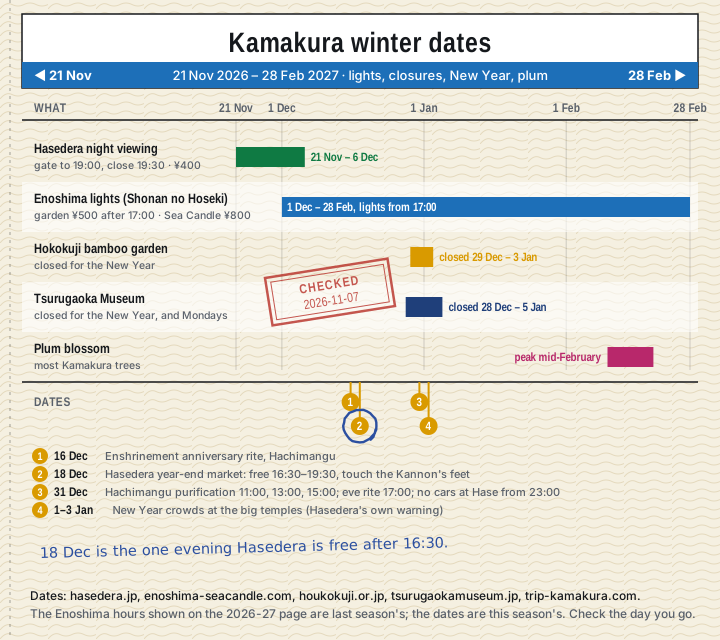
- 21 November–6 December 2026: Hasedera's autumn night viewing. The gate stays open until 19:00 (grounds close 19:30), the same ¥400 ticket, held in rain. The only weeks of the season a Kamakura temple is lit after dark.
- 1 December 2026–28 February 2027: the Enoshima illumination, Shonan no Hoseki, on the island 25 minutes down the Enoden from Kamakura. Samuel Cocking Garden ¥500 after 17:00, Sea Candle ¥800, the two together ¥1,100. The hours posted on the 2026–27 page are last season's (weekdays 17:00–20:00, weekends and 20–30 December to 21:00); the illumination guide has the ticket sets and the train back.
- 16 December: the enshrinement anniversary rite at Tsurugaoka Hachimangu.
- 18 December: Hasedera's year-end market, Toshi-no-ichi, on the temple approach from about 10:00 to 20:00: stalls selling daruma, rakes and calendars. On this day only, visitors may enter the inner sanctum of the Kannon hall and touch the feet of the statue, and entry is free from 16:30 to 19:30 (¥400 before that, as usual).
- 31 December: at Hachimangu, the great purification at 11:00, 13:00 and 15:00, the burning of old talismans at 16:00 and the New Year's Eve rite at 17:00. Hasedera's 108 bell strokes at midnight are by postcard lottery (applications had to arrive by 30 November), and the temple's notice says no cars are allowed around Hase from 23:00 and that some trains do not run overnight.
- 1–3 January: New Year visits. Hasedera's notice warns of heavy crowds through the year-end and New Year period. The shrine's own website could not be opened when this page was checked, so its New Year opening hours are not printed here; ask at the station or check the shrine's site before you go. Hokokuji is closed 29 December–3 January, the Tsurugaoka Museum 28 December–5 January, and the city's Museum of National Treasures 29 December–3 January.
- Winter peonies: Hachimangu's peony garden by the pond opens for the New Year peonies, 9:00–16:30 (last entry 16:00), separate fee; the pages we could open do not print the amount.
- Mid-February: most of Kamakura's plum trees peak, on the tourist association's flower calendar. The autumn leaves guide covers the other end of the cold season, into early December.
What the day costs in winter
Nothing on the fare side changes with the season. Per adult, from the operators' pages:
| Price | Child (6–11) | |
|---|---|---|
| Odakyu Enoshima-Kamakura Freepass from Shinjuku (one round trip to Fujisawa, unlimited Enoden, one day) | ¥1,640 | ¥430 |
| Enoden 1-day pass, Noriorikun | ¥800 | ¥400 |
| Enoden single fares: Kamakura–Hase / Kamakura–Enoshima / Fujisawa–Kamakura | ¥200 / ¥260 / ¥310 | half, rounded up to ¥10 |
| Shonan Monorail, Ofuna–Shonan-Enoshima | ¥340 | ¥170 |
| Temple fees for the winter order above: Engakuji ¥500, Meigetsuin ¥500, Hasedera ¥400, Great Buddha ¥300 (+¥50 inside) | ¥1,750 | ¥900 (6–11) |
JR fares from Tokyo and Shinjuku are not printed here because JR East's fare pages could not be opened from our network; the gate shows the fare. The Enoshima-Kamakura Freepass calculator tells you whether the Odakyu pass or single tickets win for your rides, and the temple entrance fees calculator adds up the gates for your group. A winter day with two Kita-Kamakura temples, Hasedera, the Buddha and the Enoshima lights on the way back comes to about ¥1,750 in temple fees plus ¥500 for the garden at Enoshima, before trains.
Rather have the winter day arranged?
- Kamakura day tours from Tokyo on Viator guided days that fix the order so the gates are still open
- Enoshima-Kamakura Freepass and Kamakura tickets on Klook compare with the operator prices in the table above
PR Affiliate links (disclosure): booking through them supports this site at no extra cost. Prices on partner sites may differ from the official prices on this page.
Frequently asked questions
Is Kamakura worth visiting in winter?
If you want the temples quiet and Mt. Fuji across the bay, yes: January has the most sunshine hours of any month in the Yokohama normals (192.7) and the daytime high is about 10 °C. If you want gardens in leaf or flower, no: the hydrangeas are June and the leaves are late November to early December. The gates close between 16:00 and 16:45, so it is a shorter day.
What time do Kamakura temples close in winter?
Engakuji stops entry at 16:00 from December to February (leave by 16:30). Meigetsuin, Hokokuji and Tokeiji close at 16:00 all year, Kenchoji and Jochiji at 16:30. Hasedera's last entry is 16:30 and the grounds close at 17:00. The Great Buddha's gate closes at 17:00 from October to March, last entry 16:45, and the inside of the statue at 16:30. Hachimangu's grounds are open 6:00–20:00.
How cold is Kamakura in January?
The Meteorological Agency's Yokohama normals give a January mean of 6.1 °C, a daily high of 10.2 °C and a daily low of 2.7 °C, with 64.7 mm of rain and 192.7 hours of sunshine. Tokyo is a degree colder at night; Hakone-machi averages 0.4 °C.
Does it snow in Kamakura?
Rarely. The Yokohama table records a few centimetres of snow a year, not per month, and the winter months are the driest of the year at about 65 mm. Engakuji's page says it may close in snow, so a snowy morning is the one time to check before you go.
Is anything closed over the New Year?
Hokokuji's bamboo garden is closed 29 December–3 January, the Tsurugaoka Museum 28 December–5 January and the Museum of National Treasures 29 December–3 January. The temples themselves are open and busy; Hasedera warns of heavy crowds through the period. Hachimangu's New Year hours are on the shrine's own site, which could not be opened when this page was checked.
Can I see the Enoshima illumination on a Kamakura day trip?
Yes. The lights run from 1 December 2026 to 28 February 2027 and the island is 25 minutes from Kamakura on the Enoden (¥260). Finish at the Great Buddha by 16:45, ride on from Hase to Enoshima Station, and the garden opens its night entry at 17:00 (¥500).
Official sources (checked 2026-11-07)
- Great Buddha hours, last entry and fees (Kotoku-in, English)
- Hasedera hours and fees (admission guide, Japanese)
- Hasedera New Year's Eve bell, traffic control from 23:00, crowd notice (Hasedera, Japanese)
- Hasedera autumn night viewing 21 November–6 December 2026 (Hasedera, Japanese)
- Toshi-no-ichi at Hasedera, 18 December 2026, free entry 16:30–19:30 (city tourist association event page, Japanese)
- Hachimangu 31 December rites and times (trip-kamakura.com event page)
- Hachimangu enshrinement anniversary rite, 16 December (trip-kamakura.com)
- Hachimangu grounds hours and treasure house (Kamakura City Tourist Association facility page)
- Hachimangu peony garden hours (Kanagawa Prefectural Tourism Association, Japanese)
- Plum blossom peak in mid-February (the association's flower calendar, Japanese)
- Engakuji winter hours (Engakuji, Japanese)
- Kenchoji hours (Kenchoji, Japanese)
- Hokokuji hours and New Year closure (Hokokuji, Japanese)
- Meigetsuin hours (trip-kamakura.com facility page)
- Enoshima illumination 2026–27 dates and night tickets (Enoshima Sea Candle, Japanese)
- Climate normals 1991–2020, Yokohama (Japan Meteorological Agency, Japanese)
- Climate normals 1991–2020, Tokyo (Japan Meteorological Agency, Japanese)
- Winter in Hakone: monthly temperatures for Hakone-machi (Odakyu Hakone, English)
- Sunrise and sunset in Tokyo, December 2026 (National Astronomical Observatory of Japan)
- Sunrise and sunset in Tokyo, January 2027 (National Astronomical Observatory of Japan)
- Sunrise and sunset in Tokyo, February 2027 (National Astronomical Observatory of Japan)
- Enoshima-Kamakura Freepass prices (Odakyu)
- Enoden fares and the Noriorikun 1-day pass (Enoden, Japanese)
- Shonan Monorail fares (Shonan Monorail, English) Hours, dates and prices change. Always confirm with the temple or operator before you travel.
More for your trip
- Hakone Freepass calculator: single tickets vs the pass for your Hakone rides
- Enoshima & Kamakura calculator: single tickets vs Noriorikun vs Freepass
- Japan tax-free refund calculator: the new system from 1 Nov 2026
- Yokohama day trip cost calculator: single tickets vs the Minatomirai, JR and Tokyu passes
- Mt. Takao day trip cost calculator: single tickets vs the Mt. Takao Ticket
- Kawagoe day trip cost calculator: Koedo Kawagoe Coupon vs single tickets and the Premium pass
- Mt. Oyama day trip cost calculator: Tanzawa-Oyama Freepass A vs B vs single tickets
- Odawara day trip cost calculator: Odakyu vs Romancecar vs JR vs Shinkansen, plus Odawara Castle tickets
- Misaki Maguro Kippu calculator: does the Keikyu tuna ticket pay off for your trip
- Kamakura temple entrance fees calculator: Great Buddha, Hasedera, Hokokuji, Engakuji and Kenchoji for your group
- Enoshima island tickets calculator: escar, Sea Candle, Iwaya Caves and aquarium: single tickets vs the 1day and Area Passport
- Yokohama Cosmo World tickets calculator: ride prices and the cheapest discount ticket for your group
- Yokohama Anpanman Children's Museum tickets calculator: price by date, family total, sale date and cancellation fee
- Hako Ticket calculator: unlimited entry to 20 Hakone hot springs and museums: does it pay off for your plan
- Hakone Yunessun tickets calculator: price by date, Passport vs Mori no Yu, rentals and tattoo rules
- Hakone museums tickets calculator: Pola, Okada, Open-Air, Glass Forest and more: Freepass discounts and your group total
- Sagamiko Illumillion tickets calculator: winter lights: price by date, night free pass and the JR + bus route from Shinjuku
- Hakone Kamakura Pass calculator: one 3-day pass for both areas vs two Freepasses vs single tickets
- Sarushima Island ferry calculator: ferry and admission by fare day, timetable and the train from Tokyo
- Yokosuka Naval Port Tour calculator: cruise price by fare day, booking and whether the Mankitsu Kippu pays
- Hakone day trip from Tokyo: cost and route: three budgets and the loop in order
- Hakone Freepass: the break-even math
- Kamakura and Enoshima day trip: cost: which pass to buy
- Kamakura day trip itinerary: one-day route with Enoshima, closing times and cost
- Hakone or Kamakura? Day trip compared: cost, time, closing times and a 3-question chart
- Hakone to Kamakura by train: Hakone-Yumoto to Odawara, JR to Ofuna, Yokosuka Line to Kamakura: minutes from the official timetables and which pass covers which leg
- Yokohama to Hakone by train: Tokaido Line or the Shinkansen from Shin-Yokohama to Odawara, the Tozan Train to Hakone-Yumoto, the Freepass sold at Odawara, and why the Yokohama bus no longer reaches Hakone
- Yokohama day trip with kids: family train cost: child fares and the cheapest ticket for a family
- Yokohama Red Brick Christmas Market 2026: dates, hours, ticket prices and free days
- Yokohama day trip itinerary: one-day route, opening hours and cost
- Hakone day trip itinerary: the one-day loop in order, ride times and the last boat
- Mt. Takao day trip itinerary: which trail, official hiking times and the last cable car
- Mt. Takao cable car vs chair lift: same ¥490 fare, hours by month, the ¥1,450 Mt. Takao Ticket and which ride to take
- Mt. Takao autumn leaves festival 2026: 24 Oct – 13 Dec, peak mid-Nov to early Dec, the Fri–Sun light-up along the cable car line and the ¥1,450 trip from Shinjuku
- Tokyo to Mt. Takao by train: Keio from Shinjuku or Shibuya for ¥430, the JR Chuo Line change at Takao, the Mt.TAKAO train times and the Mt. Takao Ticket price from every station
- Mt. Takao onsen: ¥1,100 weekday bath next to Takaosanguchi Station, hours, the strict tattoo rule and the ¥3,480 weekday Yuttari Kippu
- Hakone Romancecar tickets: price, how to book, observation seats and luggage
- Hakone day-use onsen: prices, hours and tattoo rules for a hot spring on a day trip
- Hakone luggage: storage and hotel delivery: drop times, prices and lockers for a suitcase in Hakone
- Kawagoe day trip itinerary: one-day route in loop-bus order, bus times, opening hours and cost
- Hakone pirate ship tickets: Lake Ashi cruise prices, which ticket is cheapest and the timetable
- Hakone Open-Air Museum tickets: counter vs online vs Freepass price, hours and access
- Hakone Shrine: hours, access and fees: bus or pirate ship to Moto-Hakone-ko, Treasure Hall and goshuin prices, Kuzuryu Shrine and Hakone Motomiya
- Hakone Checkpoint (Sekisho) tickets: ¥500 entry, ¥400 with the Freepass, hours and the 5-minute walk from the pirate ship pier
- Hakone Gora Park tickets: ¥650 or free with the Freepass, hours, the cheaper cable car stop and Craft House prices
- Hakone Ropeway tickets and Owakudani: flat fare, hours, which pass, black eggs and the guided nature trail
- Cup Noodles Museum Yokohama tickets: admission, make your own cup noodle, Chicken Ramen Factory booking and hours
- Hakone Tozan Railway tickets: fares for every station, the 1-day pass, IC cards and last trains
- Enoshima Aquarium tickets calculator: price, pass discounts, the Odakyu set ticket from Shinjuku and dolphin show times
- Hakkeijima Sea Paradise tickets: aquarium and ride passes, which one to buy and the cheap Keikyu ticket from Tokyo
- Yokohama Air Cabin tickets: ropeway prices, the Ferris wheel set ticket, hours and closing days
- Yokohama Sea Bass ferry: water bus fares between the four piers, which boats skip Red Brick, and boat vs train
- Yokohama bay cruise prices: ¥2,000 harbour loop, ¥3,000 night cruise, factory night cruise and Marine Rouge dinner: times, piers, child fares and booking rules
- Sankeien Garden tickets: entrance fee, hours, every bus route and the Minato Burari discount
- Minato Burari Ticket (Yokohama bus and subway day pass): ¥700 or ¥750 Wide, what it covers and what it does not, every single fare, the Akai Kutsu loop and four day plans with the math
- Enoden 1-day pass (Noriorikun): price, every Enoden fare, where to buy and six day plans with the math
- Yokohama Marine Tower tickets: day and night prices, the 1-day pass, closing days and the Landmark Sky Garden closure
- Hikawa Maru tickets (Yokohama museum ship): ¥300 cash only, hours, closed days to March 2027 and what is on each deck
- Shin-Yokohama Ramen Museum tickets: entrance fee, ¥750 mini bowls at every shop, payment rules and the subway from Yokohama
- Kirin Brewery Yokohama tour: ¥1,000 from Oct 2026, when booking opens, the tasting, drinking rules and the walk from Namamugi
- Hakone bus guide: route letters, which buses take the Freepass, fares and how to pay
- Shinjuku to Hakone highway bus: ¥2,560 to Lake Ashi with no change: every stop and fare, booking in English and bus vs Romancecar
- Zoorasia (Yokohama Zoo) tickets: ¥800 adults, kids free on Saturdays, Tuesday closing, the bus from each station and Zoorasia vs Ueno Zoo
- Kamakura Great Buddha: ¥300 entry, ¥50 to go inside, hours, goshuin dates and the food rule at the gate
- Hokokuji bamboo temple: ¥400 garden, ¥600 matcha at the tea house, hours and the bus to Jomyoji
- Zeniarai Benten and Sasuke Inari: the free money-washing shrine: hours, the five washing steps, Snake days to 2027 and the 49 torii next door
- Kamakura hiking trails: Daibutsu, Tenen and Gion-yama courses: walking times, fees on the way and the free Tenen entrance
- Fujiko F. Fujio Museum (Doraemon Museum) tickets: price, when online sales open, the 60-minute entry rule and the shuttle bus from Noborito
- Hasedera temple, Kamakura: ¥400 entry, hours by season, the cave, hydrangea dates and goshuin
- Kita-Kamakura temples: Engakuji, Tokeiji, Jochiji, Meigetsuin and Kenchoji: fees, hours and the walk to Kamakura Station